

Speed Limits – Wednesday Blog by Seán Thomas Kane
This week, some moderation in Maverick’s “need for speed.”
I’ll admit that I have never seen Top Gun nor the recent sequel. My best familiarity with the film is that I once had dinner at the Kansas City Barbeque restaurant on Harbor Drive in San Diego where they filmed one of the scenes in that film. At the time I was living in Binghamton, NY and out west for the 2021 meeting of the Sixteenth Century Society and excited to see somewhere named “Kansas City Barbeque” in walking distance of my meetings. The sauce had a vinegary feel to it. Still, that “need for speed” that Tom Cruise’s character Maverick appears to have in the film is something that I can get in some regards.
I’ve been driving for close to twenty years now. When I was little I always wanted to drive the family car. To put a stop to this pestering, my Mom said, “You can drive when you can see over the wheel and reach the pedals at the same time.” Well, that happened when I was ten, and I quickly moved from being in the trailer with my Dad while we bailed hay in the summers on the farm we moved to in Piper, Kansas to driving the truck. It was one of the first really smart things I ever did. I got my learner’s permit when I was 14, my restricted driver’s license when I was 15, and my full driver’s license when I was 16 on St. Stephen’s Day 2008.
In those first few years that I was licensed I, like many teenagers, was thrilled at being able to drive fast. I learned to drive on highways before learning to drive on narrower city streets and country lanes, as I was driving daily between our farm and my high school, St. James Academy, a 30 minute journey south along K-7 on the western edge of Greater Kansas City. I have many stories from those early years driving that surely will make good blog posts in future, so I won’t tell all of them here. I learned early how to drive with greater caution in ice and snow, and in one instance did slide off a highway interchange ramp going from I-635 southbound to I-35 southbound in icy conditions. All the same, I got a sense of thrill from driving.
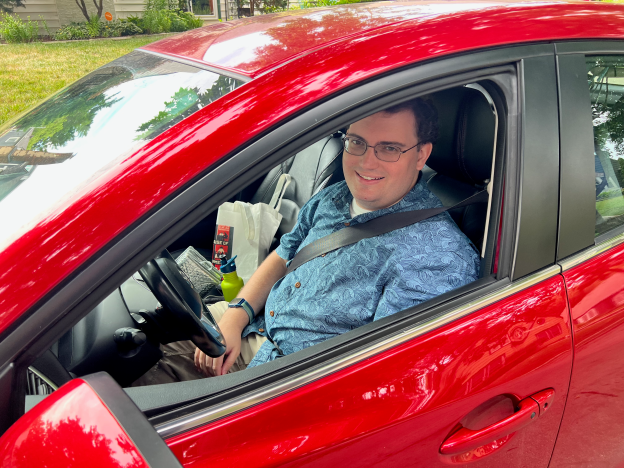
And yet, I wasn’t one who liked road trips all that much, something which changed out of necessity when I started making my 14 long drives east & west between Kansas City and Binghamton between August 2019 and December 2022. These long drives changed how I drive, and made me highly aware of what my car, which I’ve lovingly named the Mazda Rua, because it’s a red Mazda 3, does in certain circumstances. One of the greatest feelings when driving is when I get the sense that I can control the motions of my car with only the slightest movements, and when there’s a sense of connection between my thoughts and my car with my arms and hands as the conduits for that connection. In Binghamton, especially when I was teaching online and didn’t have many places to go to get out of my apartment, I would take long drives in every direction, just driving as far as I felt like I wanted to in a day and turning around. In one instance I made it east on I-86 (NY-17) as far as Hancock, NY in the Upper Delaware Valley, while in another I drove up the western shore of Cayuga Lake almost to the New York State Thruway at which point I decided to turn around and return to Binghamton for the night. I’d spend this time on the road listening to podcasts or audiobooks and exploring the world around me in ways I otherwise wouldn’t have done. I now know a great deal more about the Southern Tier and Finger Lakes than I ever would’ve otherwise simply by spending a weekend day driving around seeing what’s out there.
I’ve always known the speed limit to be more of the mark at which traffic tends to go, a number to aim for yet ideally not cross too much. Here in Kansas City, it felt reasonable to drive maybe 5 mph (8 km/h) over the speed limit but not much more than that. When I arrived in New York State, I was told by people I met there that it’s normal to go 10 mph (16 km/h) over the speed limit, and so I tried my best to keep up with the pace of traffic. It was even worse during my Longest Commute when while driving in Florida along I-10, I-75, and Florida’s Turnpike from Destin to Orlando when the traffic was moving closer to 20 mph (32 km/h) over the speed limit, and again I felt the need to keep up if only for my own safety. What struck me the most was that after the Pandemic the average pace of traffic in Kansas City has risen to 10 mph over the posted speed limit not only on the highways but in some cases on the larger city streets as well. I followed along at first, trying not to be run off the road by the more aggressive drivers tailgating me the entire way on Southwest Trafficway from Westport Road to 31st Street, for example, yet I knew that even then I would not have the reaction times I wanted and needed to be able to stop for the odd jaywalking pedestrian or animal, or other obstacle that fell into the street. Like that time a couple of years ago when I was driving on I-470 out to Lee’s Summit when I had to dodge a sofa that fell out of the back of a truck in the middle lane.
This stands in stark contrast to my experiences in other countries where the speed limits are adhered to as they are posted. As much as approaching a roundabout at 70 mph (112.65 km/h) in Milton Keynes was startling to say the least, the fact that my friend who was driving kept strictly to the national speed limit (and was driving a Tesla that has the breaking ability to slow down enough to make it to that roundabout) was a relief, if a bit of an anomaly in my driving experience. In some instances the posted speed limits don’t always make sense to me. In 2010, I was walking down a road in Gleann Cholm Cille, County Donegal, where the posted speed limit was 80 km/h (50 mph), which seemed far too fast for the width of the road in question. Now having driven in Canada, it seems even more silly considering the 401 Freeway which is the main highway in Ontario has a posted speed limit outside of cities and work zones of 100 km/h (62 mph). In what way does it make sense then for an old bóthar, a proper country cow-path in Donegal, to have a speed limit that’s only just lower than one of the highest trafficked highways in Canada?
All of this got me thinking about how I drive here in America, and after I returned from this summer’s European tour, I found myself spending less time pressing down the accelerator and more time coasting; less time aiming for 30 or 35 mph (48 or 56 km/h) and more time enjoying and observing the neighborhoods around me, safely breaking for pedestrians, and not hitting animals.
On August 31st, the California Senate passed Senate Bill 961 which will require all new vehicles model year 2030 and beyond to have technology installed which will alert drivers if they are going more than 10 mph (16 km/h) over the speed limit. How this alert will function––an alarm bell, a verbal warning from the car’s computer, a vibration in the steering wheel, a slight electric shock to the hands––remains uncertain. Yet this bill made the national news because, like Wisconsin’s seatbelt requirement passed in 1962, it presages any federal legislation on the same speed limit technology. I know many people will be upset or angry about this legislation and will say that speeding is their right as an American, or whatever they will. I am in favor of the idea yet uncertain about the execution. For one, the 10 mph warning line ought to take local conditions into account, is the traffic around you going faster than 10 mph over the speed limit, and for all of us who will likely not be driving new model cars in 2030, how long until this law has such widespread effect as to be practical? Until earlier this year my Dad was driving a 1962 Ford F100 truck as his everyday car. My Mazda Rua is now 10 years old, yet it has always had a built in feature in the navigation system that will warn me I’m crossing the speed limit by turning the white speed limit sign on the screen red.
With all that I’ve written here about slowing down on the city streets, I still would probably drive faster on highways on intercity long drives, within reason of course. Today I don’t drive on the highways much, in fact I have a knack for actively avoiding the highways most of the time and taking the city and suburban street grid wherever I need to go in Jackson and Johnson Counties. Anywhere beyond that and I’ll usually have to get on a highway to at least cross the Missouri or Kansas Rivers. My point is that the circumstances of driving really will always depend on the moment in which I’m in. Here on my street, I’m happy to drive closer to 15 mph (24 km/h) instead of the 25 mph (40 km/h) speed limit. Perhaps the best we can do short of installing technology in cars that will slow them down to the speed limit, is doing the European thing of installing speeding cameras along all of our highways, roads, and streets which will send tickets by mail to anyone caught speeding. Here in Kansas City, Missouri our red light cameras were turned off in 2015 after the Missouri Supreme Court ruled them to be a privacy violation. These camera systems wouldn’t require officers writing tickets on the side of a busy street or highway. All that said, I don’t feel optimistic that the nigh libertarian political climate of either Kansas or Missouri will go for this.
That then leaves our speeding up to the individual drivers collectively creating a speed for the flow of traffic. I could say that this will help at least keep vehicles moving at roughly the same speed which will in turn keep everyone involved safe, but that again ignores the full impact of the human factor, my interpretation of chaos theory which I wrote about last week. At the time of writing, chaos might well be the best adjective for describing the streets and highways of Greater Kansas City. And that is proof, dear reader, that leaving the speed up to the individual drivers isn’t going to work.
 Wednesday Blog by Seán Thomas Kane