Tag Archives: Translation

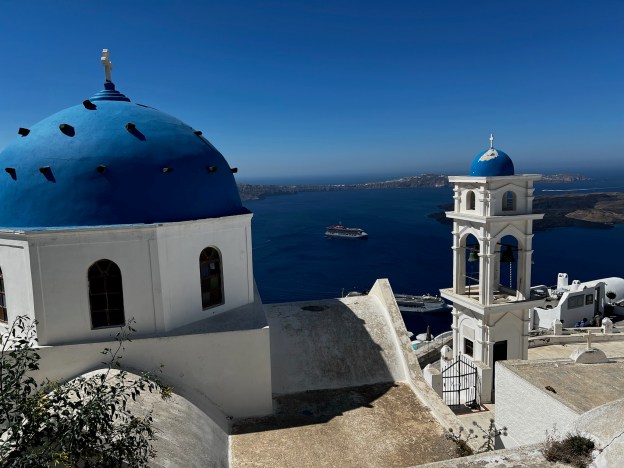
A view from behind a church on the Greek island of Santorini.

On Simplicity

This week, how the greatest wisdom is simple in nature.—Click here to support the Wednesday Blog: https://www.patreon.com/sthosdkane—Sources:Photo by Elizabeth Duke.[1] Nikos Kazantzakis, Zorba the Greek: The Saint’s Life of Alexis Zorba, trans. Peter Bien, (Simon and Schuster, 1946, 2014), 81.[2] “Elephant Tails,” Wednesday Blog 5.24.[3] “Asking the Computer,” Wednesday Blog 5.26.[4] “On Political Violence,” Wednesday Blog 5.17.


This week, how the greatest wisdom is simple in nature.


Over the last several weeks I’ve written about forms of knowledge and knowledge collecting. Knowledge is easier to identify, as it is empirical in its core. Yet on a scale even beyond knowledge lies wisdom, the cumulative sum of humanity’s understanding of the underlying character of human nature. It’s very easy for me to get bogged down in words, words, words and tie myself in knots which I find nigh unbreakable and even more undecipherable. Yet amid all those layers of paint there are often gems which merely need good editing to illuminate. This is what fills my days today, a big edit which I hope will signal the beginning of the end of my years of doctoral study.

In these years, while I’ve devoted my days to reading histories of the Renaissance intersections between the Americas and France, I’ve made a point of reading for fun all the same. I need to read things not related to my research for the escape they provide. At times these fun readings have been more thoroughly connected to my research, as in my recent choice of Jason Roberts’s Every Living Thing, yet in Binghamton I spent many happy evening hours reading Star Trek anthologies and novels while returning to my vocation each day. Of the stories that I’m drawn to, I enjoy reading books and watching films with characters that embody a certain lived experience that begats wisdom. Recently, this desire for such a character led me to read Peter Bien’s new translation of Nikos Kazantzakis’s Zorba the Greek: The Saint’s Life of Alexis Zorba. This is phronesis. Zorba’s wisdom is one that’s been gathered over the sixty years of his life and funneled toward living a good life as he sees fit. His is a simple wisdom which recognizes the physical limitations of the body in opposition to the limitless potential of the soul. I loved the first dance scene in Zorba the Greek in which the old miner erupted upward from his dinner and began to leap about. Kazantzakis describes it as though his soul could not be contained by his body and that it was that spiritual essence which spoke so fervently and wordlessly of its own joy. Kazantzakis can make even the simplest of scenes appear elegant and luminous. His description of the passage of time on the Mediterranean reaching up from Africa to the southern shore of Crete is one of my favorites. Here, I quote from Bien’s translation with the affection that beautiful prose deserves:

“The immense sea reached African shores. Every so often a warm southwest wind blew from distant red-hot deserts. In the morning the sea smelled like watermelons; at midday it vented haze, surged upward discharging miniature unripe breasts; in the evening, rose pink, wine red, eggplant mauve, dark blue, it kept continuously sighing.”[1]

The wisdom inherent in Kazantzakis’s prose lies in his ability to evoke the variable texture of nature, the changing face of it with the passage of the day. I remember once in Binghamton I have the idea to take a selfie once an hour throughout the day to see how my face, hair, stubble, and what not changed as the hours passed. I know for instance that if I want to have a lower register in my recordings of this Wednesday Blog that I need to record first thing in the morning when my tenor is closer to a baritone. This week, owing to a general sense of exhaustion, I haven’t gotten around to writing this essay until nearly 90 minutes before when the podcast normally publishes. Rather than force myself to write something earlier in the day I waited and gave myself the time to think of something good.

Wisdom is knowing that worrying won’t get you anywhere; it lies in the peace of mind and heart that keeps us happy and healthy. This evening, while I was having dinner with one of my best friends and his wife and young son, I brought up my particular conundrum of the day. Jokingly, the suggestion that I write about simplicity was made. I shrugged, thinking of William of Ockham, one of Bill Nye’s favorite history of science examples to use, and decided to run with it. After all, often the wisest people that I’ve met are the ones who embrace the simplicity of living a life embracing their own nature. The wise know that they are going to grow old and die and don’t worry about it. I find myself thinking of this as I watch without much resource as my hair recedes. I’ve joked that my particularly follicly impaired genes may require an eventual investment in a variety of hairpieces for different degrees of formality. I’ve grown in my own comfort with taking care of myself, applying sunscreen before going out on walks around the neighborhood now to mitigate the inevitable that comes from having largely Irish genes and living in the far sunnier Midwestern climate than my ancestors’ rain soaked home soil in Mayo. In his Saint’s Life, Alexis Zorba often doesn’t worry about these things and expresses frustration and even anger when the narrator, his boss, frets about the things he cannot control. I’m better at this than I have been, which is reassuring in some ways of looking at things, yet I still have room to grow.

Wisdom is trusting the people around you to do what they feel is best. If the simplest solution is often the best, then why aim to make things overly complex? Complexity requires forethought, or sometimes is the result of a lack of forethought. Last summer I delighted in writing several essays for the Wednesday Blog attempting to adapt chaos theory to explain human behavior.[2] We need both complexity and simplicity to understand ourselves and the world in which we live. Think about it: we cannot narrow things down to binary options. More often, the binary is one of a series of binaries which together form a logical thought or series. I marvel at the fact that computers most fundamentally work in the binary language of 1s and 0s, and that in this manner language and thought are boiled down to so rudimentary an interpretation. It’s for this reason that while I’m concerned by the rise and development of artificial intelligence and its misuse, I feel a sense of assurance that it is still limited by its basic functions and limited by the abilities of its artifice.[3] The human brain is a wonderous and ever complicated organ which evolved to fulfill its own very particular needs. On the simplest level the brain thinks, it sends directions to the rest of the body to keep the body operating. In a theological framework, I’ve argued that the brain may be the seat of the soul, the consciousness that is at the core of our thought. My earliest memory that I’ve written about here was the first time I recognized that particular voice of my own consciousness, which occurred sometime when I was 3 years old.[4]

Wisdom is intangible, it’s something that you have to learn to recognize. This is perhaps the most complex tenant that represents something simple. In order to truly become wise, one must understand that wisdom isn’t something you can buy off the shelf or write your way into. For all the words which Zorba’s boss writes, allowing them to consume him, he remains feeling unfulfilled in life. It’s why the narrator of the novel struck out from his books and sought to live among ordinary people, buying a stake in a lignite mine on the southern shore of Crete. On his way there in the Piraeus he met Zorba, the man who within a few pages became his foreman and the one who’d realize his idea of finding wisdom in the living world. The simplest explanations are often best. Zorba lives to enjoy the life he has, and when things go wrong––as they often do––he finds something to build upon and start over again.

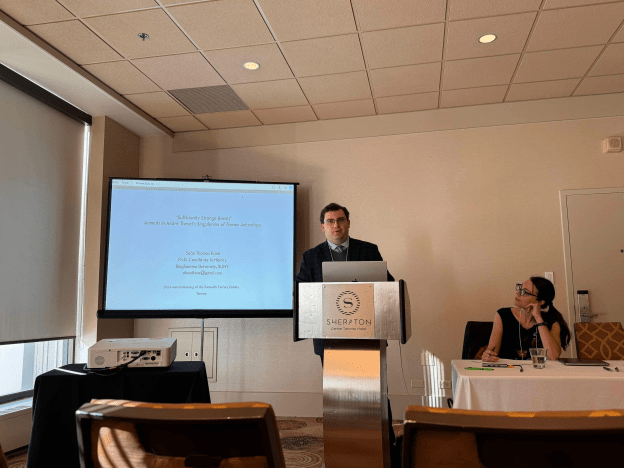
A couple of months from now I’m going to be contributing my own experiences to a tacit knowledge panel at the History of Science Society’s conference in New Orleans about how I’ve been able to maintain a full research load and writing all year round with hardly any funding at all. I recognize that the circumstances of these past few years have been marked by my own poor decisions and mistakes that I’ve made along the way. Yet in spite of those, and bad luck in many respects, I’ve been able to continue with my work and to produce historical studies that are beginning to make a decent contribution to the history of science in the Renaissance and specifically to the history of animals in that same period. I’m looking forward to that panel, and to the two papers I’m presenting during the same weekend. Maybe, like Zorba, when things feel like they are about to go well I’ll feel the need to rise to my feet and leap into the air as though my soul were attempting to escape from my body. Simply put, for all the trouble that life has brought, joy is overpowering when pure.


[1] Nikos Kazantzakis, Zorba the Greek: The Saint’s Life of Alexis Zorba, trans. Peter Bien, (Simon and Schuster, 1946, 2014), 81.

[2] “Elephant Tails,” Wednesday Blog 5.24.

[3] “Asking the Computer,” Wednesday Blog 5.26.

[4] “On Political Violence,” Wednesday Blog 5.17.

A Sense of Purpose

This week, the third in several scribblings about my research: how studying Thevet and his world fulfills a need to find purpose in life.—Click here to support the Wednesday Blog: https://www.patreon.com/sthosdkane


This week, the third in several scribblings about my research: how studying Thevet and his world fulfills a need to find purpose in life.


Throughout my graduate education the need for new work to compliment, correct, or add to old work has remained a constant theme. It’s critical to our profession, otherwise why devote our time and talent to studying the past if we’re merely rehashing something already said in the generations of our profession’s own history? I passed through the first five of years of my graduate education without that purpose or that drive, and I think it’s what kept me behind some of my colleagues in achievement. Yet when I found something to make my own, a historical topic upon which to pitch my tent and make myself known, I took that chance. Still, I wasn’t entirely sure what value studying Thevet actually brought to the profession. He is an important figure of middling influence in the development of Renaissance natural history, one whose contributions have often been reduced to laughable exemplars of a time before the scientific study of zoology developed. A secondary approach I take to Thevet is to view his work in light of the great contributions to natural history of the great minds of the Enlightenment, active two centuries after the cosmographer, who are often the next great mile marker in the long road that is the history of natural history.

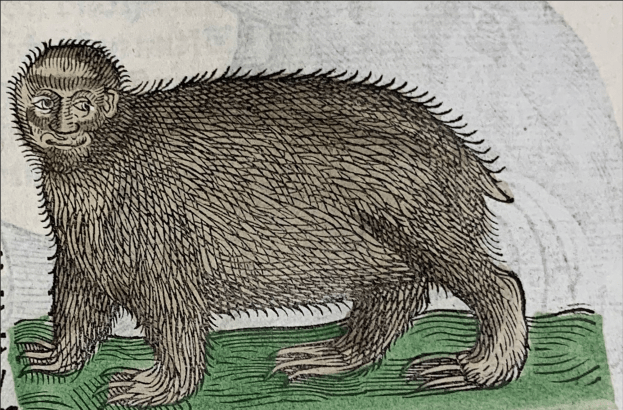
Of these Enlightenment naturalists, the Comte de Buffon (1701–1788) acknowledged the better parts of what Thevet wrote and adopted those as mile markers in his own natural histories. I think Thevet often appears in the eighteenth century because the center of European thought had shifted by that time from Italy, the radiant heart of Renaissance humanism, to France and so the likes of Buffon and Humboldt would’ve been familiar with Thevet as he was one of the more prominent French naturalists whose books were available. Thevet’s notoriety in his own century lay predominately in the transalpine republic of letters, most famously with his Zurich-based admirer Conrad Gessner (1516–1565) who was personally responsible for elevating Thevet’s natural history beyond the original editions to a broader consciousness by including Thevet’s animals in his own Icones animalium and Icones avium omnium of 1560 and his German Thierbuch of 1562. While Thevet’s Singularitez was translated into Italian by the Venetian Giuseppe Horologgi in an edition published by the eminent Venetian printer Gabriele Giolito de’ Ferrari (1508–1578) with the title Historia dell’India America detta altramente Francia Antartica, that volume didn’t carry over the woodcuts which Thevet included in the first edition published in Paris by Maurice de la Porte in 1557 that were copied for Christophe Plantin’s 1558 edition published in Antwerp. This says to me that these pictures didn’t fit the purpose of Giolito’s edition; they especially didn’t fit the sorts of books he anticipated selling Thevet’s alongside. As such, without the pictures Thevet’s work doesn’t seem to have carried as much weight in Italy and is instead better remembered in its original French.

When I was first searching for copies of the Singularitez in August 2019, I initially downloaded a copy of the 1878 Paul Gaffarel edition of the book, which while of great utility especially in its footnotes, isn’t as important as any of the original 1557 or 1558 editions published in Paris and Antwerp to my research. These are the core sources for my work; in particular I used a copy of the 1558 Plantin edition published in Antwerp as my main source for my translation. I can make the case that the Plantin edition is more important in the context of Thevet’s natural history, as it’s the same edition that Gessner acquired and used as the basis for his inclusion of the sloth and toucan in his 1560 pair of Icones books, however in all truth I ended up working with that edition because it was the first one that I found from the sixteenth century. Unlike the two Paris editions (1557 & 1558), Plantin’s edition was not intended for a domestic French audience. The most recent effort of mine toward the publication of my translation was to translate the different royal and imperial privileges and letters to patrons of each translator in order to fully place my own translation within the varied contexts in which each of these contemporary editions existed. It’s interesting to see Thomas Hacket’s 1568 English translation be dedicated to Sir Henry Sidney, who was a major player in the Elizabethan conquest of Ireland and in the early English colonial enterprise. In contrast, Horologgi’s translation begins with a letter to his patron, Paolo Giordano I Orsini (1541–1585), the Duke of Bracciano and like Sidney a noted military man. Thevet himself dedicated his book to Jean de Bertrand, Cardinal of Sens (r. 1557–1560), and in doing dedicated it to the French national cause within which one can best understand the whole French expedition in Brazil.Thevet sought a sense of purpose in his life built upon the travel books he loved to read. He made himself a character in those books, a cosmographer who could be trusted to tell the truth of the faraway because he had seen it with his own eyes. The logic of this always made good sense to me, after all the authority of the historian lies in our expertise and familiarity with our sources. In my case, I’ve found a sense of purpose in my life built upon the travel books I loved to read, and I’ve built my career on my expertise in Thevet’s works. We need to have a sense of purpose in what we do to find life rewarding. I’ve done jobs that’ve been for the money and sure they’ve kept the lights on, but they haven’t been nearly as fulfilling as my research and teaching, which I love doing. The people I’ve met in academia are among my favorite anywhere, fellow experts with whom I can discuss historical topics with a sense of mutual respect and admiration. That’s what I want in my life more than anything else, that community that comes from our profession and a sense of purpose in what we do.


On Translation

This week, how I take nuance and particularity into account in my efforts as a translator.—Click here to support the Wednesday Blog: https://www.patreon.com/sthosdkane


This week, how I take nuance and particularity into account in my efforts as a translator.


When I chose to study André Thevet (1516–1590) and the three-toed sloth in August 2019 I did so because I already knew French and the need to learn a new language was less pressing than if I’d chosen to study another source in the history of natural history. I chose Thevet because it was practical, and I chose the sloth because the thought of being a sloth historian made me laugh. From the first day working on Thevet, I found that my understanding of his books was heightened when I took the time to type out my own translations of his text. Thevet wrote in Middle French that is native to the middle decades of the sixteenth century. I arrived at this project very familiar with Early Modern English, the contemporary form of this language to Thevet’s time, as my history master’s thesis delt with sources in that chronological variety of English from Thevet’s generation and the one just before. I’ve never had much trouble understanding the most prolific author of Early Modern English literature, Shakespeare, but I think I’ve had a tolerance for varieties in speech that’s allowed for me to try to think beyond my own millennial Midwestern metropolitan American English and be willing to understand the likes of Shakespeare from a young age.

So, when I began translating passages from Thevet’s Singularitez de la France Antarctique for my own professional use in my dissertation, I decided that as long as I was translating that book I might as well translate it with the intention of sharing Thevet’s words beyond the scholarly analysis and critique which lie at the heart of my work as a historian. This first draft is built around the 1558 French edition published by Christophe Plantin (c. 1520–1589) in Antwerp and contains footnotes drawn from the 1878 French edition by Paul Gaffarel published in Paris, two Brazilian Portuguese translations by Sergio Amado (1978) and Estêvão Pinto (1944, using the 2018 reprint), and the partial 1986 English translation by Arthur Stabler and Roger Schlesinger which contains only Thevet’s North American chapters.

I finished the first draft of this translation in Summer 2023 and am now looking ahead toward the second draft which is the next stage of the project, and I hope the last one before I feel confident in formally writing to the publishing editors whose press sales agents I’ve spoken with about this project at conferences over the last two years. The second draft will consist of two main stages. First, I will cross-reference my translation and the 1558 Antwerp edition on which it is primarily based with the 1557 first and 1558 second editions published in Paris by Maurice de la Porte, two Venetian editions translated into Italian by Giuseppe Horologgi and published by Gabriel Giolito de’ Ferrari (c. 1508–1578) in 1561 and 1584, and the 1568 full English translation by Thomas Hacket published in London by Henry Bynneman. Second, I will seek to make my translation more understandable for a 21st century English-speaking reader while endeavoring to preserve Thevet’s particular mannerisms and voice, a writing style with which I’ve become quite familiar in the last 6 years to the point that I can now confirm at least two French translated manuscripts in the Bibliothèque nationale’s collections in Paris are verifiably written by Thevet. He had a way of writing that’s unmistakable.

These two competing axes create a binary star system around which my translation revolves. On the one hand, I want to be true to the original text, to preserve the author’s voice and something of their spirit which remains in those words. On the other hand, I need to make my efforts readable for my own contemporaries. Thevet and his contemporaries are notorious for long run-on sentences that would make Hemingway shake his head in earnest frustration. Where do I break up a long sentence while preserving its overall integrity? Furthermore, at what point should I decided to remove the bracketed notations of page breaks in the original text? There the 1558 Antwerp edition is most fully evident as its pagination has several quirks that make it stand out from the 1557 & 1558 Paris editions. At this point, Plantin published books with folio numbers rather than page numbers, so the first two pages were in fact folios 1 recto (1r) and 1 verso (1v). These names refer to the custom that scribes traditionally started writing on the back side of the vellum (recto in Latin) and then flipped the skin over once ready to continue writing on the verso, or opposite side. In several instances the folio numbers actually decrease in the book, notably in Thevet’s chapter on the sloth, which makes the footnotes on that core element of my research particularly confusing if you’re paying close enough attention. So, in summation the inclusion of the page breaks with the folio numbers keeps my translation grounded in Plantin’s edition, however that may break up the text in an uncomfortable way for some readers.

Ultimately, I am not the author of this book, merely a herald relaying it on for our time. My voice is there in the handful of introductory chapters I’ve written to go along with this book. These chapters describe Thevet as a reader of travel literature and place his accounts of the Americas beyond what he himself saw in Brazil in the context of their French and Spanish sources. I see my efforts in this as a means of introducing the reader to Thevet, a man who today exists on the furthest margins of the popular imagination of the First Age of Exploration in the English-speaking world. Thevet remains present in academic circles, there were at least four papers presented at this weekend’s annual meeting of the Renaissance Society of America in Boston which discussed Thevet, mine included. I hope this book will be useful to fellow academics and perhaps will entice curious readers to learn more about this man who I’ve spent the last 6 years of my life getting to know.I find myself drawn as much to the effort of a translator as I do to the work of a historian these days. We live in such a fractious time when reasoned debate and earnest discourse is riddled with dangers and seemingly improbable to undertake. I feel as though I’m constantly translating my thoughts and character for others to understand me. It’s why I enjoyed my time in Boston because that city has a large enough Irish American population that when I’d tell my name to a cashier to put on a carry-out order they’d actually spell it in the proper Irish manner; this never happens in Kansas City. That said, I felt that I had to translate my expectations and personal limits to be able to live even for just a few days in a city as expensive as Boston where I was often paying double what I’d normally pay at home in restaurants. In translating I recognize that each of us think in slightly different ways and see the world in which we all live in just as unfamiliar terms to one another. Difference enhances our common humanity and elevates our manner to something greater than ourselves.


The Divine Essence

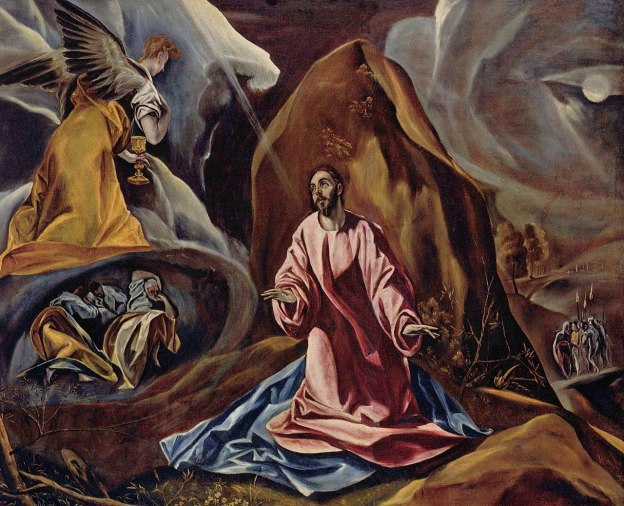
Art: Studio of El Greco, “Agony in the Garden,” (1590) oil on canvas, 102 x 131 cm, Toledo Art Museum, Toledo, Ohio, USA, ⁠National Gallery, London⁠.

This week, a meditation on the Name of God.—Art: Studio of El Greco, "Agony in the Garden," (1590) oil on canvas, 102 x 131 cm, Toledo Art Museum, Toledo, Ohio, USA, National Gallery, London.Click here to support the Wednesday Blog: https://www.patreon.com/sthosdkane


This week, a meditation on the Name of God.


At the start of Advent last November, I picked up a little blue book after Mass as an Advent lectio divina guide for the coming weeks. I’d done this several times before in Advent and Lent, the two holy seasons of preparation in Christianity, yet this time I actually read that little blue book and kept up with it each day through Christmas. By the end of it I was looking forward to being done with this one part of my nightly routine before bed, the time when I was able to sit and read the daily reflection. I wasn’t sure then if I would pick up the little black book when it appeared at my parish the weekend before Ash Wednesday, and yet when it was there, I took a copy home.

This year’s little black book offers reflections on St. John’s Gospel, the most spiritual in focus of the evangelists. Several aspects of the readings have caught my attention, usually out of a curiosity concerning the grammar or translation of the biblical text. On one early day, the reflection was on John’s recounting of the arrest of Jesus in the Garden of Gethsemane. This recounting contradicts the three other Gospels in that Jesus asks the soldiers to let his disciples go, rather than the disciples taking flight in fear of the soldiers. It is more self-sacrificial, following the prophetic undertones of the Gospel overall. Not only does this vital moment of arrest in the Passion narrative take place in a Garden, akin to the Garden of Eden where humanity’s fall into sin occurred, but it is also here where Jesus revealed Himself as God the Son. Quoting here from the New American Bible:

[4] Jesus, knowing everything that was going to happen to him, went out and said to them, “Whom are you looking for?”[5] They said to him, “Jesus the Nazorean.” He said to them, “I AM.” Judas his betrayer was also there with them. [6] When he said to them, “I AM,” they turned away and fell to the ground. [7] So he again asked them, “Whom are you looking for?” They said, “Jesus the Nazorean.” [8] Jesus answered, “I told you that I AM. So if you are looking for me, let these men go.”

(John 18: 4–8)

In this passage the omniscience of God is first revealed, followed by the humility of God the Son as merely one among them, “the Nazorean.” Here though the omnipotence of God as the Divine Essence, existence in its purest form as “I AM,”[1] before showing such mercy toward the soldiers at making it clear he was in their power and would surrender to them yet asking for mercy from them for his friends, his disciples who not being omniscient were very much afraid as any of us would be. It is the third part of this passage, the identification of God that I wish to focus on here.

The Name of God is known as the Tetragrammaton after the four Hebrew letters which comprise that Name. These are the four holiest letter combinations out there. The Name of God is too sacred to write in Judaism, and considering Hebrew is an abjad lacking written vowels it’s not entirely certain how this Name was originally pronounced before that prohibition.[2] This prohibition extends in some traditions to not even writing the word God, as it is capitalized as the common Name of God in regular parlance. I grew up capitalizing this word in reference to the Abrahamic God, who I do believe is the Creator and One True God, I don’t just recite the Nicene Creed every week at Mass to do it; and yes, this capitalization is in line with the tradition of capitalizing proper nouns in all of the languages I speak and write. Yet I’ve never really thought of God as a name, rather it’s a title in the same way that Christ is a title and Jesus the name. I’ve had some students over the years who won’t write God out, instead writing “G-d” out of respect for this title, which I think is fair. For the sake of my readers, I won’t include the Hebrew Tetragrammaton here, you can look it up on your own.

What I’m more interested in is how the Tetragrammaton was translated from Biblical Hebrew into the other languages in which I’ve read the Bible. There are really four such languages: English, Latin, Koine Greek, and Irish. 

I was first introduced to the Bible and to my Catholic faith through English, I was born in the second generation after the vernacular Mass was allowed largely replacing the older Tridentine Mass said in Latin. The New American Bible (NAB) which I read from a few paragraphs back is the translation that I grew up with, and the one which I use in all aspects of my life. It was also developed during Vatican II as the approved English biblical translation for the United States. In Ireland, Australia, and New Zealand the Jerusalem Bible (JB) is the translation used, while in Great Britain the English Standard Version – Catholic Edition (ESV-CE) is used. 

I was introduced to the Latin Vulgate and Greek New Testament and Septuagint in high school and college and today I own a copy of the Greek New Testament published by the German Bible Society (Deutsche Bibelgesellschaft). Both are key sources for the English translations that I grew up with, alongside the Hebrew Tanakh itself. I chose St. James Academy for my high school years largely because they offered Latin, and while the fact that Latin remains the official language of the Roman Catholic Church, I was more interested in reading classical Roman literature. Likewise, the first of the two Ancient Greek classes I’ve taken was at St. James under the direction of our Latin teacher Bob Weinstein. That class was focused on Classical Attic Greek from democratic Athens of the 5th century BCE. In college at Rockhurst I made the 5 century leap forward to the Koine Greek of the 1st century CE when I studied Biblical Greek under Professor Daniel Stramara. I wasn’t the best student, yet I was fascinated by that class and would love someday to study Latin and Greek more fully. It would certainly be a benefit to my research.

Finally, while I’ve known of the Bíobla Naofa, the approved Irish translation of the Bible, for a long while, I only bought one in the last year. Irish is an odd language for me that feels untouched by the embrace of vernacular piety for me as by the time the Vatican II Council occurred between 1962 and 1965 my family largely spoke English, though the last generation of native Irish speakers were still around. For me then the Bíobla Naofa is as much a study tool as it is an aspiration of piety. I keep mine on my desk the easier to reference when I’m curious how a particular word or phrase is translated into Irish. The Bible is a good source if you want to see how common biblical names are translated from one language to another. It’s how I know that the Irish biblical tradition predates the Anglo-Norman invasion of 1169 because St. John is called Naomh Eoin, not Naomh Seán. My name is an Irish rendering of the French name Jean, while Eoin is an older rendering of the Latin and Greek name Ioannes, which is also the parent of the French Jean. The Evangelist is thus known by the same name today as the Celtic monks knew him in the early medieval period when the Irish cultural influence on Europe was at its peak.

Returning then to the Tetragrammaton, when I read this passage from St. John’s Gospel that evening, I was curious to see how it was translated from the original Koine Greek into Latin and Irish. Translation is a funny business, it’s not ever as simple as going word-by-word and replacing the original language’s text with the target language’s equivalent. There’s far more nuance to each language and its dialects to allow for this. I’ve learned this in my efforts to translate André Thevet’s 1557 book Les Singularitez de la France Antarctique from Middle French into Modern English. The last English translation was written in 1568 and is thus in Early Modern English from the generation just before William Shakespeare. Thanks to the bard Early Modern English is still fairly familiar to many of us, myself included, yet it is still different from how this language sounds and is written today. To make the first draft of my translation I brought together a composite of the 1558 Antwerp French edition, the 1568 London translation, the 1878 Paris French edition, and the 1944 and 1978 Brazilian Portuguese translations to create an accurate and modern English translation fitting for the 21stcentury.[3] All this is to say that translation is far more complicated than just taking the original text and interpreting each word on its own. The words work together within the ecosystem of the phrase.

I was curious then to see if the English “I AM THAT AM” was perhaps clunkier than the Greek. This full phrase is familiar to me especially from the Burning Bush story in the Book of Exodus (Ch. 3), in which Moses meets God in a burning bush. This scene is beautifully retold in the 1998 animated film The Prince of Egypt which is a classic from my childhood. The four words we have mirror the four letters of the Tetragrammaton in the original Hebrew, yet these four words are reduced to two in Greek. In John’s telling Jesus’s response “I AM,” is written in the original Koine Greek as “ἐγώ εἰμι,” (John 18:5) with the full phrase in the Septuagint’s retelling of the burning bush story written as “ἐγώ εἰμι ὁ ὤν,” (Exodus 3:14) or I am the Being. I feel this final word ὤν is essential here. It is the present active participle of the Greek copular verb εἰμι. In a sense, it is saying that God is existence itself, the essence behind the Cosmos and all Reality itself. One translation of ὤν in the Liddell, Scott, Jones Ancient Greek Lexicon (LSJ) is the English word fact.

This is adopted into Latin somewhat, as the Vulgate is drawn so much from the Greek Bible, where the Name of God is rendered as “Ego sum qui sum,” whence we received the English “I AM THAT AM.” Yet because Latin doesn’t have a similar present active participle for the copular verb sum, the reuse of the indicative present active form sum is necessary. The English present participle of be is being, yet replacing the second am in the name with being doesn’t work grammatically in this language.

I was pleasantly surprised to see the Irish translation of this phrase for how simple it is. The Greek ἐγώ εἰμιwas translated as “Is mise é,” a phrase which I’d usually translate back into English as “I am he.” On an immediate level this is profound in its everyday character. This is something I’d say when someone asks “An bhfuil tú Seán?” Yet on a deeper level it speaks to Irish’s ability to express emphasis in a manner unfamiliar to English. The first person pronoun in Irish is , this is the translation of both the English I and me. Yet the -seending tacked onto it expresses extra emphasis on the pronoun. The closest we can get in English, or at least in my American English, to this is saying “me too,” or perhaps capitalizing ME and adding an exclamation mark behind it (or several if you’re one of those people who are overly fond of exclamatory sentences). So, God’s existence is expressed in Irish in the emphatic, as something to be shouted from the rooftops in wonder all while reflecting the priority Irish gives to all of us to be worthy of emphasizing no matter how mighty or small we may be. The Irish translation of the full Name from Exodus is “Is mé an te atá ann,” which is closer in meaning to the Greek ἐγώ εἰμι ὁ ὤν, translating into English as “I am the one who is.” Again, this speaks to the ability of Irish to interpret the existence of God as the essence of reality.

In my undergraduate years when I started to think deeply about the Tetragrammaton & the Name of God, I settled on the idea that the best way to describe God without limiting God in human terms was to focus on God as the essence of life. In this way, I began to refer to God in my theological studies as the Divine Essence, in an attempt to better reflect this truth that God is omniscient, omnipotent, and omnipresent. The Divine Essence rises above any limitations of human terminology or senses of gender that weigh down even the word God, which is traditionally masculine in English and its fellow Indo-European languages. I’d rather see God in God’s fullness existing beyond gender, the better “to see the Face of God,” to quote Jean Valjean’s last words in the musical adaptation of Victor Hugo’s Les Misérables.I’ve had trouble with this thinking in the last few years, because how should I begin to approach God in these terms in prayer? How can I seek any sort of personal connection to God when I’ve devoted such effort to seek to understand God in such abstract terms by stretching language as far as it will go without breaking? This Lent that is where I stand, and where I am uncertain. Looking at the story of the Garden of Gethsemane told in John’s Gospel in this year’s little black book, I noticed that while Jesus revealed His true Nature, he also identified himself as mere “Jesus the Nazorean,” a human and God all the same. That human nature is approachable, personable. I remember how in the Ignatian Examen one is called to think of one sitting with Jesus while one reflects on their day. This is a starting point, and a good point of departure for reflection this Lent.


[1] In my Catholic tradition we capitalize this phrase as the name of God.

[2] See Richard Elliott Friedman, The Exodus: How it Happened and Why it Matters, (New York: HarperOne, 2017) for more on this. I really enjoyed reading this book a year ago.

[3] NB: I used a 2018 reprint of the 1944 Brazilian Portuguese translation.


Lost in Translation

This week, I talk about my experiences as a translator. — Click here to support the Wednesday Blog: https://www.patreon.com/sthosdkane

Over the last three years I have consistently worked in the background of my dissertation research and all the other things I’m doing, including this blog, on translating one of my dissertation’s most important primary sources from Middle French into Modern English. That book, André Thevet’s Les Singularitez de la France Antarctique was initially published in 1557 and then translated into English only 11 years later in 1568 by a man named Thomas Hacket. However, since 1568 Hacket’s translation has been the only one that English-speaking readers wanting to explore Thevet’s Singularites have had available to them. 

There are some partial translations out there, most notably Roger Schlesinger and Arthur Stabler’s 1986 book André Thevet’s North America: A Sixteenth-Century View, yet Hacket’s remains the only full translation into English. So, not only is the work I’ve been doing helpful for my own research, yet it is also groundbreaking in reopening that dusty door that leads into Thevet’s life and work for a great many English-speaking readers and scholars. It’s my hope that people find my translation of The Singularites of France Antarctique both useful and fascinating to read, as it offers a window into a worldview that in some cases makes sense while in others appears far out of place in our own world.

I have always had a fascination with and love for languages. As long as I can remember I’ve had memories, and many of those memories are of long hours engrossed in one language or another, like many of my relatives taking watches apart to see how they work I often do the same with language, learning how each grammar and mode of thinking developed in a common lineage and dialogue with its neighbors and relations. My own language studies began with Latin, which I first tried to learn 20 years ago as a 10 year old, though it wasn’t for another four years until I started high school at St. James Academy that I really began to understand what I was looking at. Around the same time, I also started studying Irish in the evenings at the Irish Center of Kansas City. Both languages are ones that I still study, and enjoy reading, speaking, and writing. 

In the years since, I’ve learned French to a level that when I’m there I can go about my life in France without using English. Translating Thevet’s Singularites has really helped with that, as three years of intense reading of his Singularites really gave me a strong impression on how French, albeit in an older form, works. One of the big differences with my translation of the Singularites is that I took a lot of time to consult page-by-page several modern Portuguese translations of his work published in 1978 by Eugenio Amado and in 2018 by Estêvão Pinto. Thanks to their common Latin heritage, and to the general use of Spanish around me for much of my life, I find reading Portuguese and Spanish to not be very difficult at all. 

There are languages out there which I can read, and to a degree write in, but cannot speak very well. Portuguese and Spanish fall into this group, as does Ancient and Modern Greek. I studied Classical and Koine Greek, two ancient variants, in high school and college at Rockhurst, yet I just don’t have the training or experience with either forms of Greek to be as comfortable or confident in Greek as I’d like. Eventually, I do want to spend the time to learn Ancient Greek as well as Biblical Hebrew, yes at some point I’d like to study the Bible in the way that I’ve studied the works of the humanists from the fifteenth and sixteenth centuries.

I’ve also here and there studied Bulgarian, Mandarin Chinese, Māori, and Egyptian Hieroglyphs. Again, all of these came out of pure curiosity on my part, and while I’m unable to speak the first three or properly read the latter, I do know a thing or two about each. Thanks to my work with Bulgarian, I can read the Cyrillic alphabet, and I do remember a few things, though I haven’t used any of it in quite a while. During the opening ceremony of the Beijing Winter Olympics last year, I ran through what I could remember from my Mandarin Chinese class in the Spring semester of 2017, and found that I still had the pronouns, some verbs, and a handful of nouns, which was more than I expected. In past years I’ve found I can make out text in various Polynesian languages because of the time I spent in 2014 and 2015 learning about how Māori works. Egyptian Hieroglyphs are another animal. I found my curiosity with Ancient Egypt reignited in the Summer of 2019, and pursued the task of learning how to read this most ancient of script with a passion. I can make out some characters, and I remember a fair bit about how the various forms of the Ancient Egyptian language fit in with its Coptic descendants.

Last week, I found myself reading about the Coptic language and its various dialects. I was most interested in how older pharaonic Egyptian place names and terms had survived the millennia into the Coptic that persists today in Egypt and among the Coptic diaspora. It struck me how because the Coptic alphabet is modeled after Greek, I could read most Coptic words, and where there were unfamiliar letters all I needed to do was look to the Demotic script used alongside the more formal Hieroglyphs, and I’d find the source of those letters. Each of these languages are vehicles for the perspective of a particular people at a particular time and place in the long human story. They allow us to get closer to understanding how other people see their own world, and their place in it.

Thevet often referred to his own people as “Christians” and less frequently as “our Europe.” He lived at a time when the older idea of Christendom––comprising of Syriac, Greek, and Latin churches that traced their roots back to classical antiquity––began to fade away with the triple influences of the collapse of the last vestiges of the Roman Empire in Constantinople, the Protestant Reformations, and the beginning of the First Age of Exploration. This Christendom steadily became known in the sixteenth century as Europe, and eventually with the establishment and flourishing of transoceanic European settler colonies as the West. Reading Thevet’s works, looking through his eyes, I now understand how he saw his own world at least a little better.

Understanding the Classics to Understand Ourselves

I’m writing this having just read a stirring article in Commonweal by Cathleen Kaveny, a professor of law and theology at Boston College, on the merits of reading St. Augustine’s Confessions in the original Latin. Professor Kaveny’s article was in response to Princeton’s Classics department’s much noted decision to cut the requirement for its undergraduate majors to prove proficiency in Latin and/or Ancient Greek in order to earn their degrees. I’ve had a number of discussions with friends and colleagues about that particular decision, being a current student of Latin myself, and an off-again-on-again student of Classical and Koine Greek. While I personally haven’t yet read Augustine in the original Latin, in part from a personal dislike for what I perceive as the grumpiness of St. Augustine’s writings (of the early Church Fathers I prefer St. Gregory of Nyssa), I can relate to the thrill and benefit of reading these texts in their original languages.

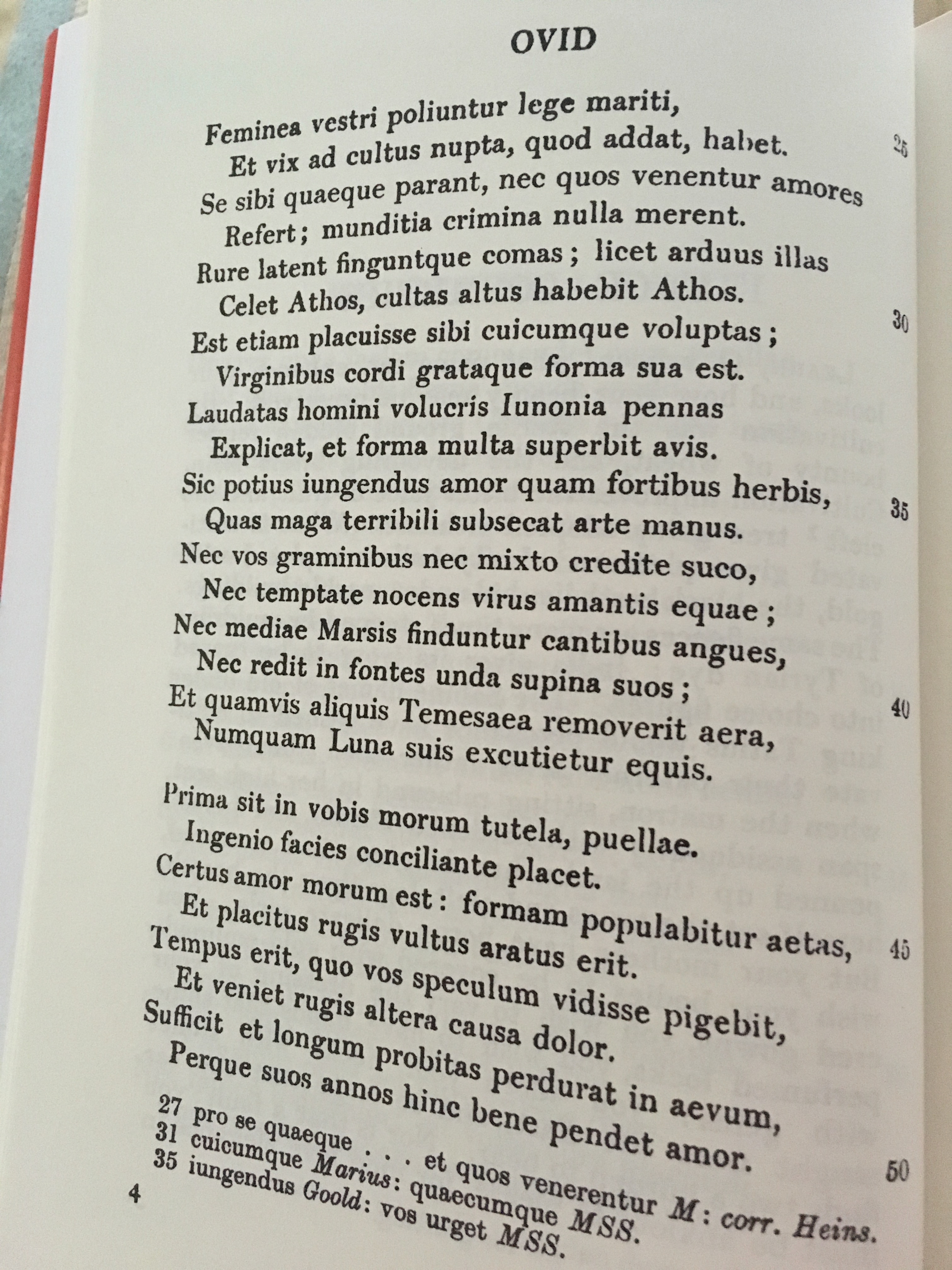
A page from my copy of Ovid’s Ars Amorita

There’s something lost in the translation of any text. English, for all its excessive complexity, lacks the imperfect tense for verbs, meaning that when I am trying to express an idea in any of the languages my sources are written in that uses imperfect verbs, I’m often left struggling to find a really good clear way of expressing that the action is in the past but not quite completed. Think about particular words or phrases in English that sound like other words; the planet Uranus has a funny name depending on how you pronounce it, but that relation between the seventh planet and your posterior anatomy is lost if you try to translate it into practically any other language.

Beyond just understanding literature as its authors intended, the study of Latin and Ancient Greek is critically important to understanding the origins of our civilization, however problematic that word may well have become. The civilization of the peoples whose cultural origins are drawn from Europe, both eastern and western, derive in their origins from the ancient civilizations of the Greeks and the Romans. Those cultures, those powers, those memories have had such a profound and lasting influence on our world today that it would be profoundly shortsighted to stop teaching about them to such a detailed level as many programs do. Our political systems have their origins at least in part in the Classical World, modern representative governments can draw some of their lineage from the democracy of Athens as well as from the Roman Republic.

Generation after generation following the fall of the Western Roman Empire tried in their own way to set themselves up as the heirs of Rome, from Theodoric and the Ostrogoths based at Ravenna in the fifth century CE through Charlemagne and his successors the Holy Roman Emperors in the German-speaking lands north of the Alps, to the Tsars of Russia, the revolutionaries of France, and the founders of the United States. I once wrote in my book Travels in Time Across Europe that to me, Paris today feels as close to what I’d imagine an idealized vision of Rome during the height of the Republic would’ve been like two thousand years ago. The symbols of those governments, particularly of the Roman Republic and the later Roman Empire, remain so present in so many aspects of our world today.

I study the history of French natural history texts written in the second-half of the sixteenth century right at the tail end of the Renaissance that began in Florence in the late fourteenth and early fifteenth centuries. The whole idea of a renaissance is that it was a period when classical culture, literature, architecture, politics, and philosophy saw a revival, a rebirth as is the etymology of the word “renaissance” itself. Advocates of this “renaissance” at the time saw themselves as rekindling the light of the classical world, of restoring the course of what at that time was beginning to be understood as European (aka Western) civilization.

The accidental realization that the Americas existed in 1492 thanks to Columbus resulted in one of the greatest changes in the history of humanity, the opening of the Atlantic and the beginning of permanent contact between the peoples of the Americas and those of Eurasia and Africa. It’s because of this that I prefer not to refer to our civilization as “Western” or “European,” but rather as an Atlantic civilization. It is still the descendant of the civilization of Christian Europe, itself a descendant of the older Mediterranean civilizations of Greece and Rome, but since 1500 our civilization has been profoundly altered by its encounters with civilizations beyond Europe’s waters.

I concede that many of the worst aspects of our Atlantic civilization, from colonialism to slavery can trace some of their origins back to the Greeks and Romans, and that ideas like Manifest Destiny here in the United States have been argued to have drawn influence from older ideas like Rome’s right to rule the world, but even in the historical periods when these claims were being made they were incredibly flimsy. That said, of any problem today, one cannot tie modern ideas of race back to the classical world, as our ideas about race didn’t really begin to develop until 1500; it’s development in the Americas is a central theme to my research.

All this said, we need to understand our history to understand who we are and how we got here, and to do that we need to understand the classical foundations upon which our civilization has been built. The best way to understand those foundations is to be able to read the books they left behind in their original languages. Since the Renaissance we’ve remained generally in the same steady period of knowledge about the classical past; in fact one could argue that the beginnings of all modern fields of research can draw their origins back to the humanists of the Renaissance who sought to revive the sciences of the classical past. Language barriers speak more so to the problems with our education system in general than to anything else. Language education isn’t prioritized in this country, where assimilation and Americanization have been the standards for generations; we come to expect schoolchildren to only know American English because anything else would be unpatriotic. Even if a student comes into a Classics program with a foundational knowledge of one of the Romance languages, in this country likely Spanish, they’ll have a way into beginning to understand Latin. There are strong connections between languages as much as there are between cultures of different ages, we just have to know where to look.