Tag Archives: United States

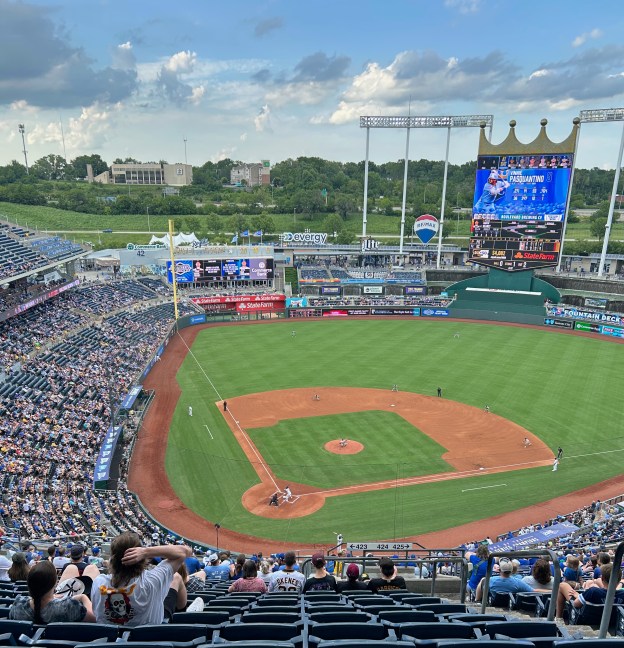
A photo from the upper deck at Kauffman Stadium looking down toward the baseball field during a Kansas City Royals game in July 2025.

Embodied Patriotism

This week, on the patriotism we live in our ordinary lives.—Click here to support the Wednesday Blog: https://www.patreon.com/sthosdkane


This week, on the patriotism we live in our ordinary lives.


This Monday, after a long day working on my dissertation I went with my parents to Kauffman Stadium to see the Kansas City Royals play the first game in this week’s series against the Pittsburgh Pirates. Of the many things that I think of when I see the Pirates, memories of the weekend I spent in Pittsburgh in January 2020, or memories of watching them with my grandmother play the Cubs on WGN in my youth, I have a slight soft spot for the Pirates as a fellow legacy nineteenth-century team (1887) in the National League Central alongside my Cubs (1876), the Reds (1890), and the Cardinals (1892). The great Irish American artist Gene Kelly often said that he took up dancing to meet girls and to be agile and athletic so he could play outfield for the Pirates, his hometown team.

On this particular Monday, once we finished our walk into the stadium, bought our dinners and bottles of water, we made our way up to the top level of the stadium, the View Level to watch the game. I broke off from the rest of my family for a few minutes when we made it up to the 400s level to buy myself a brat. I didn’t realize though that the pregame ceremonies were reaching their conclusion with the march of the color guard and the performance of the national anthem. I consider myself patriotic in my own way; I hope you’ve seen in the last six months on this blog that I strive to elevate my fellow countrymen, my fellow humans in fact, through evocations of all the tremendous things we are capable of doing, of the extraordinary acts of ordinary people.[1] So, as the singer began her tune, I looked around at the people around me to see what I should do. At that moment I was at the register paying for my brat (everything is self-checkout now), yet as I saw no one else at the registers beside me were stopping to make our salute it occurred to me that nothing could be more American, dare I say more patriotic, than engaging in commerce with overpriced foods and drink that’s probably not good for any of us. I quickly finished my purchase and stepped back from the register and took a place beside a group of fellow millennials who held their right hands over their hearts, as we’re taught to do.

Throughout the game, a strong showing by the Royals who hit in 9 runs over the Pirates 3, I thought about this brat purchase during the national anthem and felt resolute in my decision. There are people who I know who take the anthem very seriously to the point of zealotry. In my many years of attending baseball games and soccer matches I’ve often wondered what would happen if someone chose to keep their hands at their sides or even remain seated during the anthem? We saw the harsh reaction of the clamorous cacophony when Colin Kaepernick kneeled during the anthem a decade ago. At the time I was ambivalent yet now having heard more stories of oppression and promises unkept I appreciate what he did. I believe this question of how free we are to patriotically express discontent in civic rituals is essential to the vitality of a democracy. I’ve often found the crafted rituals which the Royals put between innings to be at times bordering the ludicrous. This is especially true in 2025 after the Royals ruined their relationship with so many of us Kansas Citians with how they misled us and took advantage of us in this year’s stadium sales tax vote. My distrust of the team is why I effectively retired the Royals cap that I bought only two years ago at another visit to Kauffman Stadium.

We embody our rituals by wearing American flags on our clothes and demanding unquestioning patriotism in this American life. Here I’m adopting Céline Carayon’s notion of embodied language in her 2019 book Eloquence Embodied about early colonial French communications and relations with Indigenous Americans through gestures and visual language.[2] Today in the United States our patriotism is just as often meant to be blood-red flowing within our bodies as it is worn on our chests and loudly proclaimed with often poorly sung renditions of the national anthem, a hymn requiring professional training to perform. It is meant to be shouted in unquestioning proclamations of American freedom even as that liberty seems ever more fleeting under the combined weight of a cruel-minded governing majority and an even crueler corporate elite that has created so much of the embodied rituals which define American culture in the 21st century. These rituals, always sponsored by some robber baron and crafted by their public relations department, sing proudly of American freedom all while ensuring their own profits at the expense of the American people’s own freedom from want and fear. We embody our patriotism in what we purchase and where. Earlier that day, looking for a late afternoon pastry, I ended up at my local Whole Foods. Their bakery is good; the chocolate croissants are about what you’d expect for a gargantuan corporation’s attempt at mimicry of a Parisian classic. Yet as I bought a slice of pizza that caught my eye thinking how I might stop here for pizza by the slice more often I felt a pang of guilt after all there’s a good local pizzeria, Pizza 51, just across the street and several more within walking distance. Even as bakeries go as fair as Whole Foods is during the morning rush I would much rather go to McLain’s, the Roasterie, or Heirloom, all local bakeries within walking distance of my family home and along the route I was driving yesterday afternoon. Yet where Whole Foods won was that they forego the usual bakery hours and keep baking pastries in the afternoons whereas the others are usually low on their morning batches or already closed for the day. I’ve known for most of my life that these big corporate chains put tremendous stress on small local businesses; in fact I’ve flatly refused to shop at Walmart for this very reason, only buying a couple of bottles of water at one in the Kansas City suburbs once in 2020 when my Dad’s old truck broke down outside of it during the evening rush hour under a hot summer sun.

The America that I love seems more and more fraught the further from walkable neighborhoods and into the suburbs and exurbs you go. This is where most Americans have built their lives in common isolation living in mansions of rest surrounded by moats of artificially green grass regardless of how dry the local climate may be. It’s a life spent driving individually in vehicles increasingly resembling The Princess Bride’s rodents of unusual size in their environmental dangers. Several months ago, I had a bad argument with an attendant at a car wash in a nearby suburb because I ended up in the members’ lane on accident. I told the teenager working there that I made the mistake because there wasn’t a sign that I could see in my Mazda where the two lanes split (the big overhead sign is blocked by a dumpster from my lower line of sight) while the guy kept telling me that I can’t pay in the lane I was in. I was angry because the way that place was built favored the minivans, SUVs, and trucks that most people drive at the expense of those of us who still drive sedans. Yet I lost my temper because when the management got involved in our deteriorating conversation they shrugged off my suggestion that the row of ground-level signs standing outside their toll booth ought to be placed where the lanes split saying “that’s something for corporate to decide.” This is where that America of neighbors seems to be at least dormant to me; rather than making decisions that will benefit all of us together we instead more often choose inaction rather than risk our own individually precarious position. I grew up admiring the likes of Daniel Burnham and was proud as a young kid to say I was from Carl Sandburg’s City of Big Shoulders with big ideas and big ambitions. I’m just as proud to have witnessed firsthand the renaissance that Kansas City has experienced since the millennium. Those sorts of dreams and ambitions are what make me proud to embody our shared patriotism when I feel we’ve warranted it. I prefer the embodied patriotism my parents and grandparents taught me which as I’ve gotten older, I’ve found grew out of the progressive and city beautiful movements of a century ago and felt their greatest expression during FDR’s New Deal in the 1930s. That is my America, the America of neighbors standing up for each other. I see that America every day in my neighborhood where people say hello to each other when walking down the sidewalks or on the Trolley Trail. It’s for that America that I feel pride is warranted, that America which we should be working to rebuild by reconnecting our car-dependent suburbs and neighborhoods, by forcing us to spend time with each other again, to be social again.


[1] That’s one of my favorite lines I’ve ever written.

[2] Céline Carayon, Eloquence Embodied: Nonverbal Communication among French and Indigenous Peoples in the Americas(University of North Carolina Press, 2019).
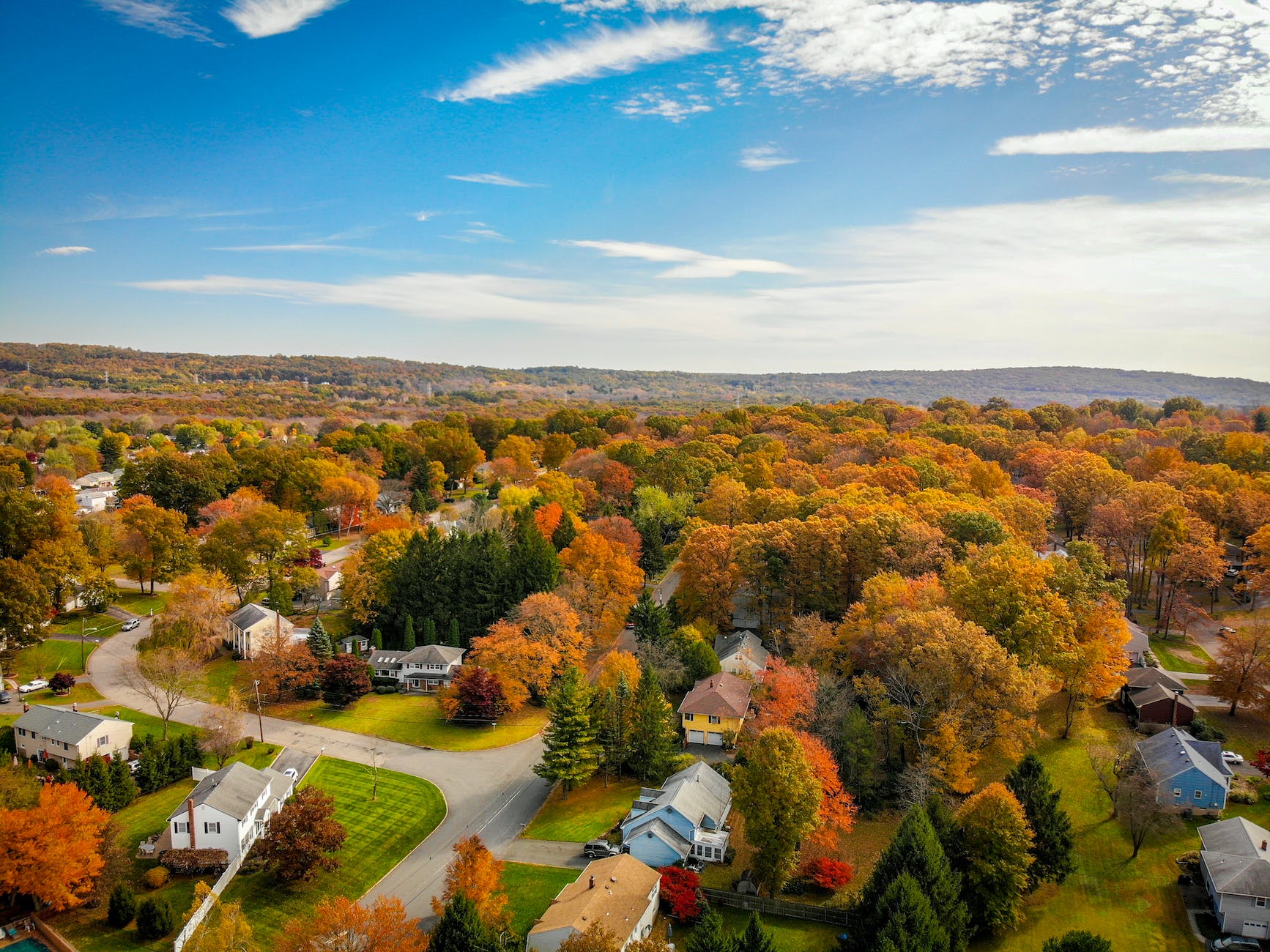

Cultural Homogenization

Photo by Dave Frisch on Pexels.com

One of my favorite YouTubers is J.J. McCullough, a Vancouver-based political columnist for The Washington Post who creates videos discussing topics of culture, politics, and society here in North America. In the summer he made a video discussing the topic of cultural homogenization, of how all cities here in the US and Canada tend to have a fair number of similar things going on. It’s a thesis that I agree with, though with some hesitancy.

I for one am happy with this idea that you can go to any major city in these two countries today and generally feel rather familiar with your surroundings. It’s why I’ll often prefer to stay in chain hotels over smaller super-local B&Bs or even use Air BnB or VRBO when I’m traveling. I like the fact that I know what to expect in a hotel room from the generic furniture to having the same soaps and shampoos to having the same set up with the TVs. When I travel, I’m not traveling to spend my time in a hotel, rather I want that consistency as somewhere I can return to and feel familiar in after a day of going around a city that I may not know quite as well.

Likewise, on the long drives I’ve done four times a year for the past 3 years between Kansas City and Upstate New York, I’ve often mentioned along the way that I feel at home in the suburbs of the various cities I tend to stop in. In particular, my usual overnight hotel in Columbus felt quite familiar, in part thanks to its modern décor and highly suburban surroundings, far more so than Binghamton, NY where I’ve been working on my PhD. This has led me to often remark that leaving Columbus is like leaving the familiarity I’ve come to know and appreciate in the urban Midwest as I head into the Appalachians of New York.

The biggest difference here that I’ve noticed between Binghamton and the other American cities I’ve lived and worked in––Chicago & Kansas City––is that Bing has had a rougher recent economic history than either of the two. While Chicago was able to survive the decline of older industries in the Great Lakes Region, aka the Rust Belt, through its sheer size and the diversity of its economy, and while Kansas City has had a renaissance of its own in the last twenty years to the point that it is today a thriving, growing metropolis with ever increasing opportunities, Binghamton has never really had the size or the economic diversity to stay as strong throughout the bad last few decades of outsourcing jobs and closing down old factories in some of these older towns and cities in the Northeast. There are some hints of this continental North American culture here in Binghamton and in Broome County more broadly, just look at the national chains that line Vestal Parkway, but in its current state I argue that this city has far more in common with the other old industrial centers of the Northeast, particularly in New York and Pennsylvania that have seen their main industries move away within the last 40 years than it does with the broader North American culture.

Still, there are moments when I’ll be driving around suburban Broome County where I’ll find myself remarking how similar the houses are to some of the older Cook County suburbs of Chicago, albeit built in a valley surrounded by what the US Geological Survey calls “small mountains.” I myself am a child of the western DuPage County suburbs of Chicago, and after moving grew up on the far western edge of Kansas City, Kansas, whose older neighborhoods to the east are equally similar in their character and in the age of the buildings to some places here in Binghamton, Johnson City, and Endicott.

In seeing those similarities I’m seeing the broad cultural trends of a century ago. Just as today there are particular architectural styles that are in fashion across this continent, from the renovation of old urban industrial buildings into lofts to the big glass buildings that mark the styles of the later 2000s and into the 2010s, a time when after the worst of the Great Recession had passed, I do think in retrospect we’ll say was a time of optimism, however short it ended up being.

In the media I consume, I’ve often found it interesting that I’ll prefer to watch the national evening news broadcasts over the local news. In my own case I’m a PBS Newshour guy, and there’s something about watching that broadcast that I know millions of other people around the U.S. are also watching, and that it’s coming from a studio in in the Virginia suburbs of D.C. (a place I know very well), that makes me feel like I’m a part of a wider community. The same goes for watching Jeopardy! every weeknight. It’s a show that I know a big number of people watch from all living generations, and it’s 30 minutes a day when I can feel like I’ve got something in common with all of them. I don’t otherwise watch much popular TV, and when I do watch shows that’ll catch the headlines like the recently released Lord of the Rings: The Rings of Power, I often have to ignore those same headlines and subreddits for how negative they often become. In those moments, that hour a week, I want to enjoy the story and not be caught up in what other people might think about it.

Our world is built on mass-production in every sense of the word. We wouldn’t be able to sustain the lifestyles we lead, nor our current population, without industrialization. So, while I will go on a limb and try out the local cuisine when I’m traveling, whether that’s crab cakes in Maryland or the breakfast burritos in Austin, I still like to see what my usual staples are like in a given place. I’ll freely admit to preferring to get a burger or pizza or chicken when I’m doing overnight stops in cities in part because after a day of traveling, I don’t want to be as adventurous, yet also because I can use that baseline, that control, to see how they do the same sorts of meals in a given restaurant in one city and compare it to all the others I’ve tried that in. In some cases, like at Mr. Bartley’s Burger Cottage in Cambridge, Massachusetts it was a wonderful choice, in others like at many of the places I’ve ordered burgers at higher altitude in the Rockies, it’s been a poor choice seeing as I’m less of a fan of well-done beef.

Yet with all this mass-production it strikes me as funny that we often have our very particular ways of distinguishing ourselves, from monograms to those new Facebook avatars, that are themselves mass-produced. I first started seeing this style of monogram, one large letter surrounded by two smaller letters, when I was in college. They often became near logos for the people who used them, yet those very personal symbols were themselves created from templates and used by millions of other people. I did the same thing with the logo for this podcast, which I chose out of a set of templates as a matter of convenience when I was creating it, my own meager attempts at making a logo had all been rejected by Anchor’s formatting.

When it comes to some of the very local sayings that J.J. mentioned, like the often-heard Kansas Citian remark, “if you don’t like the weather just wait five minutes,” it’s something I’ve also heard in many other cities. When I moved to London, I found that our North American customs surrounding weather & seasons made a lot more sense there. The dates when we demarcate our seasons, Winter & Summer starting at the solstices, Spring & Fall at the Equinoxes, makes sense in Europe. It doesn’t make sense here in North America where the weather fluctuates dramatically within a given day. Even now, I’m wearing short sleeves on a 66ºF (19ºC) day in Upstate New York and watching the leaves now past their Fall peak begin to be blown off the trees by the impending winter air. Last week, by comparison, I was wearing thick wool sweaters, wool socks, with a coat, hat, and gloves when outside. Our weather makes a lot more sense when you think of it continentally, after all no one place is entirely separated from everywhere else in North America when it comes to the weather. The snow that strikes the Dakotas one day could well fall in the Mid-Atlantic States a day or two later.

I love Kansas City, and Chicago, the two cities I consider to be my hometowns. I love the things they do that are different from other cities, like Chicago’s hot dogs, Italian beef, and deep dish, or Kansas City’s barbecue. They are the two cities where my own experiences, and my family’s American experience has played out, both in their old urban neighborhoods and in the postwar suburban sprawl where I grew up. I appreciate all the things they have in common, things which they share with much the rest of the metropolitan cities of North America. That’s what’s made places like St. Louis, Denver, Columbus, Indianapolis, suburban Maryland & Virginia, and even Toronto feels like a place where I could settle down. I’ve heard Toronto referred to as a cleaner version of Chicago. It’s what’s made the big merging metros of the Northeast––Philly, New York, and Boston––feel less foreign to me than the cities that lie between them and the Midwest.

I’m happy that we have so much in common in this time when we seem so set on dividing ourselves into parties and camps constantly at odds with each other. Our commonalities demonstrate how much we depend on one another.

Twelve Hours of Mask Wearing

This evening I had the opportunity to travel from my usual place of business in Binghamton, NY to the sunny port city of San Diego on the far side of the country and this continent. It was my first time flying on a full transcontinental route; coming from the Midwest I’ve benefitted from living almost halfway between Atlantic and Pacific until now. The experience was largely uneventful, though I’m humbled by the fact that this continent across most of which I’ve now driven (as far to the east as Boston, as far to the west as the Great Salt Lake) could be crossed in the same amount of time it would normally take me to drive west from Kansas City to that place in western Kansas where I’ve found myself within sight of the tallest clouds rising off the Rockies just west of Denver. I spent the flight reading a compelling story, checking my preferred flight tracking app, and listening to Planetary Radio. 

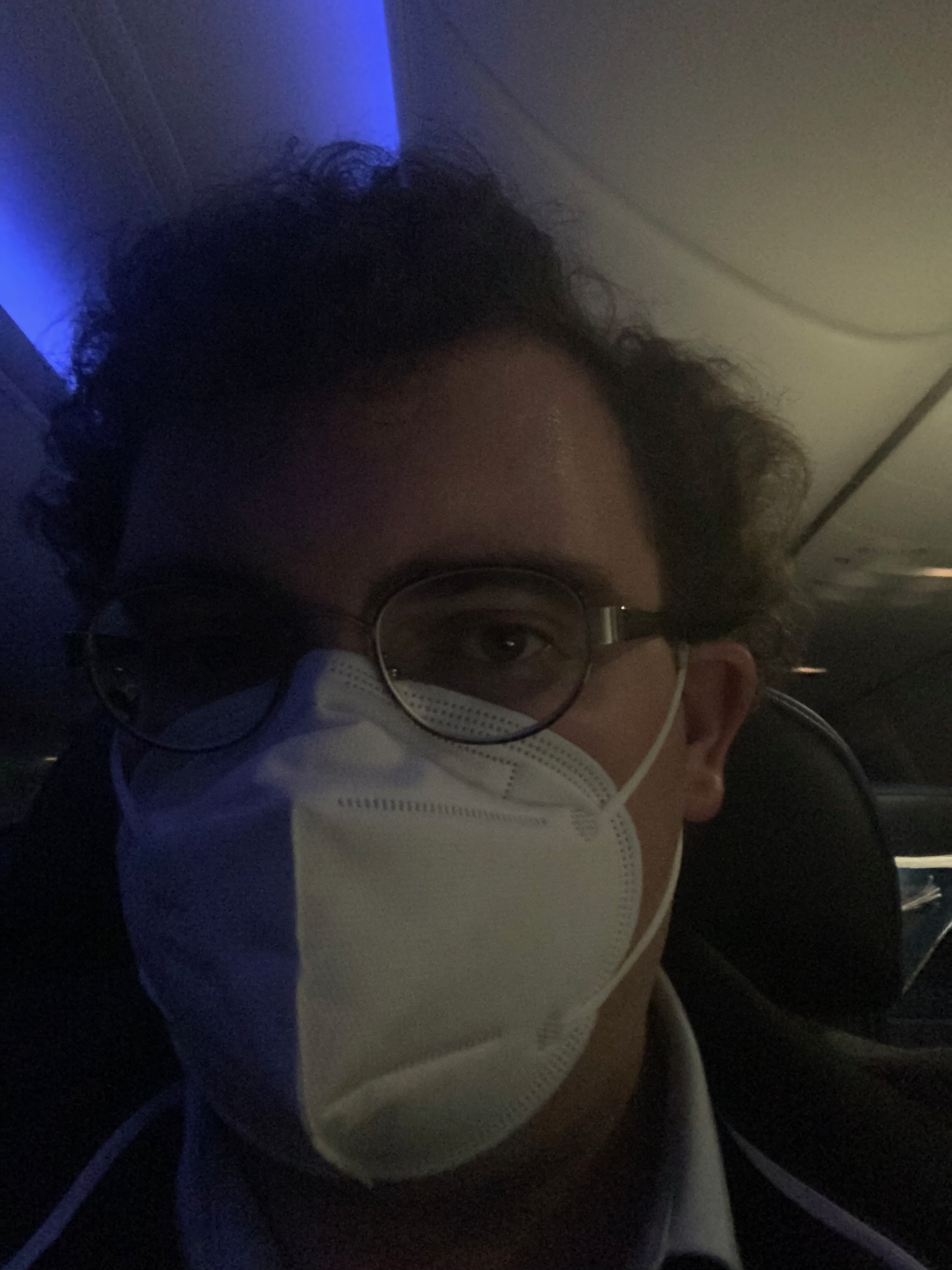
But the greatest physical reminder of this flight and this entire day will be the pain in my ears and the sides of my head from wearing this KN95 face mask for so long. I dearly hope we climb out of this hole of a pandemic we’ve dug ourselves into, and that my fleeting escapes from mask wearing as I took a drink of water would be signs of a future when we won’t have to wear these masks to travel. And yet, I worry that our relatives and neighbors who cry wolf about these masks so forcefully that events meant to be dull, like school board meetings, become events rife with danger, that these our fellow Americans are the ones whose actions will only keep these mask mandates in place longer. After all, we’d be further out of this continuing crisis if we were as a country more fully vaccinated. Being triple-vaccinated against COVID-19 myself, I know I’m probably safe, but the best way to ensure that is the case both for myself and for all the people around me on this plane from the oldest passenger to the youngest infant are safe as well.

I worry that in the fear-mongering of the last decades we’ve lost a sense of communal spirit. We’ve become suspicious of our neighbors who once we could trust. Any statement deserves to be questioned, so I ask you now: what went wrong? When did we choose to fear others before learning to appreciate them? And why don’t we lower our pride for even a minute and let ourselves lower our guard?

We have a lot of problems facing us today. Step one clearly will mean that we’ll have to at least start by looking each other in the eye and at the very least saying hello. It’s a start.

I don’t think I’m in New York anymore.

The American Civic Religion

One of the best ways for any government or other institution to assert their authority over its followers, whether they be citizens, consumers, or believers, is through a degree of providing those followers with a higher purpose to aim for in their devotions. As Catholics, we strive for Salvation, Union with God, Heaven, or whatever you want to call it. As capitalist consumers, we seek our own wealth and prosperity, and by buying into this economic system, by clicking that yellow purchase button on Amazon, we hope that our accumulation of material goods will bring us one step closer to being that prosperous person. Yet as Americans, citizens of the United States, regardless of partisanship, we are taught from a young age to value the preservation and promotion of some of the core ideals, “life, liberty, and the pursuit of happiness,” as Jefferson put it.

With each of these institutions, there is always a need to establish a degree of devotion among their followers; with each, that devotion is something that was at one time new. In the political case of the American civic religion, we can easily trace the origins of that devotion back to our founding myths surrounding the American Revolution (1775-1783), when, as the story goes, a few brave colonists decided to value their freedom over loyalty to their distant king back in Great Britain. With this determination, they rebelled and declared their independence in July 1776. The Founding Fathers of the young republic that became the United States took on the mantle of apostles or saints, and over time the institutions of the republic became nigh sacrosanct: at the end of the day, the Constitution, the rule of law, and the fact that we live in a democracy became irrefutable testaments to that religion.

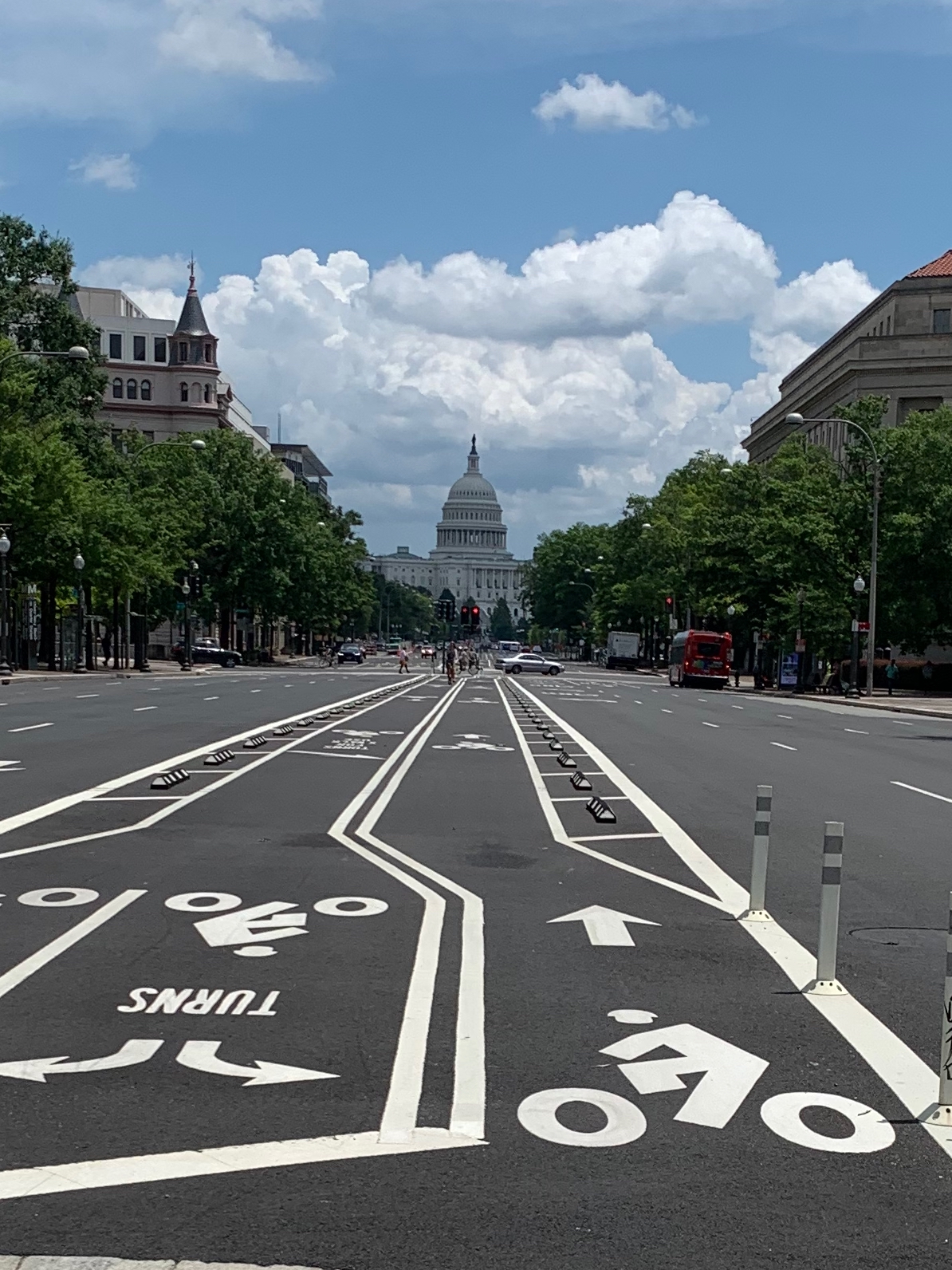
Whenever I am in Washington, D.C., and see the Capitol dome for the first time on that particular trip, I’m reminded of the scene from Frank Capra’s 1939 film Mr. Smith Goes to Washington, starring James Stewart in the title role. The naïve young senator, upon first seeing the Capitol dome from inside Washington Union Station is gobsmacked, and struck by the sight of seeing the St. Peter’s of his deep-rooted belief in the inherent goodness of our government by, for, and of the people. I admit, on my most recent trip to D.C. last week, while I was excited to see the Capitol as I crossed Pennsylvania Avenue, I couldn’t help but feel that as profound our civic religion remains, it nevertheless faced its greatest test in generations this January when the Capitol was attacked by supporters of the now former President on the day when Congress met to certify the results of the Presidential election.

It’s curious to me, because as much as people from both sides of the political divide tout their devotion to “freedom,” the meaning of that very abstract word seems to change depending on the moment. In the broadest sense, freedom is one’s ability to decide how to live one’s life; in the narrowest, freedom has been interpreted as justification to deny the same basic decency and liberty to others on the basis of one’s own biases. I could very well turn this weekly blog into a mouthpiece for all the libels I’d ever want to spin, and likely that sort of fear-mongering clickbait would increase my readership, but I like to think of myself as a nice guy, so in this outlet I refrain from those sorts of obscenities.

As with any other form of devotion, the American civic religion has its own enforcement, people who seem to make it their life’s mission to call out or track down heresies against the civic religion no matter the cost to themselves or their target. This is often realized most fully in the scare tactics used by some to keep their followers loyal to their particular version of the civic religion. Fear keeps people energized, fear of loss, fear of the other. While I will always stand and applaud at the ballpark when the obligatory salute to veterans occurs, I find it chilling that if I didn’t stand, if I didn’t salute the military, it could be damaging to me. The extreme literalness of some religious sects in this country has been carried over into the civic religion, all to the extent that it has been monetized and turned for profit in our devotion to the markets and the accumulation of wealth.

Heretic hunters often have their own faults, that’s where the sacrament of confession comes into play. As a Catholic, I believe that my sins are forgiven in the confessional, so long as I am truly repentant, truly sorry for where I’ve gone wrong. Of course it could be argued that I could then say I could do anything I wanted, so long as I went to confession afterward, but there the actions wouldn’t convert to real results, as I wouldn’t actually believe in the power of the sacrament. So too with our civic religion, as forcibly the heretic hunters may decry their opponents, their enemies as they might well call them, they themselves will always have faults of their own, sins of their own. If we are going to preserve this country, its civic religion, its belief in democracy and in a future where representative government is a strong and viable option, we need to recognize that everyone has problems, and that everyone deserves second chances.

So, as I walked across Pennsylvania Avenue last Thursday, my mind turned to the supporters of the former President who violated the most sacred temple of our civic religion on January 6. Many of the same individuals and organizations that pose as heretic hunters in this civic religion of ours were the same ones that promoted the Big Lie which drove that mob to break into the Capitol, and the rioters themselves, in that most extreme act of heresy against the civic religion, cast themselves as restoring the faith, restoring the power of the people over our government. They too deserve second chances, the opportunity to repent and return to the fold, but not without some penance for the crimes they committed.

If anything, the entire civic religion, built on myth as much as on the ideals of the Revolution, deserves a second chance. It seems increasingly clear to me that the civic religion, the United States as a political community united around our common Constitution, needs refreshing, both to address the shortcomings and wrongs of the past and present, and to reaffirm the foundational covenants of this country’s relationship with its people in a way more in line with the circumstances facing us today in 2021.

What is citizenship?

16179019_10210642139022398_8265398912556879037_o

Photo: Cole Gibson

In our present time of political upheaval around the globe, the central questions of any political society are once more in the foreground. Central to these is the question of what it truly means to be part of a political society, to play one’s part in this comedy we call politics. In most constitutional countries today, the citizen, the most basic piece in the larger puzzle that is the body politick, fulfils this role. What does it mean to be a citizen, and furthermore, what is citizenship, the state of being a citizen? Citizenship is an old concept, one that can be traced back to the earliest polities, from the Ancient Greek πόλις to the varying degrees of Roman citizen, through concepts of medieval subjecthood, to the Renaissance and modern understandings of citizenship within the Westphalian empires and nation-states that have been the norm in the West since the mid-seventeenth century.

Today our definitions of citizenship are primarily two-fold, founded upon both ius sanguinis and ius soli. Jus sanguinis is the understanding that one’s legal status as a citizen is based solely upon one’s ancestry, one’s blood. As an American citizen who has at times, and will certainly again, prefer to live overseas in the U.K., should any of my future children be born beyond the borders of the United States, they will automatically be United States citizens, having inherited that citizenship from me, their father. However, should they be born in the United Kingdom, the children of a permanent resident of that country, they will have also inherited British citizenship through ius soli, having been born on British soil.

These two sub-classifications of citizenship are straightforward enough, and reasonable means to define what makes a person a citizen. Yet a citizen is not just an individual who happens to have either been born in one country, born to a parent from a country, or who has resided in a particular country for an extended period of time. A citizen is also an active participant in their government. The chief way a citizen can partake in politics, can wield the power that comes with their citizenship, is through voting. Without the right to vote, citizenship is but a muted title, a lame duck of a word.

Here in the United States, the most fundamental definition of who can vote simply considers age and time spent in a particular state. In most cases, an American citizen can vote in their state if they are 18 years of age and have resided in that state for at least 90 days. Yet politicians who see their only hope of maintaining power resides in further limiting who amongst the citizenry can vote have begun to pass legislation restricting voting rights from a wide swath of citizens. In Missouri, a citizen must present a state issued ID card when arriving at their voting precinct, yet that state issued ID card can only be granted to the citizen by the state if that citizen can a.) prove their citizenship, and b.) prove their residency. In order to prove one’s citizenship, one either must present a valid birth or naturalisation certificate, or a valid U.S. Passport to the D.M.V. Furthermore; one must prove that one does live at one’s legal voting address. The latter can be arranged, through the presentation of a utility or car bill, or even a bank statement, yet the former is far more complicated to find, particularly if the citizen in question was born in another state.

These laws have been written to “combat voter fraud”, yet there has been hardly any such voter fraud anywhere in the United States in the past twenty years. What these entirely unnecessary laws do accomplish is to restrict voting rights to a select few, to a smaller portion of the population. This is one of many symptoms of our ailing democracy, of our democracy that is sickened and addicted to the power of the almighty dollar. The same politicians that have instituted these voter suppression laws are also the ones who stand to gain the most from having a smaller electorate. Their political power rests squarely on the broad shoulders of their own special interests, cemented through bribery and intimidation alike. This is why sensible gun control legislation has not passed in Congress, despite the string of mass shootings and domestic terror attacks that have plagued this country. This is why the United States does not lead the nations of the world in combatting climate change, in keeping to the standards set in the Paris Climate Agreement. This is why an entire generation of Americans are left in severe debt and often unable to find work upon earning their Bachelor’s degrees. This is why the House Republicans voted to take federal health insurance from 20 million Americans. The voice of the citizen has been overwhelmed by the voice of the special interest.

Our democracy is under threat of becoming a plutocratic oligarchy, a nation governed by a class solely defined by their wealth. Sure, any American can make it to the top, but so long as that American is of European descent, and is willing to do anything it takes to earn more money. The dignity of the citizen is being replaced by the pessimistic wolfish piracy of an unscrupulous few that never outgrew their days of playground bullying. We the citizens should continue to make ourselves heard, we must continue to protest, to march, to call our elected officials, to tweet them, to write to them, to visit their offices and make ourselves heard. But most importantly, come Election Day, we must go out and vote! Without our voting rights were are not citizens but merely voiceless sheep being led about at the whims of a small few.

If our democracies are going to make it through this present time of political upheaval, we the citizens of those democracies must ensure that our voices are not silenced, not muffled by the wealthy and powerful. A person who has nothing to their name, not even a penny, should still have the right to vote; after all that person is a citizen of the country they were born in. Whether we like it or not, we are all subject to the ebbs and flows of the political process. It is up to us to ensure we control that tide, lest it sweep over us and leave us for dead.