Tag Archives: US Politics

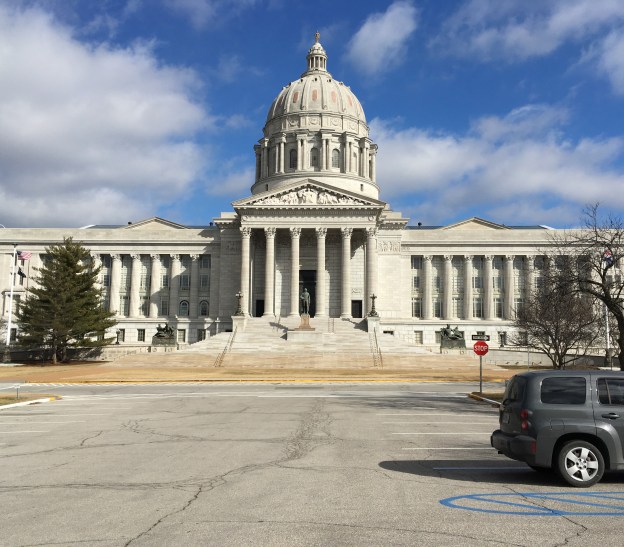
A photograph of the Missouri State Capitol building taken by the author in January 2017.

On Democracy, Part II

This week, on the current round of redistricting sweeping through Missouri.—Click here to support the Wednesday Blog: https://www.patreon.com/sthosdkane—Sources%5B1%5D “On Democracy,” Wednesday Blog 5.39.[2] “We, Irish Americans,” Wednesday Blog 6.10.[3] “On Servant Leadership,” Wednesday Blog 6.15.[4] “Freedom from Fear,” Wednesday Blog 2.6; “Embodied Patriotism,” Wednesday Blog 6.26.[5] “Governor Kehoe announces special session on congressional redistricting and initiative petition reform,” Office of the Governor of the State of Missouri, 29 August 2025.[6] “A Scary Time For Chicago | Trump Gets FOMO Over China's Military Parade | Donald's Life Lessons,” The Late Show with Stephen Colbert (3 September 2025), YouTube.[7] “A Defense of Humanism in a Time of War,” Wednesday Blog 6.24.


This week, on the current round of redistricting sweeping through Missouri.


When I wrote my essay “On Democracy” last December, I anticipated that it would be the only thing I wrote concerning the most recent Presidential election.[1] I wanted to say more, in fact I went back and forth on saying something stronger and more forceful, yet what I ended up with turned out to be just right for the moment. It remains one of the essays I’m most proud of from the Wednesday Blog. The first half of 2025 was marked by a series of essays which followed up on “On Democracy” and commented on the growing number of political crises blowing across this country and here in Missouri and Kansas especially.[2] I even found that the usual low readership numbers on my political essays was mitigated somewhat with these essays; I attribute that in part to my choice to stay positive and focus on the extraordinary acts of ordinary people that have proven essential to the course of American democracy in the last 250 years and remain vital to the continued survival of our Republic today.[3]

All that said, and as much as I am a political animal, I would much rather write about my research and about my English translation of André Thevet’s 1557 book Les Singularitez de la France Antarctique which I’m currently editing. Those are the things which make me happy today because when I’m engaged in my historical work, I feel connected to my friends and colleagues who I’ve met in academia over the years. I want to be known a historian first and a writer second. I’m learning things everyday about Thevet and his worldview that I only barely noticed when I was deep in the effort of translating his book in the first place.

Yet current affairs in Jefferson City are pressing enough that I feel it is my duty to speak up. I know there are very real risks to publishing, saying, or writing anything political today. I’m in a precarious place now as a Ph.D. candidate approaching my dissertation defense and looking at a job market that feels smaller and more threatened than it did a year ago. I know that saying anything political could make me a harder sell for many hiring committees to accept. I take this risk because it is the right thing to do.

Today, 10 September, the Missouri Senate is set to vote on a new congressional map drawn by an uncertain cartographer, possibly in Jefferson City, possibly in Washington, with the intention of ensuring that the Republican Party secures a clear electoral victory in the 2026 congressional midterm elections in spite of learned expectations that the president’s party always loses seats in the midterms after they assume office, and the living reality of our moment in which the majority party is acting to preserve its own power and the wealth of a few at the expense in the political rights of everyone else. I’ve written time and again here that my America in its purest form is embodied in the New Deal and Great Society, and in FDR’s Four Freedoms speech.[4] Sure, we haven’t gotten there yet, all that means is we should keep working for it. America is a shining beacon of democracy for all the world to see, even if that beacon’s shadow often also shows our flaws played out before it like hand-puppets on a screen. Democracy requires participation; it’s the greatest form of government we’ve yet invented because it requires the most of the governed to understand how government works and to participate in their own government for the common good.

This new congressional map is not democratic. In fact, it is the anthesis of democracy. In his statement announcing the Republican supermajority’s push to force this map through the Missouri General Assembly, Governor Mike Kehoe openly stated that this map is intended to protect “Missouri’s conservative, common-sense values should be truly represented at all levels of government, and the Missouri First Map delivers just that.”[5] This was expected, yet still bold by a sitting governor to be so openly one-sided. On Thursday, 4 September, the window to submit written testimony on the redistricting bill opened on the Missouri House of Representatives’ website. I sent in the following statement:

In his statement announcing this new mid-decadal redistricting effort, Governor Kehoe explicitly said this was to preserve “conservative values.” With that out in the open, I want it to be known that if this map is intended to support conservative party politics in Missouri, then it impedes on the rights of all of us moderate, liberal, and progressive Missourians. It is a blatant abuse of power that targets us Kansas Citians in particular. I want to see Missouri create a nonpartisan independent board which draws the electoral maps, so they are fair for all Missourians. I ask the committee to reject this redistricting map for its blatant partisanship and the fact that this redistricting process is costing the taxpayers’ money that could and should be spent elsewhere.

This is the sum of it. I do not think it is hyperbole to say that my own political rights are under threat by this bill. Rather, what was once extreme is today expected because any rules we had for electoral fairness have been thrown out the window. It’s true that both parties gerrymander their congressional maps, but the Republicans do it far more. It’s also true that the Democrats are gerrymandering congressional maps in the states that my party controls. I want independent redistricting maps in all 50 states, the District of Columbia, Puerto Rico, and every territory. That should be our goal. Yet in this moment we need to fight for democracy to save it. This is a struggle here in the United States, yet it is being felt around the globe. Who else is as influential in world geopolitics today who could take up the mantle of democracy if we discard it? What keeps striking me about what the Republicans are doing is that it is all for short-term goals that masquerade as solutions to the country’s problems. What I and many like me want are long term solutions that will actually resolve many of those problems.

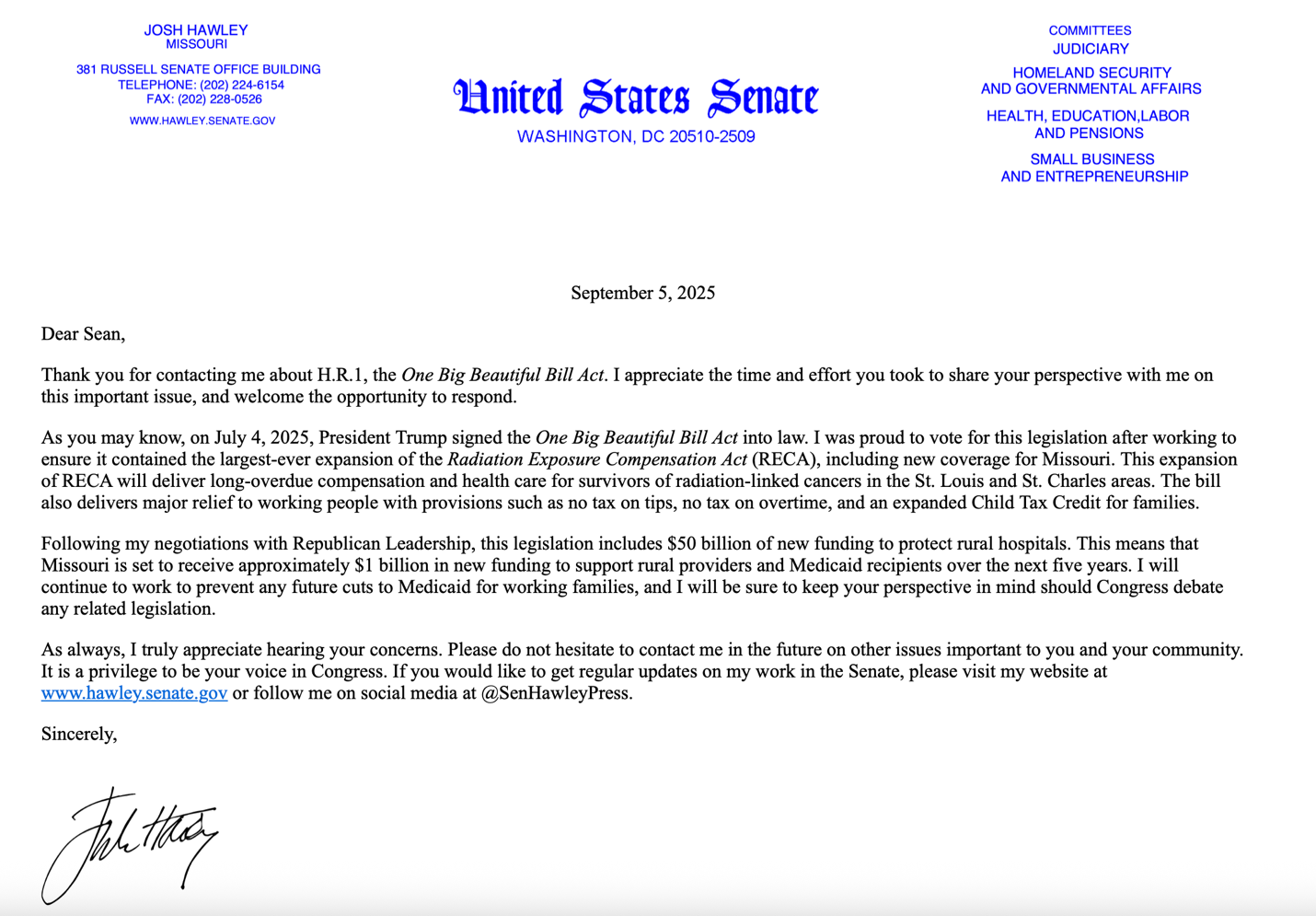
With this new congressional map, I and every other moderate, liberal, and progressive on the Missouri side of Greater Kansas City will lose all federal representation. We currently are represented in Congress solely by Congressman Emmanuel Cleaver II, who has served this city for many decades. I regularly send emails to our senators, Josh Hawley and Eric Schmitt about a variety of issues that I care about from restoring funding to the National Endowments for the Arts and Humanities (NEA, NEH) and the National Science Foundation (NSF), to my fears of presidential overreach with so many executive orders which seek policy changes that by law can only be made through acts of Congress. In every instance, the response I receive has nothing to do with what I wrote. In the case of an email I sent to Senator Hawley concerning my fears over my profession’s long-term viability in this country as federal funding to universities and research institutions is threatened for political reasons, I received an email back lauding the Big Beautiful Bill and all the good it will do for America. A screenshot of that email is included below.
Meanwhile, Senator Schmitt’s office only responds with campaign emails pretending to be official senatorial correspondence. This ought to be illegal in my opinion, and a version of the Hatch Act of 1939 should be passed for the Legislative Branch to keep Members of Congress from using their official correspondence to actively campaign for their offices. I have a folder filled with all of the emails I’ve received from his office since April 2024 and normally they will go directly into that folder. Yet there was one email his office sent me in response to my concerns over cutting funding to the Corporation for Public Broadcasting which was such a blatant example of his dismissive approach to his constituents who disagree with his views that I became pretty angry. 
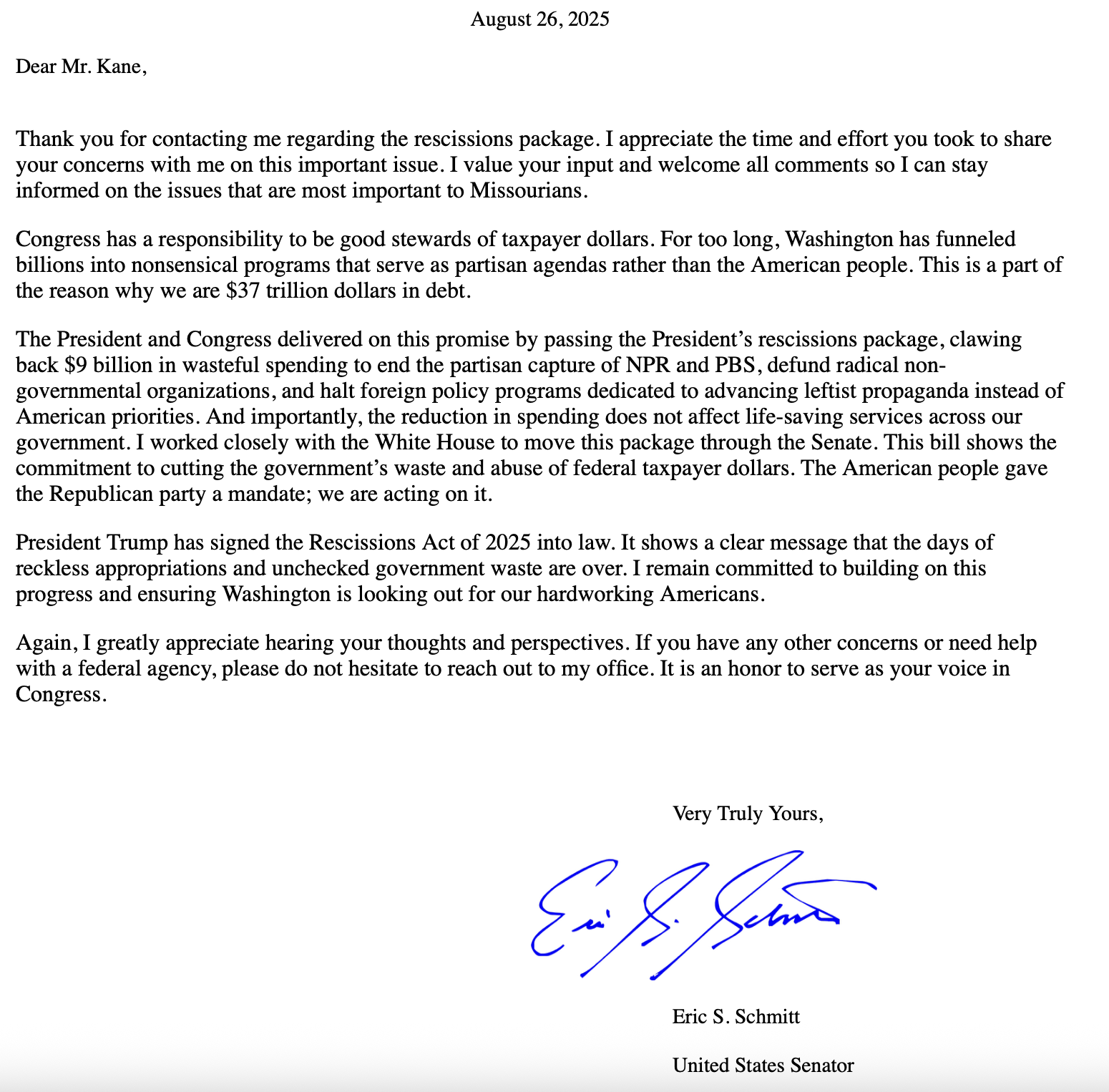
So, I called his Washington office, realizing as the phone was ringing that it was after business hours in the East, and left a voicemail. In summation, I challenged him to actually address his constituents’ concerns. I borrowed what I imagine is the lingo of the manosphere, a foreign corner of the Internet to me and challenged him “man to man to stop being a coward and do his job for all Missourians, not just those in his own party.” I haven’t gotten a response to that one, whether by email, phone, or letter. This is not how I like to talk to people, let alone write to them. I would rather find ways to speak to people in their own language to lift them up. I’m my worst when I lose that sense that I can say or do something that will make the lives of the people around me better.

It’s in this spirit that I decided to write again this week about democracy. Any form of representative government requires that we trust in each other for it to function. This is one of the central tactics of the current majority party. The President recently called the city of my birth a “hellhole,” something that I take personal offence to. I appreciated Stephen Colbert’s response, especially the heartfelt final two words of it.[6] In my essay “A Defense of Humanism in a Time of War” I wrote that I don’t want to be known as a pacifist because there will always be schoolyard bullies to contend with.[7] The people in power today here in Missouri and the slim governing majority in Washington are the biggest bullies this country has seen in a long time. They evoke the worst aspects of America, the greed that embodied both the First Gilded Age and the garishness of this Second Gilded Age in which we live. Not content with letting the democratic process that brought them into office work as it has for over two centuries, they insist on doing what they’ve accused their opponents of doing: rigging the electoral process in their favor. They clearly do not trust us, so why should we trust them?

Democracy is nourished by a love of neighbor. American democracy in particular is built upon a bedrock of idealism that we are still trying to achieve. That is what we need to work on. Robert Reich, the former Secretary of Labor, argues that we are on the verge of a second Progressive Era, a time of tremendous political reform. We who oppose the Missouri supermajority and the thin ruling majority in Washington need to remember that end goal. We need to sustain the democratic spirit through this time of trouble so that we can have a better tomorrow. I’m writing this knowing the risks because I feel it’s my duty as an American. I will always stand up for my neighbor regardless of if we agree or disagree on a given topic just as I will stand up for my colleagues, students, friends, and family because it’s the right thing to do.


[1] “On Democracy,” Wednesday Blog 5.39.

[2] “We, Irish Americans,” Wednesday Blog 6.10.

[3] “On Servant Leadership,” Wednesday Blog 6.15.

[4] “Freedom from Fear,” Wednesday Blog 2.6; “Embodied Patriotism,” Wednesday Blog 6.26.

[5] “Governor Kehoe announces special session on congressional redistricting and initiative petition reform,” Office of the Governor of the State of Missouri, 29 August 2025.

[6] “A Scary Time For Chicago | Trump Gets FOMO Over China’s Military Parade | Donald’s Life Lessons,” The Late Show with Stephen Colbert (3 September 2025), YouTube.

[7] “A Defense of Humanism in a Time of War,” Wednesday Blog 6.24.
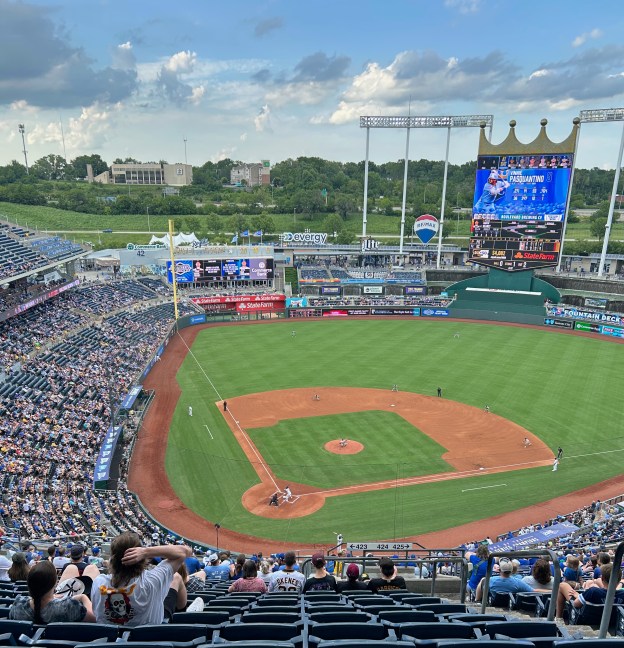

A photo from the upper deck at Kauffman Stadium looking down toward the baseball field during a Kansas City Royals game in July 2025.

Embodied Patriotism

This week, on the patriotism we live in our ordinary lives.—Click here to support the Wednesday Blog: https://www.patreon.com/sthosdkane


This week, on the patriotism we live in our ordinary lives.


This Monday, after a long day working on my dissertation I went with my parents to Kauffman Stadium to see the Kansas City Royals play the first game in this week’s series against the Pittsburgh Pirates. Of the many things that I think of when I see the Pirates, memories of the weekend I spent in Pittsburgh in January 2020, or memories of watching them with my grandmother play the Cubs on WGN in my youth, I have a slight soft spot for the Pirates as a fellow legacy nineteenth-century team (1887) in the National League Central alongside my Cubs (1876), the Reds (1890), and the Cardinals (1892). The great Irish American artist Gene Kelly often said that he took up dancing to meet girls and to be agile and athletic so he could play outfield for the Pirates, his hometown team.

On this particular Monday, once we finished our walk into the stadium, bought our dinners and bottles of water, we made our way up to the top level of the stadium, the View Level to watch the game. I broke off from the rest of my family for a few minutes when we made it up to the 400s level to buy myself a brat. I didn’t realize though that the pregame ceremonies were reaching their conclusion with the march of the color guard and the performance of the national anthem. I consider myself patriotic in my own way; I hope you’ve seen in the last six months on this blog that I strive to elevate my fellow countrymen, my fellow humans in fact, through evocations of all the tremendous things we are capable of doing, of the extraordinary acts of ordinary people.[1] So, as the singer began her tune, I looked around at the people around me to see what I should do. At that moment I was at the register paying for my brat (everything is self-checkout now), yet as I saw no one else at the registers beside me were stopping to make our salute it occurred to me that nothing could be more American, dare I say more patriotic, than engaging in commerce with overpriced foods and drink that’s probably not good for any of us. I quickly finished my purchase and stepped back from the register and took a place beside a group of fellow millennials who held their right hands over their hearts, as we’re taught to do.

Throughout the game, a strong showing by the Royals who hit in 9 runs over the Pirates 3, I thought about this brat purchase during the national anthem and felt resolute in my decision. There are people who I know who take the anthem very seriously to the point of zealotry. In my many years of attending baseball games and soccer matches I’ve often wondered what would happen if someone chose to keep their hands at their sides or even remain seated during the anthem? We saw the harsh reaction of the clamorous cacophony when Colin Kaepernick kneeled during the anthem a decade ago. At the time I was ambivalent yet now having heard more stories of oppression and promises unkept I appreciate what he did. I believe this question of how free we are to patriotically express discontent in civic rituals is essential to the vitality of a democracy. I’ve often found the crafted rituals which the Royals put between innings to be at times bordering the ludicrous. This is especially true in 2025 after the Royals ruined their relationship with so many of us Kansas Citians with how they misled us and took advantage of us in this year’s stadium sales tax vote. My distrust of the team is why I effectively retired the Royals cap that I bought only two years ago at another visit to Kauffman Stadium.

We embody our rituals by wearing American flags on our clothes and demanding unquestioning patriotism in this American life. Here I’m adopting Céline Carayon’s notion of embodied language in her 2019 book Eloquence Embodied about early colonial French communications and relations with Indigenous Americans through gestures and visual language.[2] Today in the United States our patriotism is just as often meant to be blood-red flowing within our bodies as it is worn on our chests and loudly proclaimed with often poorly sung renditions of the national anthem, a hymn requiring professional training to perform. It is meant to be shouted in unquestioning proclamations of American freedom even as that liberty seems ever more fleeting under the combined weight of a cruel-minded governing majority and an even crueler corporate elite that has created so much of the embodied rituals which define American culture in the 21st century. These rituals, always sponsored by some robber baron and crafted by their public relations department, sing proudly of American freedom all while ensuring their own profits at the expense of the American people’s own freedom from want and fear. We embody our patriotism in what we purchase and where. Earlier that day, looking for a late afternoon pastry, I ended up at my local Whole Foods. Their bakery is good; the chocolate croissants are about what you’d expect for a gargantuan corporation’s attempt at mimicry of a Parisian classic. Yet as I bought a slice of pizza that caught my eye thinking how I might stop here for pizza by the slice more often I felt a pang of guilt after all there’s a good local pizzeria, Pizza 51, just across the street and several more within walking distance. Even as bakeries go as fair as Whole Foods is during the morning rush I would much rather go to McLain’s, the Roasterie, or Heirloom, all local bakeries within walking distance of my family home and along the route I was driving yesterday afternoon. Yet where Whole Foods won was that they forego the usual bakery hours and keep baking pastries in the afternoons whereas the others are usually low on their morning batches or already closed for the day. I’ve known for most of my life that these big corporate chains put tremendous stress on small local businesses; in fact I’ve flatly refused to shop at Walmart for this very reason, only buying a couple of bottles of water at one in the Kansas City suburbs once in 2020 when my Dad’s old truck broke down outside of it during the evening rush hour under a hot summer sun.

The America that I love seems more and more fraught the further from walkable neighborhoods and into the suburbs and exurbs you go. This is where most Americans have built their lives in common isolation living in mansions of rest surrounded by moats of artificially green grass regardless of how dry the local climate may be. It’s a life spent driving individually in vehicles increasingly resembling The Princess Bride’s rodents of unusual size in their environmental dangers. Several months ago, I had a bad argument with an attendant at a car wash in a nearby suburb because I ended up in the members’ lane on accident. I told the teenager working there that I made the mistake because there wasn’t a sign that I could see in my Mazda where the two lanes split (the big overhead sign is blocked by a dumpster from my lower line of sight) while the guy kept telling me that I can’t pay in the lane I was in. I was angry because the way that place was built favored the minivans, SUVs, and trucks that most people drive at the expense of those of us who still drive sedans. Yet I lost my temper because when the management got involved in our deteriorating conversation they shrugged off my suggestion that the row of ground-level signs standing outside their toll booth ought to be placed where the lanes split saying “that’s something for corporate to decide.” This is where that America of neighbors seems to be at least dormant to me; rather than making decisions that will benefit all of us together we instead more often choose inaction rather than risk our own individually precarious position. I grew up admiring the likes of Daniel Burnham and was proud as a young kid to say I was from Carl Sandburg’s City of Big Shoulders with big ideas and big ambitions. I’m just as proud to have witnessed firsthand the renaissance that Kansas City has experienced since the millennium. Those sorts of dreams and ambitions are what make me proud to embody our shared patriotism when I feel we’ve warranted it. I prefer the embodied patriotism my parents and grandparents taught me which as I’ve gotten older, I’ve found grew out of the progressive and city beautiful movements of a century ago and felt their greatest expression during FDR’s New Deal in the 1930s. That is my America, the America of neighbors standing up for each other. I see that America every day in my neighborhood where people say hello to each other when walking down the sidewalks or on the Trolley Trail. It’s for that America that I feel pride is warranted, that America which we should be working to rebuild by reconnecting our car-dependent suburbs and neighborhoods, by forcing us to spend time with each other again, to be social again.


[1] That’s one of my favorite lines I’ve ever written.

[2] Céline Carayon, Eloquence Embodied: Nonverbal Communication among French and Indigenous Peoples in the Americas(University of North Carolina Press, 2019).


On Democracy

This week, for my birthday I want to write to you about my belief in all of us and how democracy remains our best hope. — Click here to support the Wednesday Blog: https://www.patreon.com/sthosdkane


This week, for my birthday I want to write to you about my belief in all of us and how democracy remains our best hope.


One of those great efforts with which human history is concerned is the question of what our original nature was at our beginning and if and how we have changed that nature. The French anthropologist Claude Lévi-Strauss’s notion of the primitive as “closer to humanity’s origins” and living in a state without the societal and technological innovations “that obscure their nature” evokes this original nature, what in Christianity is called our original sin, or biologically our evolved state as a particular form of bipedal mammals among other lifeforms.[1] The seeming natural state of human societies until very recently has been toward forms of monarchy and aristocracy, the Tory Party in Britain today still refers to itself as the natural party of government because they descend through many generations from the old Cavaliers who supported Charles I and the aristocrats in the Parliaments of the Stuart and Georgian centuries who opposed the liberal reforms of the Whigs. Here in the United States, our own whiggish political tradition sees its modern manifestation in the old establishment wing of the Republican Party, also known as the Grand Old Party or G.O.P., whose founders in the 1850s included former Northern members of the Whig Party once led by our own aristocrats, men like Henry Clay and John Quincy Adams in the early republic.

Yet those same men stood for something beyond just preserving their own aristocratic power within their own society. These American Whigs and their Republican and Democratic successors aspired to a high ideal of human nature that entrusted power in the hands of the many rather than in those of a few or the one. Dr. Heather Cox Richardson recently wrote in her Letters from an American about how the Secessionists who dragged this country into our Civil War in 1860 and 1861 were trying to assert their own aristocratic vision of the republic that would benefit the few at the disregard of most and the expense of the many. As James J. Sheehan reminded us in his essay in the December 2024 issue of Commonweal, Tocqueville wrote that the chief difference between the source of power in an aristocracy or a monarchy, or their corrupted forms oligarchy and a tyranny, and the source of power in a democracy is that “despotism may govern without faith, but liberty cannot.”[2] The despots rely less on our trust in their rule, and in many of the cases we see today they sew discontent in government, the economy, and for all of us with each other in order to assert their authority and keep hold of power. 

Democracy is a far harder thing to keep, as Dr. Franklin knew well. The inclusion of more and more people complicates any organization, yet it also allows that organization to better reflect all involved. Democracy requires the efforts of all of us to survive; if left unwatered and unnourished by each generation it will wither and die like any other flower or fruit on the vine. Throughout my life, I’ve looked to heroes in our history from Lincoln, Mandela, Óscar Romero, Popes Francis and St. John XXIII, to people closer to my own life. What all of them have in common is a desire to improve the lot of humanity, and in the case of Lincoln and Mandela to promote democracy in their homelands. When I look ahead and worry about what might be coming in these next four years, I often wonder if I would be safer, happier, healthier, and living a more fulfilled life elsewhere in another country where I can leave the troubles of my own behind. Yet I remember these heroes, MacDonagh and MacBride, and Connolly and Pearse, my great-grandfathers who fought in the two World Wars, the dreamers and optimists who organized and marched non-violently for civil rights here in America and in Ireland too, and looking again at our own day I pause. This is our time to make life better for our successors while we live to overcome the long winter of fear before us. If I left now, could I look those heroes of mine in the eye when my time ends?

I believe in democracy because it is the best form of government we’ve yet imagined. I believe in representative government because I would rather have a say in my neighborhood, my city, my county, my state, and my country than not. I believe in democracy because I believe in humanity and that all of us can make something better if only we believed in ourselves and in each other. I believe that before that original sin there was original grace, original goodness; that before the first frown there was the first smile; that before the first thoughts of lust there were thoughts of love. I believe in democracy because I need to believe that I will have a future, that all the things which I’ve done in these last 31 years are building up to something which will, in Bill Nye’s words, “change the world,” no matter how small that change may be. To do any of this, to see any of this goodness in our hearts, to believe in ourselves again we need to be willing first to acknowledge our faults and second to forgive ourselves and put in the effort to make our lives better. For all our technology and our ever increasingly complicated ways of life, we are still the same humans as our ancestors living in Lévi-Strauss’s primitive manner. We retain the same bodies and souls. Because of this, we can build a future for our posterity in a spirit of grace, compassion, and optimism that would make the heroes of old proud.


[1] Claude Lévi-Strauss, From Montaigne to Montaigne, trans. Robert Bononno, (Minneapolis: University of Minnesota Press, 2019), 25.

[2] James J. Sheehan, “Democracy and Its Discontents,” Commonweal, December 2024, 13.


The Power of Personality

The Power of Personality Wednesday Blog by Seán Thomas Kane

This week on the Wednesday Blog, a look back 200 years to another time of great political change in the United States. — Click here to support the Wednesday Blog: https://www.patreon.com/sthosdkane

Next week, I will be teaching about the Era of Good Feelings and the elections of the 1820s which saw the rise of the Second Party System in my Eighth Grade United States History classes. The Era of Good Feelings was a period of political transition between the two-party politics of the Early Republic between the Jeffersonian Democratic-Republicans and the Federalists led by Alexander Hamilton and John Adams towards the Democratic Party founded by Andrew Jackson and the Whigs founded by remnant Federalists and anti-Jacksonians. This era is so named because it saw one major political party, the Democratic-Republicans, dominate American politics after the decline of the Federalists after the War of 1812. The President of the late 1810s and early 1820s, James Monroe, and his successor John Quincy Adams sought to ensure party politics would never return, yet those hopes soon proved futile.

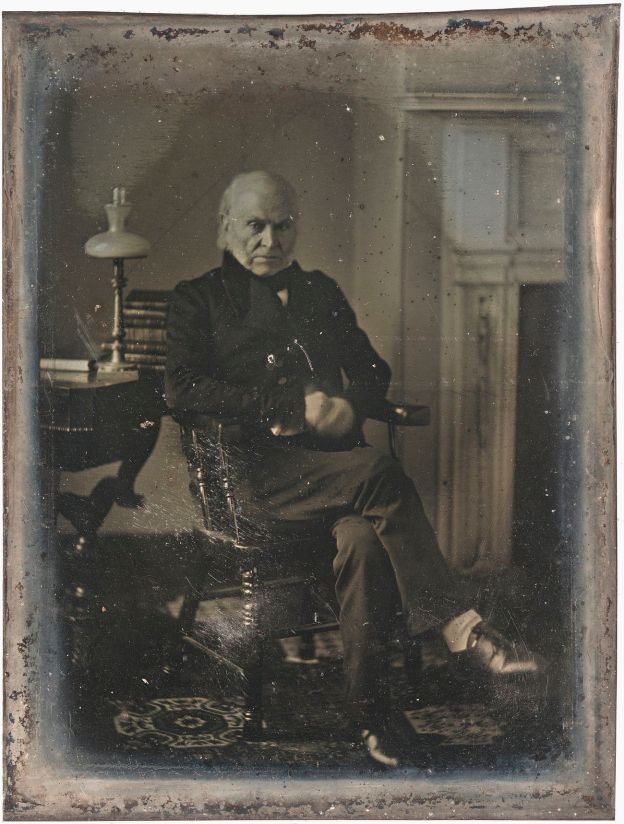
I’ve long enjoyed reading about John Quincy Adams, the eldest son of the second President, John Adams. The younger Adams had many qualities that I admire in a public servant: a great intellectual talent, a Ciceronian love of rhetoric, the patience of a great diplomat, and an openness to change for the benefit of new ideas. Adams was an early abolitionist and supporter of women’s suffrage fifty years before the passage of the 13th Amendment and a century before the 19th Amendment became law. Adams even tried to found a national university and a national observatory, as well as get the United States to adopt the metric system. 

Sadly, none of these things happened during his administration, which ended in failure when his old political rival of 1824, General Andrew Jackson, returned with a populist fervor that elevated the Tennessee planter to the Presidency in 1828. This week as I’ve been making my slides for next week, I’m struck by the clarity of choices in the Election of 1828, and how those choices were between an incumbent who ran on policy and a firebrand outsider who ran on personality. It’s a familiar election narrative, yet it provoked a new conclusion about our current political stalemate between 2023’s Democrats and Republicans than what I had considered before.

Whereas the far-right of the Republican Party has a loud and defiant outsider candidate to rally behind to promote their vision of America, no other faction in either the Republican or Democratic Parties have the same kind of clear leadership. The parties are in a moment when few unifying voices can be heard, when there is always something about the current roster of politicians that leaves more voters choosing between “the lesser of two evils” rather than for a candidate they genuinely like.

Now, I’m biased in this monologue that I’m writing this week: I would have gladly voted to reelect John Quincy Adams in 1828, and not just because I don’t care for Andrew Jackson. Adams is one of my favorite presidents for all the reasons I included above; and his status as one of the fathers of the Whig Party, a preeminent predecessor of the modern Republican Party, shows how party philosophy changes with each successive generation. Still, while many in his day and now might discount the idea that John Quincy Adams had a strong political personality, I suggest we look to the politics of the early republic to find a guide out of our current quagmire.

Having a political figure who can unite a broad coalition behind their own banner, someone who is well liked by a majority of the voting public, is a way to move out of a period of uncertainty and nigh political chaos into a restored stability. The recent political history of the United States has elevated some who could fit this model, yet the extreme levels of bile flung by one faction at another leaves any sense of partisan unity, or better yet partisan magnanimity, far from certain. This leader should be able to bring this wide coalition together yet be humble enough to practice servant leadership, and remember they are in their role as President to help and guide the American people.

The great challenge of our time is to find a common purpose where we have long seen what divides us. It is a challenge which I know we can overcome, a hope which I believe we can realize.

Politics and the Citizen

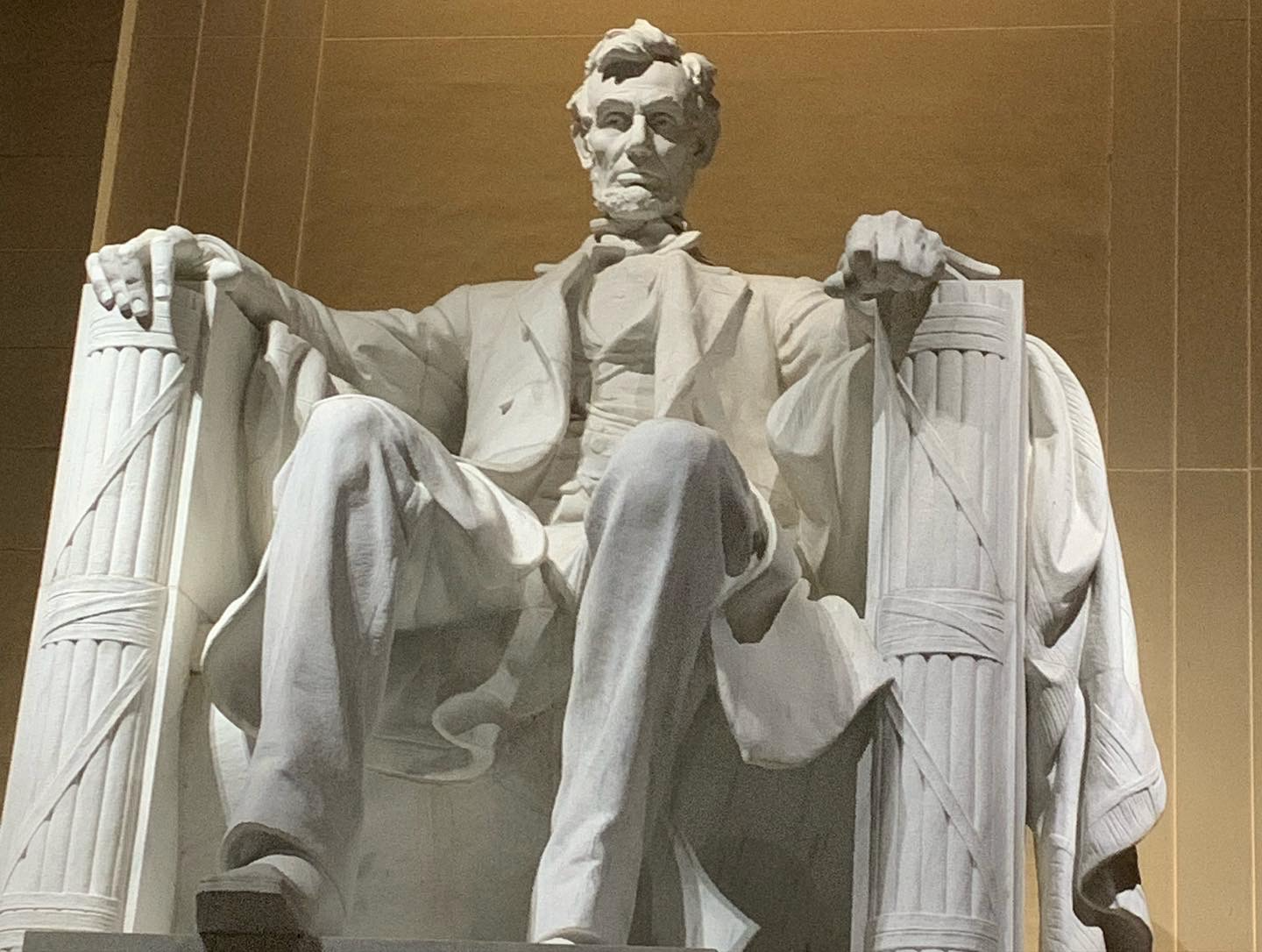
Mr. Lincoln

Politics and the Citizen Wednesday Blog by Seán Thomas Kane

This week, I want to speak to you about the meaning of the word "political."

Words are at the center of all our political debates. They are at the center of our lives, the core of our existence. We would not exist as we do without words. Words have tremendous power to do good, to inspire people to achieve wonderous things, to rise above what they thought possible and make a better future. Yet words are also dangerous when poorly used. They can have the effect of destroying trust between people; they are capable of breaking up families and communities. Without common words we cannot have a common society.

I was struck last week reading in the New York Times how the protests following the recent Supreme Court ruling of Dobbs v. Jackson Women’s Health Organization were rephrased by the far right as an “Insurrection.” That is a word that has been far more justly levied at their own faction, whose actions on January 6th last year proved their lack of faith in a democratic society. Other words and ideas have been poisoned by the same fearmongers from Critical Race Theory to the Green New Deal. These are ideas and proposals that if considered in their true meaning have merit, yet any mention of them in the political square anymore will be met with the screaming banshees in the wings whose greatest weapon and sole power is the volume of their voices.

One such word which they have demonized by their own behavior, perhaps the most critical word to our democracy, is politics. It is taboo now to be political in a crowd when you don’t know everyone else’s own political views. A professional soccer team wearing practice shirts recognizing racial inequality is dangerously “politicizing” an otherwise family event. It’s curious to me because their own use of the word “political” has no bearing on the actual meaning of the word, nor on its origins.

The word political simply refers to the idea of the city, the polis in Greek. To be political is to be a citizen, an active member of society. To be political is to participate in government through voting, running for public office, and serving the people in the public sector. To be called political is one of the greatest honors anyone can bestow, for it means you care about something greater than yourself, you care about your community and want to contribute to its future.

In the ancient and medieval context, a citizen was far more particular of a person than today. The idea of universal suffrage is a modern thing, something that has been fought for down the generations and even still is being fought over today. Today though I believe the best way to describe a citizen is simply a person who wants to contribute to their own community. They need not have the papers conferring official legal citizenship in their country of residence, for even without those individual people can make a difference to their communities.

This is intolerable to those who demonize the word political. Why else would they make such an effort to poison an entire population against such an idea that at its core is meant to better their lives? It is intolerable to them because they know their views, as extreme as they are, are in the minority among their fellow citizens. There are generations of Americans who have come to recognize the benefits of democracy, and who have pushed us to improve upon those benefits already existing, that they might be extended to more and more people until eventually some day we may have true political equity. 

Yet now, as has happened in every generation since the founding of the first English colonies on the East Coast 415 years ago the powerful voice of a small few who see democracy as a threat to their own interests has influenced the course of affairs in this country to the great detriment not only of we the American people but of humanity at large. I’m speaking of course of the West Virginia v. Environmental Protection Agency ruling made on the last day of the recent session of the Supreme Court. In that ruling the conservative majority declared that regulation should only be conducted through legislation. This means the President and any federal agency acting under the authority of the Presidency, even if acting in the best interests of the people they are sworn under oath to serve, have less ability to create broad regulations that are not expressly allowed under Acts of Congress.

The voices of a few who feel greater concern for their profits than they do for the future health of humanity and our home planet spoke up and were heard over the cries of the rest of us. I could say let’s trust in Congress to do their part now and legislate new regulations that will replace what was stripped from those executive orders revoked by the Court but those in Congress with the power to save us are also listening to that swansong of the soloists rather than the Dies Irae being belted by we, the chorus.

Our politics are in many ways broken by our extreme partisanship. It is this word, partisan that ought to be used when the far right uses the word political as a curse. We retreat into our slogans but don’t actually talk to one another. One side hears “Defund the Police” and the other “Law and Order” and neither leaves the table any better off. Rather, both parties find themselves far less willing to talk to the other, to find things in common with the other, to learn from each other. Once again, those fissures that threatened to make two countries out of one in that messy divorce of 160 years ago that left 6% of the population dead are beginning to show. 

Do we really want to go down that path again? Do we really want to fall into such political disfunction that we cease to see each other as fellow citizens and instead as enemies? We have let the battle cry change from “E Pluribus Unum, Out of Many One” to “No Compromise”, leading us to rally ’round our own partisan flags to the detriment of our common threads. I want to cry out in pain every time I see the American flag used as a symbol by those who want to be exclusionary, by those who would see all it has stood for over these past centuries be replaced by the worst of our nature: by our greed.

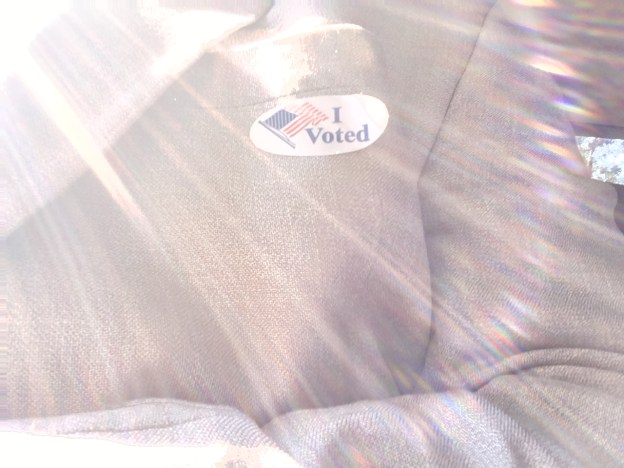
2016 Super Tuesday Democrats Abroad Primary

As citizens of a democracy, we have a right to know, to understand, and to discuss these questions of who we were, who we are, and who we want to be. And, as citizens of a democracy, we do have the right to dissolve our democracy, to end the experiment that’s been running for so long. I recognize that our current federal system isn’t going to last forever, nothing does, yet I remain hopeful that when it does eventually take its leave that that system will be succeeded by something better, crafted by the wisdom and love of another set of founders inspired by the precedents set by the first, who will craft a new system with all the best traits of our own yet reimagined in such a way as to overcome the faults in our own today. Until then, we citizens are caretakers of this democracy. It’s a fragile gift passed down to us from our ancestors, which we get to treasure and improve as best we can so that when we pass it on to our descendants it will be in better shape than how we found it. Let’s do our duty.

Rivalries

The idea of a rivalry and all the extra stuff that goes with it seems to be baked into American culture. Rivalries often make for the most exciting games in a league’s calendar not only for the history traditionally associated with that matchup but also for the antics and occasional brawls that break out in the process of playing the game. As a young Cub fan I always expected there’d be a fight during a Cubs vs Cardinals game or a Cubs vs White Sox game, just as any meeting between the Red Sox and the Yankees seemed sure to produce the sort of atmosphere normally reserved in North American professional sports for the hockey rink.

Interestingly, going off of what I wrote about last week in terms of regionalism, I think it’s important to recognize that rivalries often define a region’s local identity more than anything else. The two great cities of Missouri, Kansas City and St. Louis, are defined just as much by the shuttlecocks at the Nelson-Atkins and the Gateway Arch as they are by the rivalry between the Royals and Cardinals, particularly during the 1985 World Series, which ended in Game 7 with a Royals victory over the red birds. I only hope that with the introduction of MLS’s new St. Louisian team, St. Louis City SC, that we’ll see a strong rivalry between “City” as likely they’re going to call themselves, and our own Sporting.

If anything unites most American cities and their surrounding metropolitan suburbs it’s a general dislike for other cities and their metros. Often the greatest of these rivalries seem to be founded in sports: the Chicago/St. Louis rivalry for example, which certainly began as a disagreement among two of the Midwest’s greatest metropolises in the nineteenth century and developed in the last decades of that century and into the early decades of the twentieth through the birth of the Cubs in 1871 and the ancestors of the Cardinals, the original St. Louis Browns, in 1882. In the decades and generations since that rivalry has grown not only with the introduction of the Blackhawks vs. Blues rivalry in hockey but also a general sentiment that I experienced as a Cub fan going to college at a place dominated by St. Louisians; it didn’t help that my freshman year was also a year when the redbirds won their last World Series.

On a larger scale it seems like we could carry this idea of the rivalry to a geopolitical level. Sure, the US has rivals, traditionally they’d be our counterparts in Europe, in particular in the nineteenth century Britain and in the first half of the twentieth century Germany. More recently though, in the last few generations the US’s biggest global rivals have tended to be the likes of Russia and more recently China. I will fully admit to playing off of the eternal bogeyman in the American psyche by playing the sublimely stereotypically Russian theme tune to the fantastic 1990 film The Hunt for Red October every time I find myself in St. Louis when the Cardinals are doing well. In my own silly way it’s playing off of fears of the bogeyman projected on the wall in this country in communism, comparing my own Cubs’ greatest rival to that red scourge.

It’s interesting though that we have come to develop such profound senses of national pride out of how different we are from other countries, or at least how different we see ourselves from other countries. People in positions of authority, both in government and in the media, have taken advantage of this idea of rivalry to profoundly change the political discussion: we hear more banter about the creeping influences of socialism or Islam today than we do from the same people about problems that face our country internally like racism, vast inequality, and the constant threat of violence due to our overly lenient gun laws.

I’ve often thought that if anything is true it’s that a people who define themselves by what they aren’t rather than what they are will surely fall apart in the long run. Equally, a people who cry wolf at the shadow of the wolf on the wall, labelling it something foreign, when its fangs are being used by the same crier to cause chaos in the cave itself is a people doomed to falter. We’ve found ways to use the excitement of sports to infiltrate our politics and our daily lives, forcing us to adopt a mindset that it’s always us vs. them. Eventually, if we’re not careful we’re going to bring about our own defeat on the field of play, and not by anything our opponents do. It’ll be an own goal, a safety, our knives in our own back that will bring the land of rivals to its knees.

An Equal and Opposite Reaction

21733868_10214068171760956_1726168460_oOne of the fundamental maxims of physics is that “For every action there is an equal and opposite reaction.” For everything that is said or done something of equal vigour must be in order. By this logic then, for every fascist, far-right, or white supremacist threat to American society and we the American people there must also be an equal reaction by the far-left, by the Anti-Fascists as they have deemed themselves. Yet what good does the threat of violent action do? What is the point of bringing one’s guns to an anti-fascist protest? What is the point of eradicating the memory of all who have had some dirt upon their hands, who committed evils in their lives?

This moment, at the closing years of the second decade of the twenty-first century, is a moment of immense change, of tribulation not unfamiliar to our predecessors from a century prior. We are living through the waning hours of a period of unprecedented social change and extraordinary wealth for many in our society. We have witnessed a plethora of forces at work in their efforts to bend our society to their aims. Some have sought to bend the law in order to further their own wealth and prosperity to the detriment of others. Still more have fought against those egotists in the defence of the common good and the wellbeing of all.

Now, as we look ahead towards the last months of 2017 and the new year 2018 we are beginning to recognise as a society how uncertain our future is. We are realising that our children will probably not be better off than ourselves, that our generation as well will probably fall in economic standing in a way unseen in the past century. It is natural to react to this with fear, to curse the political, economic, and social systems that led us to this moment. But in our present culture we celebrate fear, overreaction, and anger far too much. We have accepted extreme behaviour on television as normal, and in so doing have accepted that same extremism into our own lives.

We have reached a moment in our history when both the right and left are afraid; afraid of losing what they have; afraid of each other. We have reached a moment when the politics of fear have duped millions into electing a man entirely unfit for the duties to which he is oath-bound to serve. We have reached a moment when lies are far louder than truths and accepted as real by sections of society.

We have reached a point where at long last the old Confederate sympathies are being brought into the light of day as racist echoes of a failed rebellion from 150 years ago. Yet the zeal of the most outspoken on the far-left has created its equal reaction to the zeal of the far-right. Both now have sizeable factions at their rallies who are armed, ready to fight.

Extremism in any form is unnatural and unhealthy. Yet in the current moment in American history it is the extremes of our society that are the most vocal. I cannot deny that our political system is flawed, it absolutely is. I cannot also deny that American capitalism favours the rich, that is how the playbook has been written. I would be an idiot to ignore that our society is rigged against anyone who is not male and of European descent, there is a racial hierarchy in this country that has existed since the colonial era. But I would be blind to also deny that we can change things for the better. We can fix our corrupted political system, we can rewrite the codes that govern our capitalism, we can stand up everyday for the rights of all in this country and day by day continue to chip away at those old biases. But we cannot do these things while we are taken hostage by the far-right and far-left of our society. We cannot fully achieve the great work of our society while our society is a hostage to the militant few willing to kill their fellow Americans in defence of their extreme convictions.

We must continue to march, to protest, to organise, and to vote. We must carry on the good work that our predecessors undertook in generations past. We can make this country a better place for our children and grandchildren and great-grandchildren to live in. But we must walk the middle road of moderation to do so.

We must understand the full consequences of our actions, we must learn from our history so that we do not make the same mistakes again. There are many who are opposed to the removal of the Confederate monuments because that is “erasing our history.” I disagree. By removing those monuments to a rebellious movement in our history, we are forcing the book closed on that chapter that has yet to settle. After all, we still see the way in which Americans continue to threaten one another with violence at the slightest hint of progressive reform. To make our society better for the next generations we must rid ourselves of this disease of extremism. We must show those who want violence that through peaceful debate we can achieve far greater things.

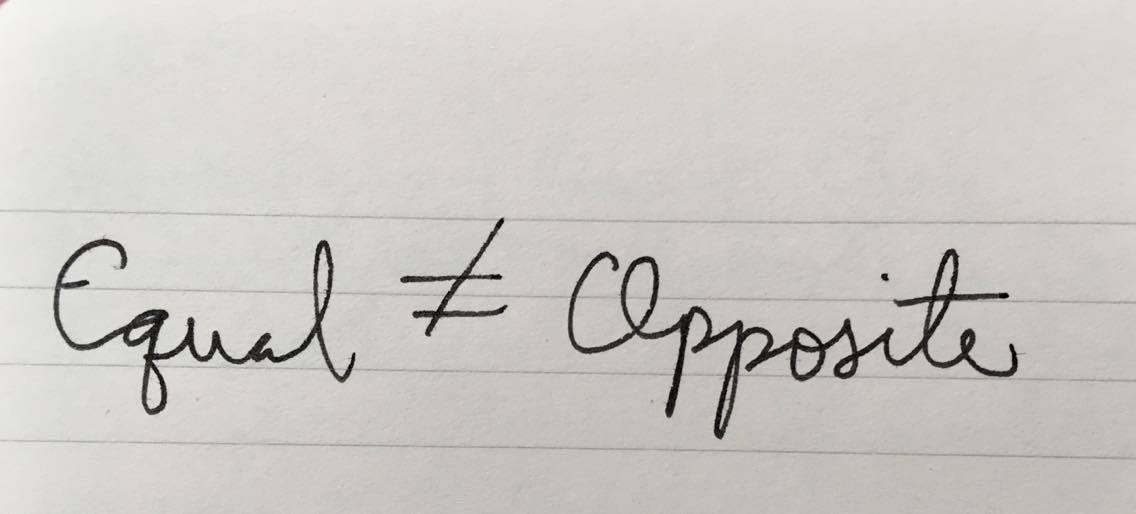
“For every action there is an equal and opposite reaction.” When the far-left responds to the far-right’s threats of violence with equal threats the far-left only continues that same cycle of violence. Consider that maxim again: “For every action there is an equal and opposite reaction.” Threats of violence may well be equal on both sides, but the threat of violence on the left is not opposite to the threat of violence to the right. It is not the positive to the right’s negative. Only peaceful protest, nonviolent refusal to play by their rules of violence can achieve that. Through peace and nonviolence we find our equal and opposite reaction. Let’s try it for once. You never know, it might just work.