Tag Archives: Washington DC

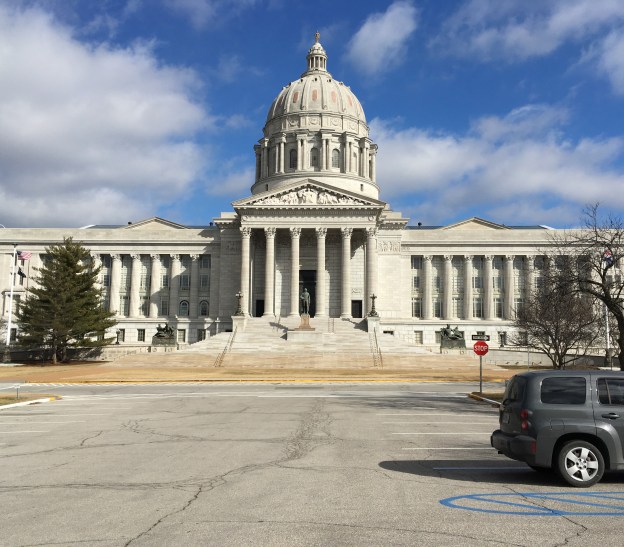
A photograph of the Missouri State Capitol building taken by the author in January 2017.

On Democracy, Part II

This week, on the current round of redistricting sweeping through Missouri.—Click here to support the Wednesday Blog: https://www.patreon.com/sthosdkane—Sources%5B1%5D “On Democracy,” Wednesday Blog 5.39.[2] “We, Irish Americans,” Wednesday Blog 6.10.[3] “On Servant Leadership,” Wednesday Blog 6.15.[4] “Freedom from Fear,” Wednesday Blog 2.6; “Embodied Patriotism,” Wednesday Blog 6.26.[5] “Governor Kehoe announces special session on congressional redistricting and initiative petition reform,” Office of the Governor of the State of Missouri, 29 August 2025.[6] “A Scary Time For Chicago | Trump Gets FOMO Over China's Military Parade | Donald's Life Lessons,” The Late Show with Stephen Colbert (3 September 2025), YouTube.[7] “A Defense of Humanism in a Time of War,” Wednesday Blog 6.24.


This week, on the current round of redistricting sweeping through Missouri.


When I wrote my essay “On Democracy” last December, I anticipated that it would be the only thing I wrote concerning the most recent Presidential election.[1] I wanted to say more, in fact I went back and forth on saying something stronger and more forceful, yet what I ended up with turned out to be just right for the moment. It remains one of the essays I’m most proud of from the Wednesday Blog. The first half of 2025 was marked by a series of essays which followed up on “On Democracy” and commented on the growing number of political crises blowing across this country and here in Missouri and Kansas especially.[2] I even found that the usual low readership numbers on my political essays was mitigated somewhat with these essays; I attribute that in part to my choice to stay positive and focus on the extraordinary acts of ordinary people that have proven essential to the course of American democracy in the last 250 years and remain vital to the continued survival of our Republic today.[3]

All that said, and as much as I am a political animal, I would much rather write about my research and about my English translation of André Thevet’s 1557 book Les Singularitez de la France Antarctique which I’m currently editing. Those are the things which make me happy today because when I’m engaged in my historical work, I feel connected to my friends and colleagues who I’ve met in academia over the years. I want to be known a historian first and a writer second. I’m learning things everyday about Thevet and his worldview that I only barely noticed when I was deep in the effort of translating his book in the first place.

Yet current affairs in Jefferson City are pressing enough that I feel it is my duty to speak up. I know there are very real risks to publishing, saying, or writing anything political today. I’m in a precarious place now as a Ph.D. candidate approaching my dissertation defense and looking at a job market that feels smaller and more threatened than it did a year ago. I know that saying anything political could make me a harder sell for many hiring committees to accept. I take this risk because it is the right thing to do.

Today, 10 September, the Missouri Senate is set to vote on a new congressional map drawn by an uncertain cartographer, possibly in Jefferson City, possibly in Washington, with the intention of ensuring that the Republican Party secures a clear electoral victory in the 2026 congressional midterm elections in spite of learned expectations that the president’s party always loses seats in the midterms after they assume office, and the living reality of our moment in which the majority party is acting to preserve its own power and the wealth of a few at the expense in the political rights of everyone else. I’ve written time and again here that my America in its purest form is embodied in the New Deal and Great Society, and in FDR’s Four Freedoms speech.[4] Sure, we haven’t gotten there yet, all that means is we should keep working for it. America is a shining beacon of democracy for all the world to see, even if that beacon’s shadow often also shows our flaws played out before it like hand-puppets on a screen. Democracy requires participation; it’s the greatest form of government we’ve yet invented because it requires the most of the governed to understand how government works and to participate in their own government for the common good.

This new congressional map is not democratic. In fact, it is the anthesis of democracy. In his statement announcing the Republican supermajority’s push to force this map through the Missouri General Assembly, Governor Mike Kehoe openly stated that this map is intended to protect “Missouri’s conservative, common-sense values should be truly represented at all levels of government, and the Missouri First Map delivers just that.”[5] This was expected, yet still bold by a sitting governor to be so openly one-sided. On Thursday, 4 September, the window to submit written testimony on the redistricting bill opened on the Missouri House of Representatives’ website. I sent in the following statement:

In his statement announcing this new mid-decadal redistricting effort, Governor Kehoe explicitly said this was to preserve “conservative values.” With that out in the open, I want it to be known that if this map is intended to support conservative party politics in Missouri, then it impedes on the rights of all of us moderate, liberal, and progressive Missourians. It is a blatant abuse of power that targets us Kansas Citians in particular. I want to see Missouri create a nonpartisan independent board which draws the electoral maps, so they are fair for all Missourians. I ask the committee to reject this redistricting map for its blatant partisanship and the fact that this redistricting process is costing the taxpayers’ money that could and should be spent elsewhere.

This is the sum of it. I do not think it is hyperbole to say that my own political rights are under threat by this bill. Rather, what was once extreme is today expected because any rules we had for electoral fairness have been thrown out the window. It’s true that both parties gerrymander their congressional maps, but the Republicans do it far more. It’s also true that the Democrats are gerrymandering congressional maps in the states that my party controls. I want independent redistricting maps in all 50 states, the District of Columbia, Puerto Rico, and every territory. That should be our goal. Yet in this moment we need to fight for democracy to save it. This is a struggle here in the United States, yet it is being felt around the globe. Who else is as influential in world geopolitics today who could take up the mantle of democracy if we discard it? What keeps striking me about what the Republicans are doing is that it is all for short-term goals that masquerade as solutions to the country’s problems. What I and many like me want are long term solutions that will actually resolve many of those problems.

With this new congressional map, I and every other moderate, liberal, and progressive on the Missouri side of Greater Kansas City will lose all federal representation. We currently are represented in Congress solely by Congressman Emmanuel Cleaver II, who has served this city for many decades. I regularly send emails to our senators, Josh Hawley and Eric Schmitt about a variety of issues that I care about from restoring funding to the National Endowments for the Arts and Humanities (NEA, NEH) and the National Science Foundation (NSF), to my fears of presidential overreach with so many executive orders which seek policy changes that by law can only be made through acts of Congress. In every instance, the response I receive has nothing to do with what I wrote. In the case of an email I sent to Senator Hawley concerning my fears over my profession’s long-term viability in this country as federal funding to universities and research institutions is threatened for political reasons, I received an email back lauding the Big Beautiful Bill and all the good it will do for America. A screenshot of that email is included below.
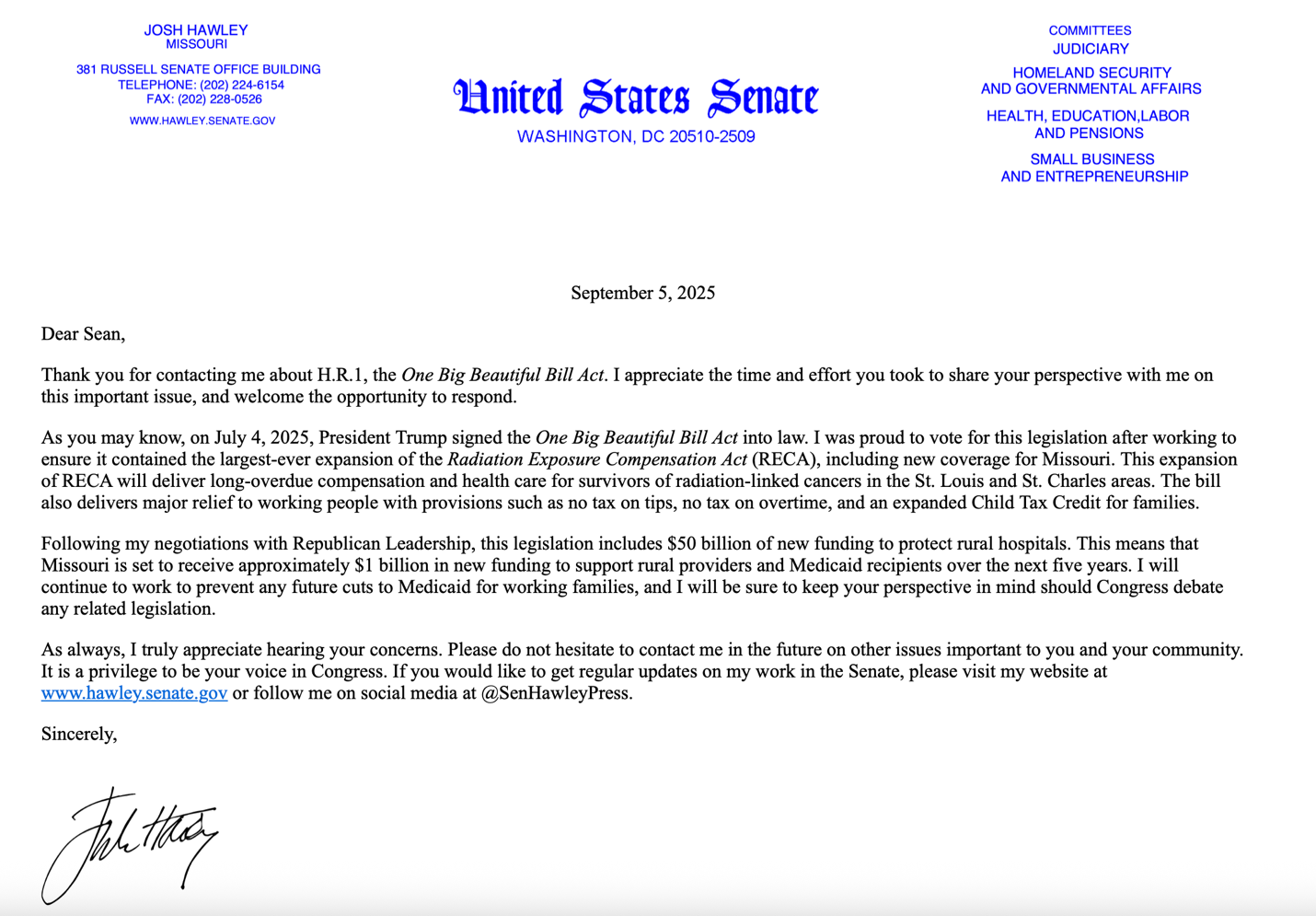
Meanwhile, Senator Schmitt’s office only responds with campaign emails pretending to be official senatorial correspondence. This ought to be illegal in my opinion, and a version of the Hatch Act of 1939 should be passed for the Legislative Branch to keep Members of Congress from using their official correspondence to actively campaign for their offices. I have a folder filled with all of the emails I’ve received from his office since April 2024 and normally they will go directly into that folder. Yet there was one email his office sent me in response to my concerns over cutting funding to the Corporation for Public Broadcasting which was such a blatant example of his dismissive approach to his constituents who disagree with his views that I became pretty angry. 
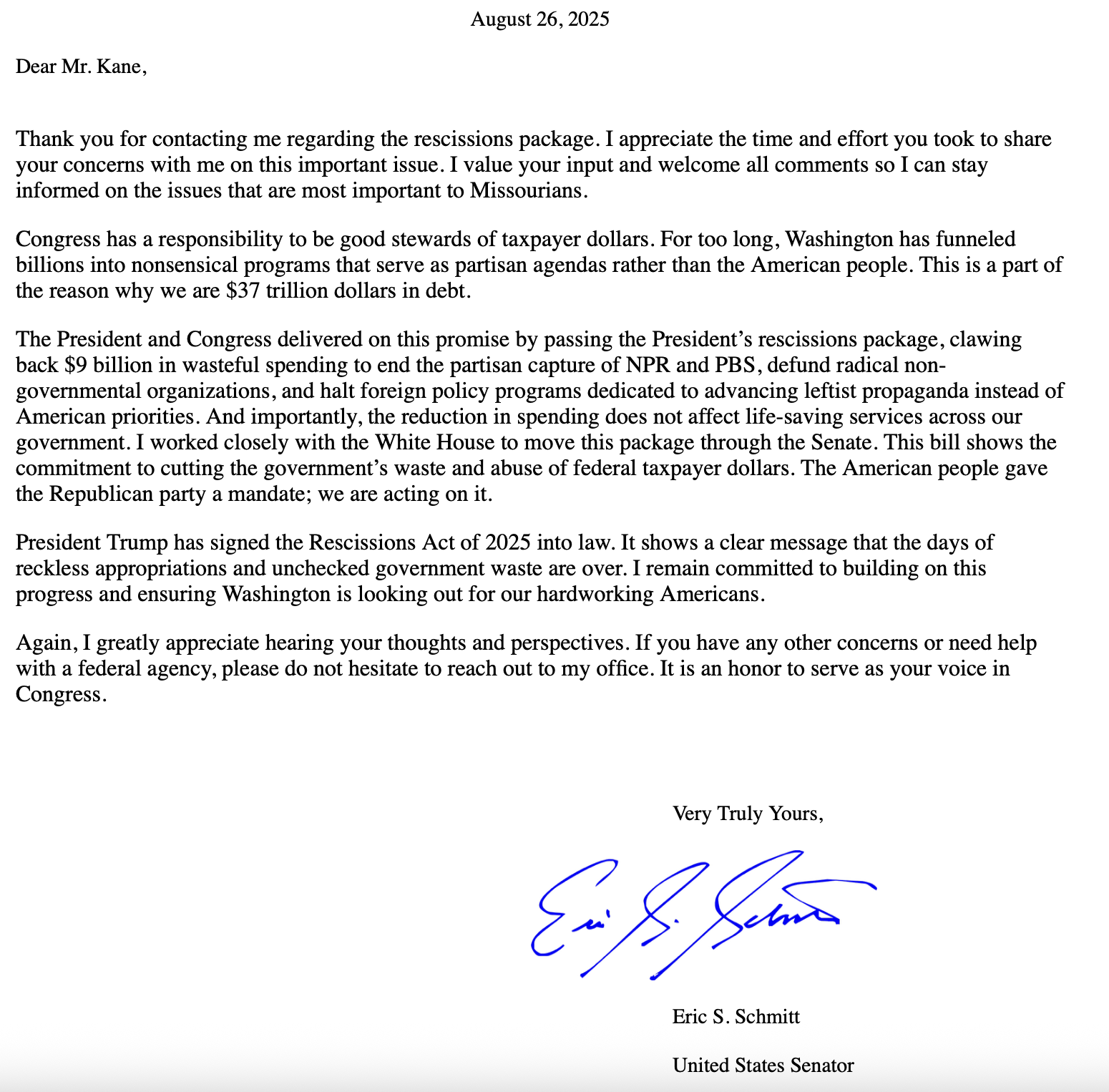
So, I called his Washington office, realizing as the phone was ringing that it was after business hours in the East, and left a voicemail. In summation, I challenged him to actually address his constituents’ concerns. I borrowed what I imagine is the lingo of the manosphere, a foreign corner of the Internet to me and challenged him “man to man to stop being a coward and do his job for all Missourians, not just those in his own party.” I haven’t gotten a response to that one, whether by email, phone, or letter. This is not how I like to talk to people, let alone write to them. I would rather find ways to speak to people in their own language to lift them up. I’m my worst when I lose that sense that I can say or do something that will make the lives of the people around me better.

It’s in this spirit that I decided to write again this week about democracy. Any form of representative government requires that we trust in each other for it to function. This is one of the central tactics of the current majority party. The President recently called the city of my birth a “hellhole,” something that I take personal offence to. I appreciated Stephen Colbert’s response, especially the heartfelt final two words of it.[6] In my essay “A Defense of Humanism in a Time of War” I wrote that I don’t want to be known as a pacifist because there will always be schoolyard bullies to contend with.[7] The people in power today here in Missouri and the slim governing majority in Washington are the biggest bullies this country has seen in a long time. They evoke the worst aspects of America, the greed that embodied both the First Gilded Age and the garishness of this Second Gilded Age in which we live. Not content with letting the democratic process that brought them into office work as it has for over two centuries, they insist on doing what they’ve accused their opponents of doing: rigging the electoral process in their favor. They clearly do not trust us, so why should we trust them?

Democracy is nourished by a love of neighbor. American democracy in particular is built upon a bedrock of idealism that we are still trying to achieve. That is what we need to work on. Robert Reich, the former Secretary of Labor, argues that we are on the verge of a second Progressive Era, a time of tremendous political reform. We who oppose the Missouri supermajority and the thin ruling majority in Washington need to remember that end goal. We need to sustain the democratic spirit through this time of trouble so that we can have a better tomorrow. I’m writing this knowing the risks because I feel it’s my duty as an American. I will always stand up for my neighbor regardless of if we agree or disagree on a given topic just as I will stand up for my colleagues, students, friends, and family because it’s the right thing to do.


[1] “On Democracy,” Wednesday Blog 5.39.

[2] “We, Irish Americans,” Wednesday Blog 6.10.

[3] “On Servant Leadership,” Wednesday Blog 6.15.

[4] “Freedom from Fear,” Wednesday Blog 2.6; “Embodied Patriotism,” Wednesday Blog 6.26.

[5] “Governor Kehoe announces special session on congressional redistricting and initiative petition reform,” Office of the Governor of the State of Missouri, 29 August 2025.

[6] “A Scary Time For Chicago | Trump Gets FOMO Over China’s Military Parade | Donald’s Life Lessons,” The Late Show with Stephen Colbert (3 September 2025), YouTube.

[7] “A Defense of Humanism in a Time of War,” Wednesday Blog 6.24.


The Longest Commute, Part 3

Day 14 of the Trip

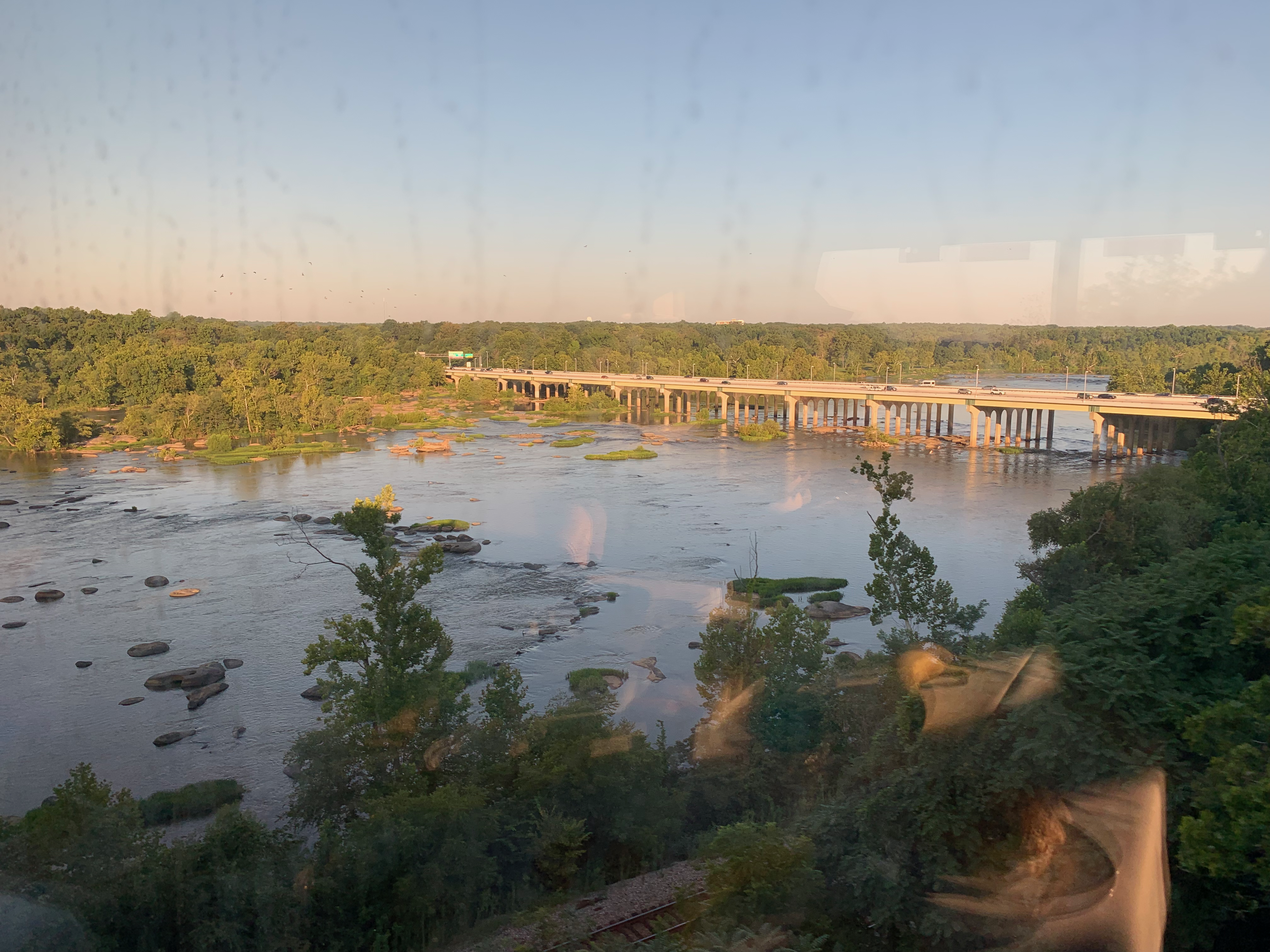
I had a restless night on board the Auto Train, from the flashing lights to my right as the curtains in my roomette with the rocking of the train, to the audible voices in the corridor beyond, to the frequent bumps and lurches on the rails. Still, after about 7 hours I decided to get up, shower, and get dressed for the day ahead. I had breakfast in the dining car as we crossed the James River and rolled through Richmond, Virginia. That capital city was radiant in the morning sun.

Crossing the James River.

At 9:30, a good half-hour ahead of schedule, we pulled into the northern terminus of the Auto Train in Lorton, Virginia, a suburb of Washington, DC nestled in the hills near the Potomac. I stepped down onto the platform soon after, collected my car, and drove into the Virginia morning bound for my main stop of the day. Virginia is one of the two oldest English colonies in North America, founded in 1607 with the establishment of Jamestown. The Puritans of New England, better known as the Pilgrim Fathers, didn’t arrive until 13 years later in 1620. Whereas the Puritans established a theocracy in the North, here in the South the Virginians established a plantation society focused on wealth and farming.

The plantations of Virginia inspired the culture and social order of the rest of the South down into the present. In some ways, these plantations are akin to the ranches of the Southwest and haciendas of the old Spanish colonies because they are all focused on the same overarching thing: using the land for its profits.

It was one such plantation that I was driving towards that morning as I passed Fort Belvoir, Mount Vernon, the home of the first President of the United States: George Washington. I’ve spent a lot of time in DC compared to the rest of the East Coast, but in all those trips I’ve never made it out to Mount Vernon, largely because I haven’t had a car on most of those trips to make the journey, or because I just couldn’t fit it into a busy schedule. So, upon seeing how close the Auto Train station in Lorton is to Mount Vernon I knew I had to fit a stop in.

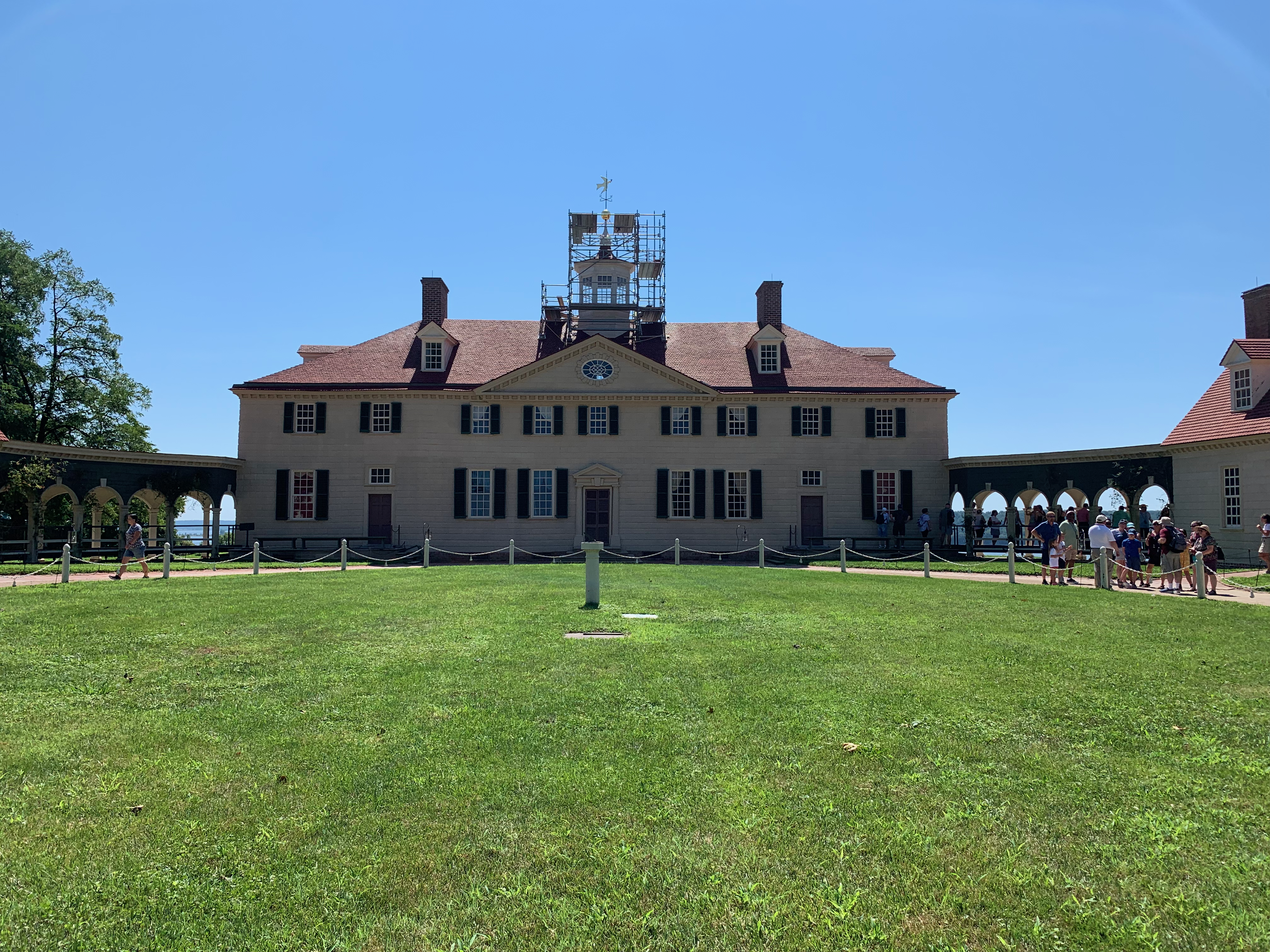
Mount Vernon.

Mount Vernon sits on high ground overlooking a bend in the Potomac about 15 miles downriver from Washington, DC. The mansion house itself was first built by Washington’s father Augustine Washington in 1734 on land that the Washington family had owned since 1674. George Washington began inheriting parts of the estate in 1754 before becoming its sole owner in 1761. The image of himself that he most wanted to be remembered by, that of Farmer George, is best realized there at Mount Vernon, which has been carefully and diligently restored to its appearance in 1799, the year of Washington’s death, by its current owners the Mount Vernon Ladies’ Association.

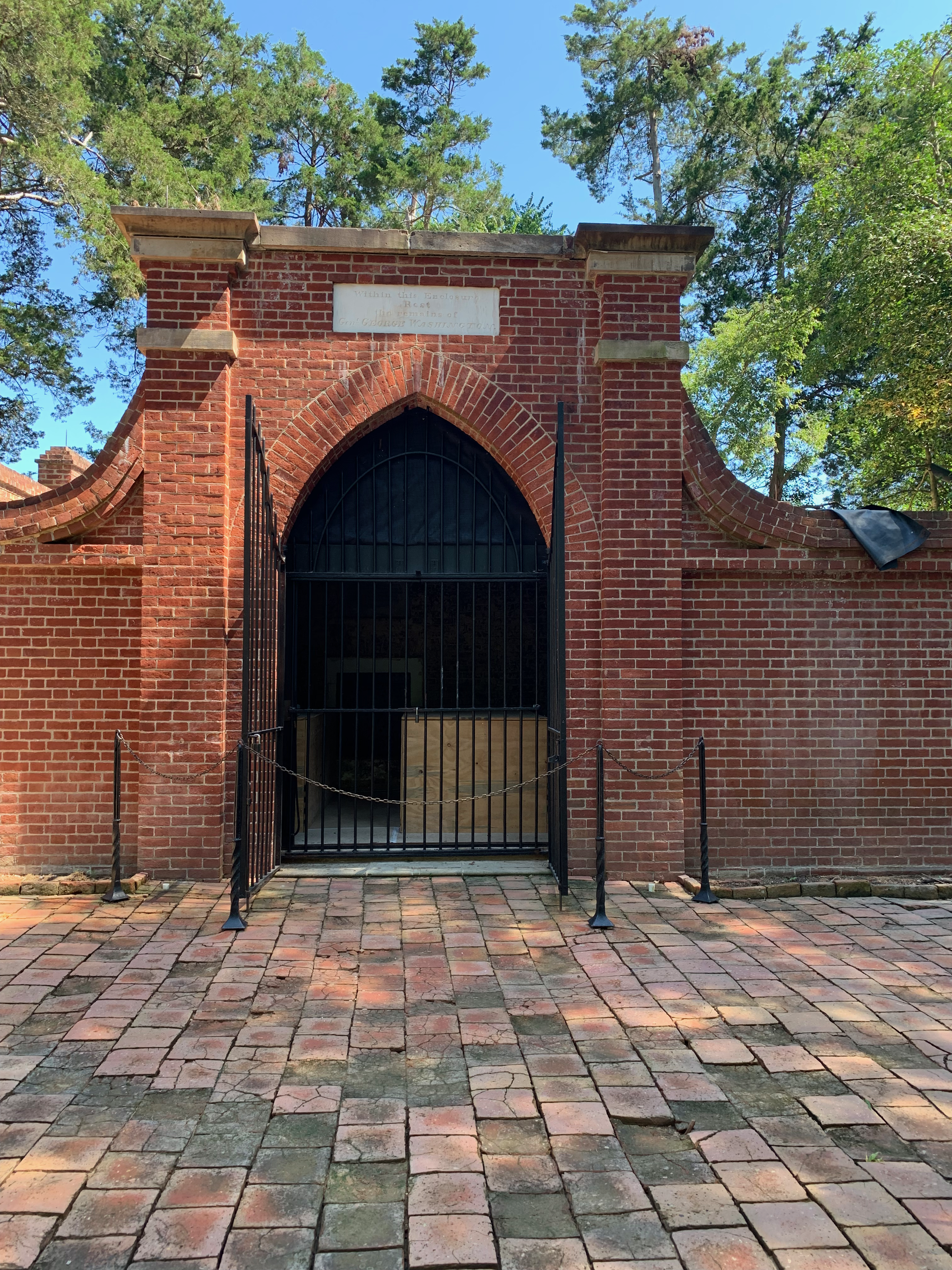
Washington’s Tomb.

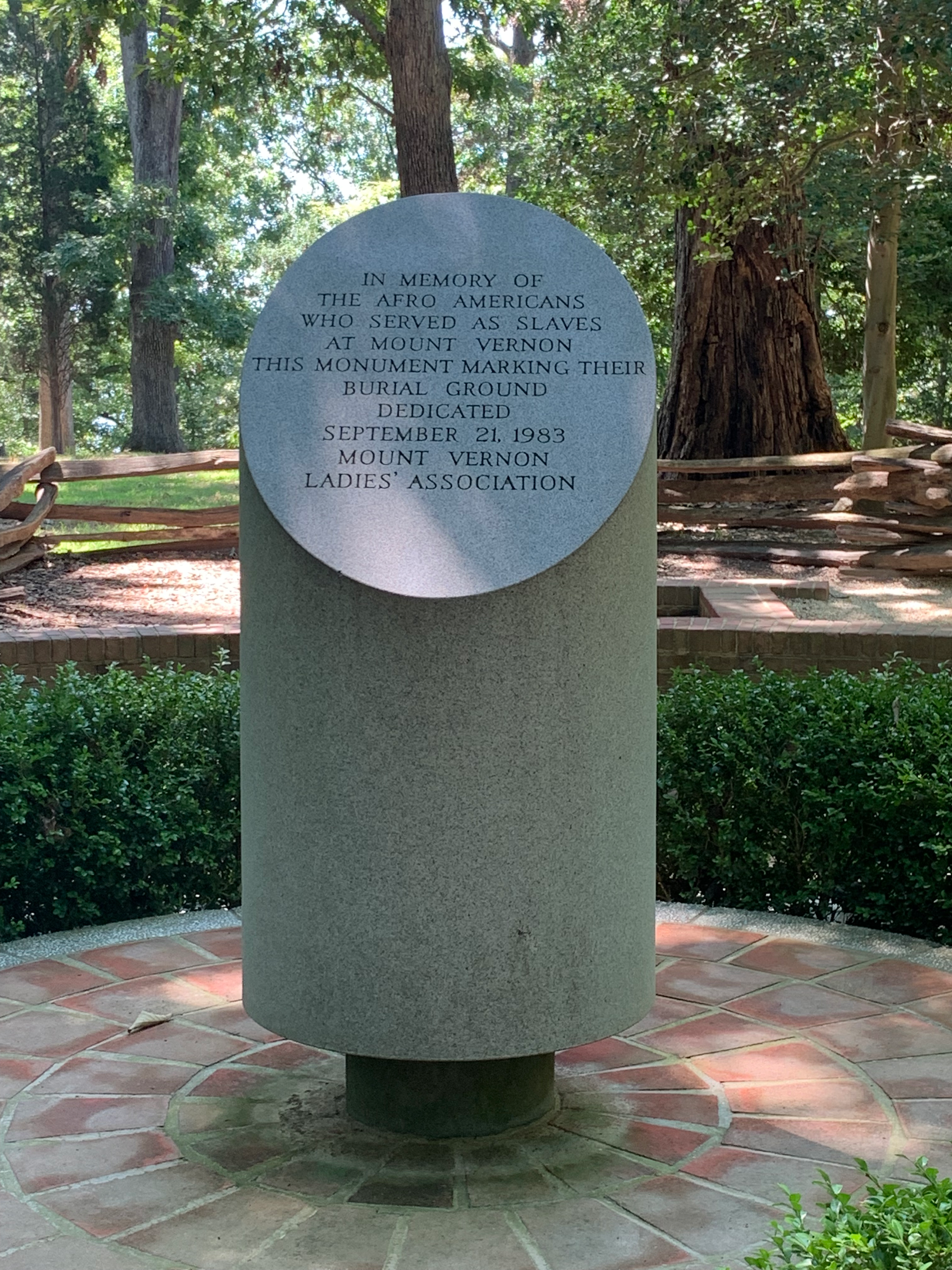
Arriving on the grounds I first made my way towards Washington’s tomb, wanting to see as much of the outdoor things to see there in the morning before the afternoon heat index well over 100ºF set in. At one point there was talk of burying Washington in the crypt beneath the rotunda of the US Capitol building, yet ever the one to avoid grandiosities Washington instead insisted on being buried in a new vault on Mount Vernon, the place he loved more than any other. His tomb is fittingly simple, a vault with an iron gate in which he and his closest family are buried. Outside of it are two obelisks which mark the graves of other Washington relatives who died in the 19th century. A short walk from Washington’s grave is another memorial marker, this one honoring the enslaved African Americans who worked on Mount Vernon. Both were somber sights to behold, the former a tomb of a man who did so much in his day to establish the precedents of our government still in place, the latter a marker of horrendous evils inflicted by that same man upon those who he relied on.

One of the great highlights for me was that afternoon when I took a guided tour of the Mount Vernon mansion, a Palladian structure that has been often used as a model for many later neo-colonial buildings to the point that the layout and interiors seemed almost familiar to me. In some respects, it reminded me of the big farmhouse that I grew up in from the front hall to the social rooms on the ground floor, which in my old house were largely all one big room, to the formal dining room off to the side. On the upper level the idea of having guest bedrooms is something that was very real to me, as we had more sleeping space for guests in that farmhouse than we had for ourselves, though there was only 1 guest bedroom in the place. On the upper level I saw the room where Washington died, restored according to a painting from the 1830s that used eyewitness testimony to be accurate to how the room had looked 30 years before.

After the deaths of George and Martha Washington and their immediate relatives Mount Vernon fell into disrepair, owing in part to changes in the plantation economy and soil exhaustion in those well-settled parts of Virginia. I was touched to learn how the estate was honored and protected by both sides during the Civil War, being one of maybe only a handful of places considered neutral. This saved and preserved Mount Vernon from meeting the same fate as many of its peers throughout the South which were often burnt and ransacked by the passing armies.

I left Mount Vernon after a good 6 hour visit and made my way northwest across northern Virginia to my hotel for the night near Dulles Airport. In general, when it comes to a bigger city like DC, if I have my car with me, I usually prefer to find hotels that are outside of the center but close to a train or metro line so that I can leave my car in a park-and-ride for the day and go into town, while not having to pay downtown hotel or parking rates. I had some ideas of going into DC on this trip, perhaps to visit the National Zoo, but ended up choosing not to, instead staying out near Dulles both that evening due to exhaustion from travel and the poor sleep the night before, and out of an eye for budgetary frugality.

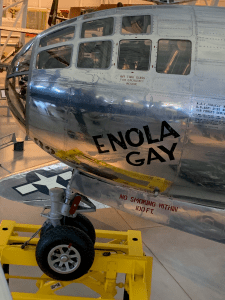
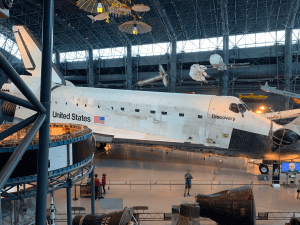
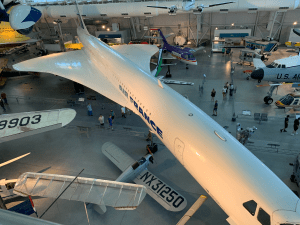
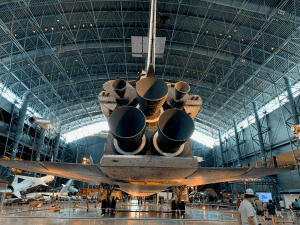
The following day I did make one tourist stop at the National Air and Space Museum’s Udvar-Hazy Center, a massive hangar near Dulles that houses the Smithsonian’s impressive aircraft and spacecraft collection. There’s an old Air France Concorde in there, as well as the Enola Gay, the B-29 that dropped the atomic bomb on Hiroshima on 6 August 1945. The Space Shuttle Discovery is also housed there, in its own wing of the hangar surrounded by other spacecraft, including John Glenn’s Friendship 7, and a collection of German, American, and Soviet rockets. They even have Chuck Yeager’s Glamorus Glennis, a Bell X-1 in which Yeager became the first human to break the sound barrier in 1947, traveling at Mach 1. I wandered around these feats of human ingenuity and engineering so excited to see each and every one of them. But I knew I needed to be moving again, back on the road north, hopefully to make good time in reaching that night’s hotel.

I left Dulles at around 13:30 that afternoon, driving around the western and northern sides of the Capital Beltway to I-95 and aiming my car northeast along that great artery of the Interstate system that parallels the Atlantic coast from Miami to Maine. Today though I would only be passing through four states, Virginia, Maryland, Delaware, and Pennsylvania. As I was driving through Baltimore, taking the Fort McHenry Tunnel under Baltimore Harbor, I decided to adjust my route a bit and not go straight to my hotel in suburban Philly but instead to make a stop at Pat’s the King of Steaks in South Philadelphia because “it’s on the way.” I made it to Pat’s just after 5 pm, as the glow of the evening sun seemed to be like twilight as it shone between the old brick buildings around the intersection of S. 9th St, Wharton St, and E. Passyunk Ave.

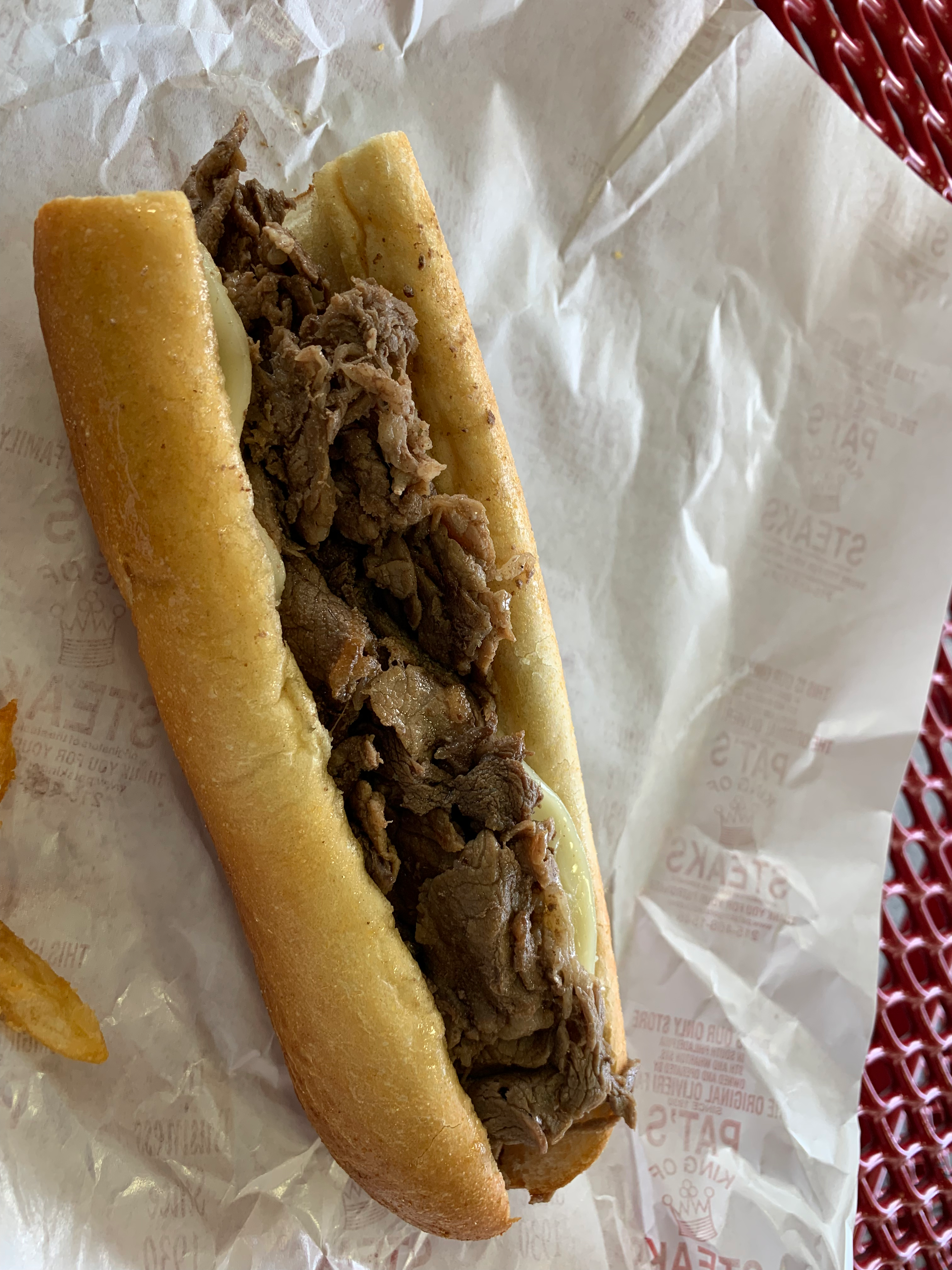
Provelone without

The last time I was in Philadelphia in October 2019 I made my first visit to Pat’s after it was suggested to me as the best option for a cheesesteak by the park rangers at Independence Hall. I found it to be as good as I was told, a wonderful steak sandwich that was one of the easiest meals I’d yet found to order. In my case, I get the “Provolone without,” that is a provolone cheesesteak without onions. On this visit I was happy to be able to have Pat’s again after the pandemic kept me from traveling throughout the East for much of 2020 and 2021. These sorts of steak sandwiches, invented by working class immigrants and their children in the big old cities like Chicago and Philly are a real wonder for American cuisine. I’d compare the influence of the cheesesteak to that of the Italian Beef, a Chicago invention that is more slowly expanding in reach beyond that lakeside metropolis to be known and loved throughout the US.

While waiting at a traffic light near the old docks on Columbus Boulevard, I looked off towards the banks of the Delaware River at the great wharf buildings that were once the beating heart of that city’s international trade. It was through one such building that my 2nd great-grandfather Edward Maher arrived in this country in 1878, receiving an honorable discharge from the British Merchant Navy in which he had served for several years. Though I don’t know which wharf or which dock was the one that witnessed his arrival in America, I felt that the sorry pair I spied that evening in their faded grandeur could well serve as proxies for the spot where that one of my own ancestors first set foot on these shores.

The idea to stop at Pat’s on the way into Philly was good from a geographic perspective, but as soon as I’d left Pat’s and made my way back onto I-95, I quickly found that from a time and traffic perspective that it wasn’t my finest moment. I crawled through Philly that evening, making it to my overnight hotel after an hour of bumper-to-bumper traffic. By then I was just as exhausted as the night before, and not in the mood to try or do anything fancy. So, I sat down on the sofa in my hotel room, turned the TV to WHYY (Philadelphia’s PBS station) and spent the evening watching Nature and NOVA, two of my favorite shows on the air.

The next morning, I woke early, and quickly packed up my things, checking out of the hotel by 8:45. I made it to the 9:10 train at the Norristown Transportation Center with a good 15 minutes to spare, enough time to buy a new Key Card, the local transit smart card issued by SEPTA (the Southeastern Pennsylvania Transportation Authority) and boarded the regional service bound for the Center City. The plan that day was pretty simple: I wanted to visit the Academy of Natural Sciences, my favorite stop on my last trip to Philly in 2019, and then get back out to my car in Norristown to begin the last leg of the trip with a drive up to Binghamton. As luck would have it, nothing went wrong with the trip that day. I made it into Philly by 10:00 am, and walked from Suburban Station to the Academy in good time, arriving about 5 minutes after they opened their doors for the day.

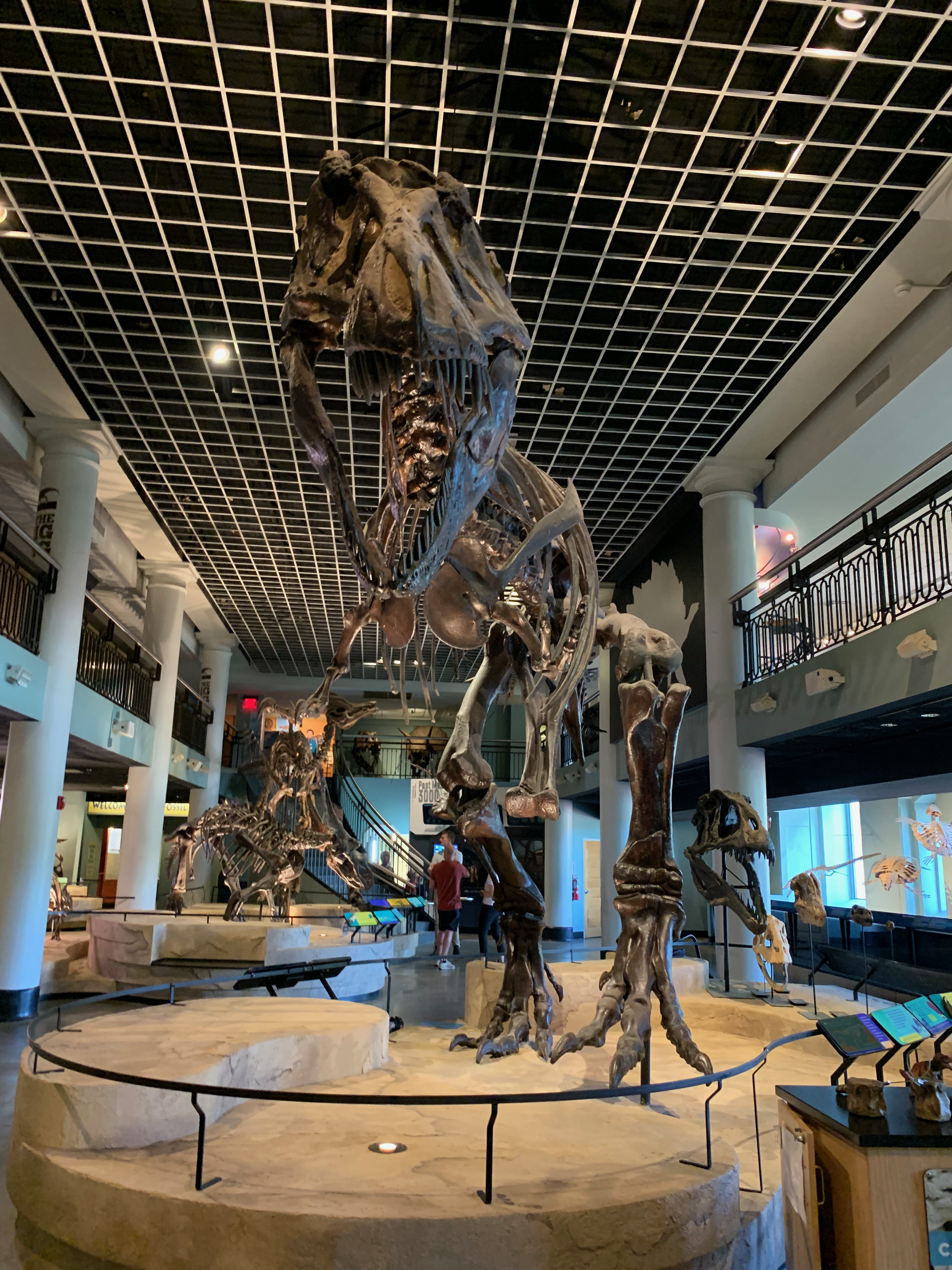
The Dinosaur Hall.

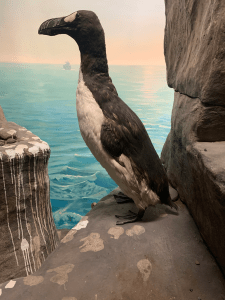
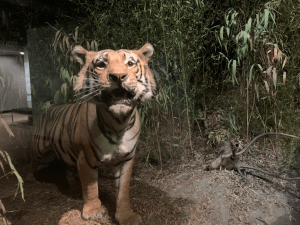
The Academy of Natural Sciences is, in my humble opinion, the best natural history museum in the East. When it comes to natural history museums, I’m especially fond of the dioramas, the displays of taxidermied animals on naturalistic backdrops, of which the Academy has plenty spread out across 3 floors. Their dinosaur collection is smaller than either the American Museum in New York or the Smithsonian’s in Washington, but when it comes to dioramas Philly has them both beat in how they’re laid out and how intimate they seem. This is especially true compared to the ones in New York where the rooms are so dark that it almost feels hard to really get an appreciation for the animals on display. My two favorite natural history museums in the US are my “home museum” the Field Museum in Chicago, and the Denver Museum of Nature and Science, both of which ought to be the poster children, or better yet the type species of American natural history museums in how they set the standard that other museums ought, in again my humble opinion, to follow.

While I was at the Academy, I noticed there was a film crew in the dinosaur hall. I looked to see who was on camera and was surprised to find it was British documentary filmmaker Dan Snow. My general rule when running into famous people is to treat them like anyone else, give them their space, and don’t disrupt what they’re doing. How would you feel if you were working, and some random guy walked up to you and started chatting? I later had a very short but pleasant exchange with him on Twitter about seeing him there. Nice guy.

I wandered around the halls of the Academy of Natural Sciences for a good two hours, just soaking all of it in. When I first agreed to come to Binghamton for my PhD, one of the big things I agreed to myself was that I’d take advantage of being so close to so many wonderful cities with astounding museums to visit as many of them as I could. Because of the pandemic I haven’t been able to be as thorough at that promise as I would’ve wanted, but I’m confident in the future as I find my way into better jobs that I’ll be able to afford the odd weekend trip to see places such as this.

From the Academy I went down into the subway under Market Street and took the trolley to 30th Street, exiting at Philadelphia’s grand Amtrak terminal, where I had a quick lunch of a chicken teriyaki bento box and looked into how to get back to my car in Norristown. I could either wait an hour and catch the same train I took that morning back out to the suburbs, or I could take a timelier route on Philly’s L and interurban services and get there far sooner. Naturally then, I chose the latter, returning to the subway to catch the L to 69th Street, where I transferred to the Norristown High Speed Line, a 13.4 mile (21.6 km) interurban that runs by, among other things, Villanova University. So, at 12:40 I found myself back in my car in the Norristown Transportation Center’s garage, quickly writing out some postcards and setting my navigation system to take me north to my final stop on this Longest Commute, my place of work itself, Binghamton, New York.

The last leg of the trip was the shortest, a mere 2.5 hours between Norristown and Binghamton along the Northeast Extension of the Pennsylvania Turnpike (Interstate 476) to the northern edge of the Wyoming Valley just outside of Scranton and then a quick jump up Interstate 81 and across the New York border to the Susquehanna valley and Binghamton. I finally arrived at my apartment at 4:30 pm on Thursday, 11 August, a full 14 days after leaving home.

Elements of this trip have been in the back of my head for a while. Over the past few years, I’ve considered driving back to Binghamton via DC or Philly, having usually done so via Cleveland or Pittsburgh. There are places in all these cities that I’ve wanted to see for a long time, wishes that my younger self had that I’m finally fulfilling. This longest commute took me through 14 states (Missouri, Illinois, Kentucky, Tennessee, Florida, Georgia, South Carolina, North Carolina, Virginia, Maryland, Delaware, Pennsylvania, & New York). The trip in full saw me travel 3,022 miles (4,863 km) across much of the Midwest, South, and Northeast of this country.

So, that’s it. That’s the story. To those of you who have been listening and reading over the last 3 weeks, from the bottom of my heart thank you, thank you, thank you. This episode, no. 39, marks the end of Season 1. I started The Wednesday Blog on a whim one morning after a sleepless night in March 2021 after I decided I wanted to write something personal and non-academic for a change. At the time I said I’d stick with it as long as it was fun and not tedious. Well, that first run of 38 blog posts set the stage for the podcast, which I started on another whim after dinner one night in November 2021. About halfway through the first season of the podcast, I decided I’d call the season over after a max of 40 episodes, to try and keep things even with the number of blog posts I published before the podcast started. So, here we are. I hope “The Longest Commute” has been as fun for you to hear as it was for me to experience and later write.

So long!

National Mall

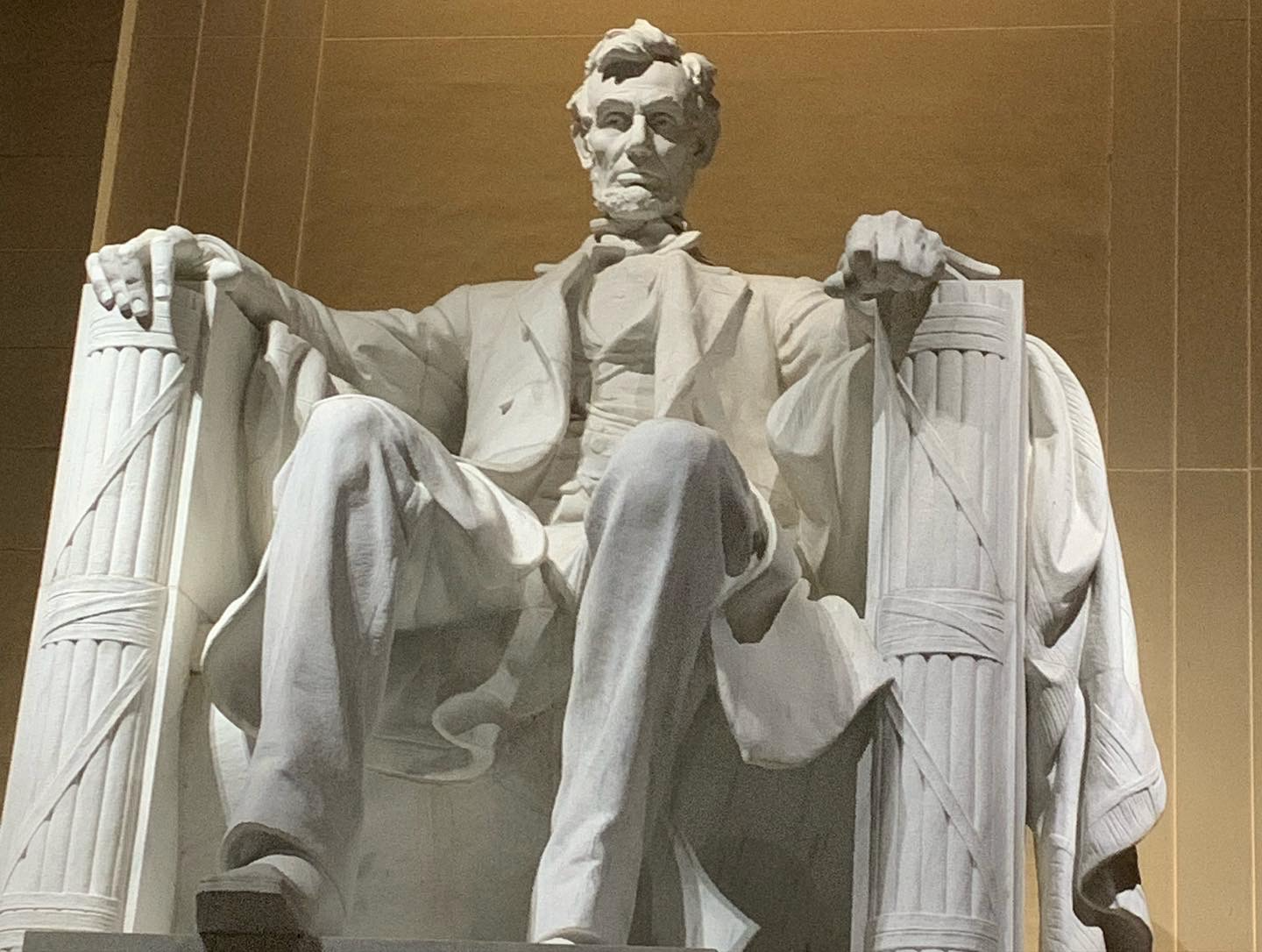
Mr. Lincoln
This week, I want to tell you about a trip I took last weekend to Washington, D.C. Links: The Smithsonian's Futures Exhibit: https://aib.si.edu/futures/ The Planetary Society's Sailing the Light documentary premiere live stream: https://youtu.be/NnKsHlV1NhA

Of all the cities in the east, Washington remains my favorite. It’s place at the emotional heart of our republic, the center of the Union that my lifelong hero President Lincoln fought to preserve, makes me yet another Mr. Smith every time I return to the capital. This week I made such a trip back to some of my favorite museums, some powerful monuments, and some good weather after months of cold and snow in Upstate New York. I decided that I wanted to make my trip a bit of an adventure and chose to drive down from Binghamton rather than fly, an easier option. This led me to an occasionally tense journey down Interstates 81 and 83 through Pennsylvania and Maryland to the BWI Amtrak station where I decided to leave my car for the weekend, figuring it’d be better to not try to drive and park in the District if possible.

Arriving in D.C. on the Acela, currently this country’s fastest passenger train, something the train nerd in me specifically chose to do, I had a similar arrival to Jimmy Stewart’s Mr. Smith at Union Station, its high vaulted ceilings designed by Chicago’s own Daniel Burnham over a century ago. Unlike Smith I didn’t see the capitol dome from the station, instead looking downward trying to find the nearest metro station to get to my hotel.

Seeing the monuments at night is always a special treat. As elegant as they are in the daytime, and some like the Vietnam Memorial are better seen under the Sun, there’s a special artistry in seeing the work of sculptors and architects illuminated with floodlights. That’s how I saw the Washington, Lincoln, and MLK Memorials, lit up solemnly. Mr. Lincoln and Dr. King looked as though they were great titans of antiquity in the glow of their memorials’ lights. 

At this time in our history, Lincoln’s struggle to save the Union and end slavery in this country once and for all seems all the more present. In the week since my last post (episode for those listening) the Russian military has invaded Ukraine. I alluded to those threats last week, but now threats have become a living nightmare for the Ukrainian people and a great storm cloud over the rest of Europe that threatens to engulf all of humanity. How do we embrace the true and righteous words of Mr. Lincoln to do the right thing and feel no evil towards others, even those like President Putin who have so brutally attacked their neighbors? I don’t have an answer to that question yet, nor am I certain that I ever will. But today’s feast, Ash Wednesday for us Catholics, fits well into this narrative as an annual reminder “Remember you are dust, and to dust you shall return.”

I spent a good deal of time on Saturday in several of the Smithsonian museums, returning to the Natural History Museum that I visited in July to double check a label for a sloth for my dissertation, and revisiting an old favorite in the Asian Art Museum. I also visited the American History Museum for the first time in over a decade and enjoyed it quite a bit more. The previous time in 2011 it seemed to be sparse in actual history, yet this time I could notice the nuance in the stories it told in the objects on display in what little space it had available.

The most insightful museum visit though was to the Futures exhibit currently housed in the Arts and Industries Building on the south side of the Mall next to the Smithsonian Castle. This exhibit, which asks visitors to imagine how our future could be a sign of human life improving offered a much needed antidote to the troubles of the world. There were examples of carbon-neutral and renewable building techniques and materials, electric cars, air taxis, and hyperloops. There was a new model of a space suit that was far less bulky than those used by astronauts today and a model of Light Sail 2, a spacecraft sent into orbit by the Planetary Society, a space advocacy organization of which I’m proud to say that I’m a member. There is no one future but many for us to choose from. It’s up to us to determine how we want our future to be written, to be designed, to be imagined.

The National Mall is the emotional heart of this country. It speaks to me of generations of memory, passion, and possibility. On this trip as well though I could imagine myself there in the future, introducing the next generation and later generations to come to that heart, to the ideals and hopes and dreams of this republic. Now at the end of my 20s, my visits to the capital mean something different to me than they did in the last decade. They represent my own future, its infinite possibilities, and how I might be able to do my part, however small it may be, to influence and improve upon our experiences.

The American Civic Religion

One of the best ways for any government or other institution to assert their authority over its followers, whether they be citizens, consumers, or believers, is through a degree of providing those followers with a higher purpose to aim for in their devotions. As Catholics, we strive for Salvation, Union with God, Heaven, or whatever you want to call it. As capitalist consumers, we seek our own wealth and prosperity, and by buying into this economic system, by clicking that yellow purchase button on Amazon, we hope that our accumulation of material goods will bring us one step closer to being that prosperous person. Yet as Americans, citizens of the United States, regardless of partisanship, we are taught from a young age to value the preservation and promotion of some of the core ideals, “life, liberty, and the pursuit of happiness,” as Jefferson put it.

With each of these institutions, there is always a need to establish a degree of devotion among their followers; with each, that devotion is something that was at one time new. In the political case of the American civic religion, we can easily trace the origins of that devotion back to our founding myths surrounding the American Revolution (1775-1783), when, as the story goes, a few brave colonists decided to value their freedom over loyalty to their distant king back in Great Britain. With this determination, they rebelled and declared their independence in July 1776. The Founding Fathers of the young republic that became the United States took on the mantle of apostles or saints, and over time the institutions of the republic became nigh sacrosanct: at the end of the day, the Constitution, the rule of law, and the fact that we live in a democracy became irrefutable testaments to that religion.

Whenever I am in Washington, D.C., and see the Capitol dome for the first time on that particular trip, I’m reminded of the scene from Frank Capra’s 1939 film Mr. Smith Goes to Washington, starring James Stewart in the title role. The naïve young senator, upon first seeing the Capitol dome from inside Washington Union Station is gobsmacked, and struck by the sight of seeing the St. Peter’s of his deep-rooted belief in the inherent goodness of our government by, for, and of the people. I admit, on my most recent trip to D.C. last week, while I was excited to see the Capitol as I crossed Pennsylvania Avenue, I couldn’t help but feel that as profound our civic religion remains, it nevertheless faced its greatest test in generations this January when the Capitol was attacked by supporters of the now former President on the day when Congress met to certify the results of the Presidential election.

It’s curious to me, because as much as people from both sides of the political divide tout their devotion to “freedom,” the meaning of that very abstract word seems to change depending on the moment. In the broadest sense, freedom is one’s ability to decide how to live one’s life; in the narrowest, freedom has been interpreted as justification to deny the same basic decency and liberty to others on the basis of one’s own biases. I could very well turn this weekly blog into a mouthpiece for all the libels I’d ever want to spin, and likely that sort of fear-mongering clickbait would increase my readership, but I like to think of myself as a nice guy, so in this outlet I refrain from those sorts of obscenities.

As with any other form of devotion, the American civic religion has its own enforcement, people who seem to make it their life’s mission to call out or track down heresies against the civic religion no matter the cost to themselves or their target. This is often realized most fully in the scare tactics used by some to keep their followers loyal to their particular version of the civic religion. Fear keeps people energized, fear of loss, fear of the other. While I will always stand and applaud at the ballpark when the obligatory salute to veterans occurs, I find it chilling that if I didn’t stand, if I didn’t salute the military, it could be damaging to me. The extreme literalness of some religious sects in this country has been carried over into the civic religion, all to the extent that it has been monetized and turned for profit in our devotion to the markets and the accumulation of wealth.

Heretic hunters often have their own faults, that’s where the sacrament of confession comes into play. As a Catholic, I believe that my sins are forgiven in the confessional, so long as I am truly repentant, truly sorry for where I’ve gone wrong. Of course it could be argued that I could then say I could do anything I wanted, so long as I went to confession afterward, but there the actions wouldn’t convert to real results, as I wouldn’t actually believe in the power of the sacrament. So too with our civic religion, as forcibly the heretic hunters may decry their opponents, their enemies as they might well call them, they themselves will always have faults of their own, sins of their own. If we are going to preserve this country, its civic religion, its belief in democracy and in a future where representative government is a strong and viable option, we need to recognize that everyone has problems, and that everyone deserves second chances.

So, as I walked across Pennsylvania Avenue last Thursday, my mind turned to the supporters of the former President who violated the most sacred temple of our civic religion on January 6. Many of the same individuals and organizations that pose as heretic hunters in this civic religion of ours were the same ones that promoted the Big Lie which drove that mob to break into the Capitol, and the rioters themselves, in that most extreme act of heresy against the civic religion, cast themselves as restoring the faith, restoring the power of the people over our government. They too deserve second chances, the opportunity to repent and return to the fold, but not without some penance for the crimes they committed.

If anything, the entire civic religion, built on myth as much as on the ideals of the Revolution, deserves a second chance. It seems increasingly clear to me that the civic religion, the United States as a political community united around our common Constitution, needs refreshing, both to address the shortcomings and wrongs of the past and present, and to reaffirm the foundational covenants of this country’s relationship with its people in a way more in line with the circumstances facing us today in 2021.

Donald Trump and the slow death of American Federalism

US flag

Today the world was flabbergasted and disgusted with our President once again. This time it was not due to his bullish techniques for getting in the front of a group picture, nor his obscene rudeness towards our closest European allies, nor even his disregard for the basic fundamental principles that all humans deserve equal treatment and rights. Far from that, today Donald Trump decided, for whatever reason, to do away with the safety mechanism that would at least temper the oncoming tide of climate change and preserve the planet that we’ve called home for millions of years. But that does not seem to matter to Donald Trump, the human epitome of ego.

He does not seem to care that withdrawing from the Paris Climate Deal will have disastrous effects for all humanity for generations to come. All he cares about is that “America receive a fair deal.” He is a businessman who has never had to deal with the realities of the world; he is a man who has never been fit to serve as President, and frankly is even less fit to do so today.

Climate change is a very real and present danger to humanity, to all of us living on Earth. We have developed our civilisations, our industries, our technologies in a manner that until recently has had a careless attitude. We have raped the Earth of its natural riches, leaving its soils forever changed, its seas void of so much vibrancy and life, and its air thick and soupy with the fumes of our industrial might.

Eventually, in the long run, humanity will inevitably outgrow this our nest, but until that day comes in the future we are stuck here. For the time that we have left on Earth we must do our best to maintain it, to keep it fresh and clean. Anyone who has maintained their own house without the help of servants will know what it means to keep the house in order. Judging from his biography, and his attitude towards the rest of humanity, I doubt Donald Trump has ever been in our shoes.

I have found myself on a daily basis pronouncing my embarrassment at the President’s actions to friends both overseas and here within our borders. My shame at seeing that most self-serving of men occupying the People’s House is far beyond anything I have ever experienced.

Setting aside the climate for one moment, though to be honest that is nigh impossible to do, as everything else is reliant on the climate’s continued health and survival, there is one other more directly American issue at hand here. For the past four months, Donald Trump has done pretty much what he promised to do, to bring stark change to Washington; but the changes that have come about in his time in office have been hardly positive. For one thing the long standing norms of the American body politick are finding themselves being forcibly changed, in many respects against their will. States like California, New York, Massachusetts, and Illinois, long considered key supporters of federalism, in comparison with the likes of Texas, Arizona, Kansas, and most of the South, are now finding their long held faith in Washington to be suddenly, and dramatically unfounded.

What Donald Trump has done is nothing short of contribute to the process of nailing together the coffin of federalism in the United States. Our country has always been an odd fit, some parts more willing than others to play along with the idea of federalism. Trump, a New Yorker, has played into the hands of the anti-federalist extremists on both the left and right, particularly the Tea Party Republicans in Congress and in the respective State Capitols around the country. When the State governments choose to ignore the needs of all their constituents, instead focusing on the demands of a few, we the citizens look to the Federal Government to back us up and defend our rights. Yet now both a majority of State Governments and the Federal Government are controlled by the same faction within the Republican Party that has cried foul at the regulations set up by big government to ensure the continued prosperity of a majority of Americans.

Their self-serving agenda has seen that this country elect one of the least qualified Presidents in its history, and that this country’s legislative electoral process be so mangled that they the small-government “we serve ourselves” far-right Republicans will be mathematically guaranteed to win for many elections to come. Now the rest of us who are not being served by this narrow-mindedness amongst those in power are left to look to the lowest levels of our government, to our cities, for protection and aid. Cities like New York, Chicago, D.C., Boston, San Francisco, Los Angeles, Seattle, Portland, and Kansas City are our last refuge in this our darkest hour. For the time being, while the current faction of Republicans remains in charge of the rest of our government, we must rely on our big-city mayors and our city councils to do what they can to ensure our cities remain safe for American democracy and multiculturalism.

As a European American male, I am a part of the least threatened demographic in the country, yet as an American I am a part of the most threatened demographic of all; for when one American’s inalienable rights are threatened, then the rights of all the rest of us are threatened as well. The day when we return to saying otherwise is the day when we, the United States of America, the nation of immigrants, of opportunity, of possibility, will be the day when we lose our national spirit.

The Problem with our Politics

Embed from Getty Images

Political parties and politics do serve a purpose in the betterment and stability of society, no matter how unstable they may seem. A political party is a tool by which people of a common perspective can organise and promote their principles and philosophy with one voice. These parties in turn have the ability to take that philosophy to the pinnacle of government and power and propose it as policy, should said party be elected into office. Yet when party comes before public the political process shows signs of putridity and decay.

Today there are a variety of party systems in use around the globe; often they are organised based upon the number of parties they allow for. Here in the United States, the political process operates on a two-party system, yet throughout Europe most polities operate on a multi-party system. Likewise, in some states one will find a dominant party system, which is essentially a one-party state yet with the trappings of a two-party or multi-party state. Each system does justice to its respective society, as only that party system which adheres to the framework of its respective society can properly do justice to its public. Yet in some cases the frameworks set up in some cases generations ago to keep the wheels of government well oiled and turning have proven themselves to be susceptible to rust and degradation.

If anything is going to halt the Republican Party’s march towards dominance in all branches of the Federal Government, it will be this principle that politics unbounded from the public need will always be overwhelmed by the public will. If the Republicans want to maintain their overwhelming majority in the House of Representatives in the 2018 General Election, they need to cast astray the bull that they let into the china shop at 1600 Pennsylvania Avenue N.W. They must disassociate themselves from Trumpism and all its baggage. If the Republicans want to stay in power they should move swiftly with the transference of power from the current President towards the next guilt-free individual on the Order of Succession.

And yet, in a somewhat comical way, the House Republicans will most likely stand by their man to the bitter end. Like a pompous captain remaining aboard his sinking ship they will be submerged into the muck and mire that spreads from the current President like a virus. It certainly seems to me that that infection is too wide spread in the halls of power in Washington for any executive change to be made prior to November 2018. Perhaps then it is up to the Democrats to take the advantage and not only expel one of the greatest embarrassments to ever befall this country from that house across from Lafayette Square, but to also regain a more sizeable position in the House from which their own philosophy can shine.

The politics of the present are all too embittered by a bad case of food poisoning. Those in power more often than not seem poisoned by the power they wield, and the personal prosperity it proposes to offer. They have proven themselves to be far too unworthy of the position of public servant through their venomous guile, their lack of transparency, and their blatant disregard for the public will. If we are not careful, this poison could sink not only the current political parties, but the entire ship of state as well. The act of preserving the body politick is a duty not just of those in positions of power, but of all citizens, all persons with a vested interest in the continued goodwill and wellbeing of the body politick. It is just as much our responsibility to reform our political processes, as it is the responsibility of those in power.

If this reform is to be successful, it must be done without violence, but through discussion, debate, and dialogue. This reform must be on all levels and must include all individuals with a desire to take part. We must craft our political society in the image of the public that it serves; otherwise that political society will only grow to serve itself. Should that happen, we will be right back were we are now, and I doubt that would be anyone’s preferred outcome.

19 June 2014 – Triumph over Indiana

On a plane this past March

as I flew from DC to KC

I found myself fast asleep

for much of the first part of the trip.

As I slept my dreams turn’d away

from the thoughts of that past day

and into a vision of some great orchestra

a chorus behind, playing that fam’d

1812 Overture of Tchaikovsky’s making.

It roared in my head, filling the mind

as ever it could with sound

abounding throughout the inner ear.

Yet the noise woke me,

forc’d me to recognise my place.

And as I open’d my eyes,

the music came to a grand finale

as the orchestra had stopped

the men of the chorus continued

singing triumphantly their final refrain

the melody from God Save the Tsar

resounded in my ears from within

triumphantly welcoming me

to the skies over Indiana.

Never before has a dream

been so grandiose as to remain

in my memory for months thereafter

as that chorus on that cold March day.