Tag Archives: Wednesday Blog

Patience

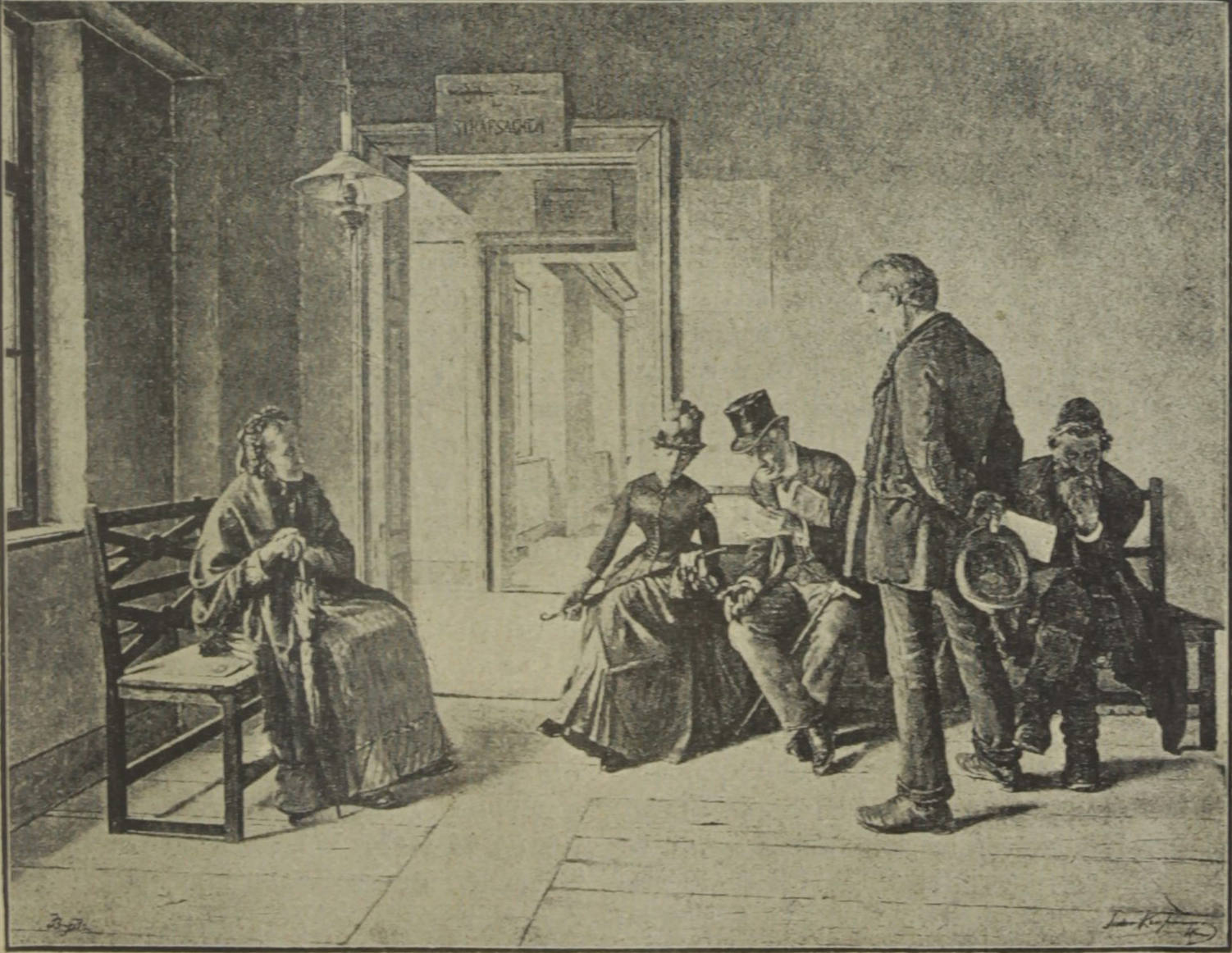
Isidor Kaufmann (1853–1921), “Waiting room at the Court”, 1888
This week, how I've learned that patience really is a virtue.

I’ll freely admit that I’m a pretty impatient guy. I feel the most rewarded when I’m able to solve problems quickly and efficiently, and throughout my life I’ve never really enjoyed dealing with things that are long term questions. As I’ve gotten older though my impatience has mellowed out, I’m more willing now to let myself take a day to relax and think rather than trying to force myself to write a page a day or read a book in an afternoon.

In the last few years, with this global pandemic, it’s really begun to occur to me that there is far more outside of my control than within it, a lot more that I simply can’t do anything about. Sure, I’m not naïve enough to think I could single-handedly stop the looming war clouds hovering over Ukraine or solve the climate crisis. Those are big problems that are going to be solved by a whole host of people likely over generations of hard work. And even in my own work as a historian, and especially as a teacher, I’ve come to learn that as much as I’d like my students to follow directions to the letter, the best I can do is make sure those directions are clear and concise and then let them go down the road I’ve laid. They’re adults after all, it’s up to them how they want to perform in my classroom.

At this moment in my work, I’m writing my doctoral dissertation. The working title is “Trees, Sloths, and Birds: Brazil in Sixteenth-Century Natural History”. It’s a bit of an odd ball of a topic, a combination of many different topics, ideas, and fields that I’ve been interested in from childhood. As of today, I have one out of six of my chapters written, and I’m glad to be in the position I am. But looking ahead at the second chapter, the next one I’m going to start writing in the next week, I’ve got to admit it’s daunting to imagine how I’m going to make it work. And that’s the key to this project and every project any of us will ever attempt; we have to be able to imagine doing it before we actually do it. So, now in my doctoral studies, I’ve learned the benefit of professional patience.

Today is one of those days when I intended to get more done than I actually have. I did make a very loose outline of the chapter I’m about to start writing, with some questions about which order the sections should go in, and I’ve made some headway in coordinating the primary and secondary sources I’m using in my thinking about this chapter. Unlike Mozart in Peter Shaffer’s play Amadeus, I don’t have a fully written draft of this chapter already done in my mind, just waiting to process through my hands and the keyboard into the word processor on my computer. Instead, I’ve got a loose collection of ideas, and an understanding that in a little while, whether it be hours, days, or weeks, I’ll start crafting those into sentences and paragraphs.

That’s my writing process today. It’s less about the mad dash to the finish, and more a leisurely stroll through different interrelated ideas that I’ve got until they’ve come together in a convincing argument that I’m willing to send around to those interested parties. Patience is a virtue, and while I’m thinking through what this chapter will look like, I’m happy to sit and wait for a good result, knowing that eventually it too will pass.

Examen

Photo by Tony Wills CC BY-SA 3.0
This week, a bit of Jesuit word play. Photo by Tony Wills CC BY-SA 3.0

I’m proud to say that I’m Jesuit educated, I earned my Bachelor’s in History and Theology with minors in French and Philosophy from Rockhurst University in Kansas City. My time at Rockhurst was one of the most formative periods in my life, a time when I feel like I really did grow into the adult I’ve become from the teenager that I was when I arrived for move in day my Freshman Year. One of the great things that the Jesuits promote is self-awareness, understanding how we exist amid the Cosmos, how we are who we are. A daily exercise of this sort of self-awareness is the Examen, a meditation devised by St. Ignatius of Loyola, the founder of the Jesuits, almost 500 years ago now.

I’ve tried doing the Examen at different points in my life, pausing during the day, most often before bed, to reflect back on the day I just lived, the highs and the lows, and offering my gratitude for all of those experiences. Naturally though there are distractions all around, whether my phone announcing new messages or the sound of a dog barking outside, or even my own thoughts about what it is I’m actually trying to do. The word examen stuck out to me yesterday, I know it as the French word for an exam, and I had a sneaking suspicion that it was originally a Latin word, after all it has that classic Latin prefix ex- included.

When I turned to my favorite Latin dictionaries, I found sure enough that the word exāmen is of Latin origin, coming from a combination of the prefix ex- and the verb agō meaning “I drive”, with the -men suffix added to render exagō a noun. Thus, exagmen becomes exāmen. Still, the meaning of this word, or rather its particular uses strike me as amusing. It is not only an examining of conscience in the Jesuit sense, but also a means of balancing something. Yet there’s a third meaning that came up, exāmen has been used to refer to exāmen apium, a swarm of bees.

At first, I’m not entirely fond of the idea of an examination of conscience having anything in common with a swarm of bees; perhaps there’s some lingering misgivings from my own childhood experiences being stung by bees (both occasions were my fault). Still, the idea that the Latin name for a group of bees, like how we might say a flock of birds or a herd of bison, would be an exāmen is curious to me. It seems as though the idea is that when we do examine our consciences, or when we consider something as fully as possible, we ought to be able to get into every little crevice of that question like a swarm of bees can.

This phrase exāmen apium is used by a number of ancient Roman authors, yet in every moment while that phrase literally means a swarm of bees it often seems to herald bad omens, whether it be a swarm of bees appearing on a standard or on the statues of an emperor or in the middle of a market. So, how can we interpret this to be more than just an odd Roman connection between bees and Jesuit meditations? Think of what might be the best thing to do after getting such an omen; rather than stand idly by and let “fate” take its course, why not instead stop, and think about what you have done to receive such a warning, and what you can do to change how things are going? One of the great disservices that our civilization’s heritage has given to us is a belief in fate, that things are decided and there’s nothing we can do to fix them. Nothing could be further from the truth! It’s up to us to examine our lives and figure out where we’ve gone wrong, and then to do the hard thing and fix our problems.

That is what at the end of the day the Examen means to me. It’s an opportunity to become a better version of myself, a reassessment that, when I don’t forget about it, happens every day.

Christmas and the Passing of the Seasons

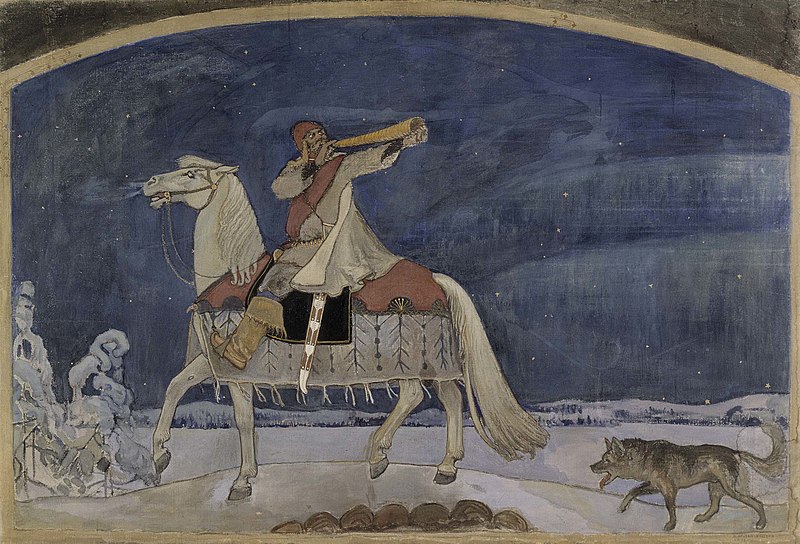
Akseli Gallen-Kallela, Kullervo Sets Off for War, 1901, tempera, 89 x 128 cm, Ateneum, Helsinki, Finland.

Christmas and the Passing of the Seasons Wednesday Blog by Seán Thomas Kane

This week I'm discussing what Christmas has meant to me throughout my life, and how it fits into the mythos of the seasons overall.

I think the general feelings I get at different times of the year were instilled very early on. I remember in first grade being told that if the weather in March came in “like a lion” it would surely go out “like a lamb,” meaning if the month started with bad weather, snow, ice, or even thunderstorms in a warmer year, then we’d end up with a quiet end to that month. Likewise, I can’t remember quite when I first heard it, that the Winter Sun always shines with the wolf’s teeth. This to say that as bright and warm as the Sun’s rays appear in Winter, you’ll still feel the biting cold of Winter if you go outside in that time of the year.

To me, Christmas has always been a bright light on a wine-dark sea, a moment of celebration, of seeing family and friends, of hearing the triumphant hymns at Midnight Mass and reaffirming how much we all really do care for each other. Christmas has its traditions, both sacred and secular: not only is Midnight Mass, now often celebrated at 21:00 or 22:00 on Christmas Eve a part of the schedule, but so too traditionally are the big family parties, unwrapping gifts on Christmas morning next to our tree, and watching any number of Christmas specials, especially Charlie Brown, and occasionally Die Hard too. The week before Christmas always includes my birthday, the 20th, which has its own traditions and things I look forward to every year.

Yet as I get older, now in the last year of my twenties, I can understand what C.S. Lewis meant in The Last Battle when he said that the eldest Pevensie sibling, Susan, didn’t return to Narnia because she had grown up and didn’t believe in it anymore. I still believe in the fact that there’s something special at Christmas, even if I’m more the skeptic about any sort of “Sanity Claus”, as Chico Marx put it, but it doesn’t have the same impact on me as it did when I was a wide-eyed child. Last Christmas … (I’ll give you a minute to sing that Wham! song) … Last Christmas, our first during the COVID pandemic, my parents and I decided to take a firmly defiant stance: we were going to go all out with the decorating and try to force the point that it was Christmas as much as possible, lest we remember we wouldn’t be going to any services or hosting any big family parties. It ended up being a melancholy affair, sure there were wonderful moments, but by and large I found myself longing for Christmases of yore when we’d be so exhausted come bedtime on Christmas night that we’d drift off into wonderful dreams, perhaps “visions of sugar-plums” dancing in our heads.

This year though, now in our second year of the pandemic if anything the three of us are exhausted by it all. The constant fear of infection, the usual work-induced weariness, and life in general. 2021 has been a hard year. We’ve struggled through it, through every season as the calendar rolls along, but I think it’s fair to say 2021, like 2020, is a year we’ll be happy to leave. This Christmas feels like Christmas, just as my birthday this week felt like my birthday usually does, but with a shrug instead of a smile. Winter even seems harder to tolerate this year. 

I was in high school when I first saw a Finnish painting that to me spoke of the nature of Winter. It shows a horseman mounted, wearing a slightly medieval garb, turning around to look up into the stars that carpet the purple night sky, illuminated as much by the snow below as the lights in the heavens above. In his hand he holds a hunting horn, which he blows to announce his ride onward as his trusty hound follows behind. The image there, of the rider in the snow beneath the stars in the purplish Winter’s night sky always seemed to speak to me of Winter, meagre and cold, yet suggestive of some magic that might exist in those long dark nights. 

It was only later, when I visited Finland for the first time in May 2016 that I learned that this painting, first created in 1901, is one by Akseli Gallen-Kallela (1865-1931), called Kullervo Sets Off for War. It depicts Kullervo, a tragic character from the Kalevala, the Finnish national epic compiled by Elias Lönnrot in the 19th century. The story behind the painting, while different from how I imagined it, reminds me nevertheless of the mystery of Winter, the unknown quality that those long dark nights hold, and the stories I’ve heard and come up with myself to give character, voice, and song to what might otherwise be a quiet, dark, and lonely time for us all.

For those of you who celebrate it, I wish you a most Merry Christmas, and for all the rest of you, Happy Holidays.

Twelve Hours of Mask Wearing

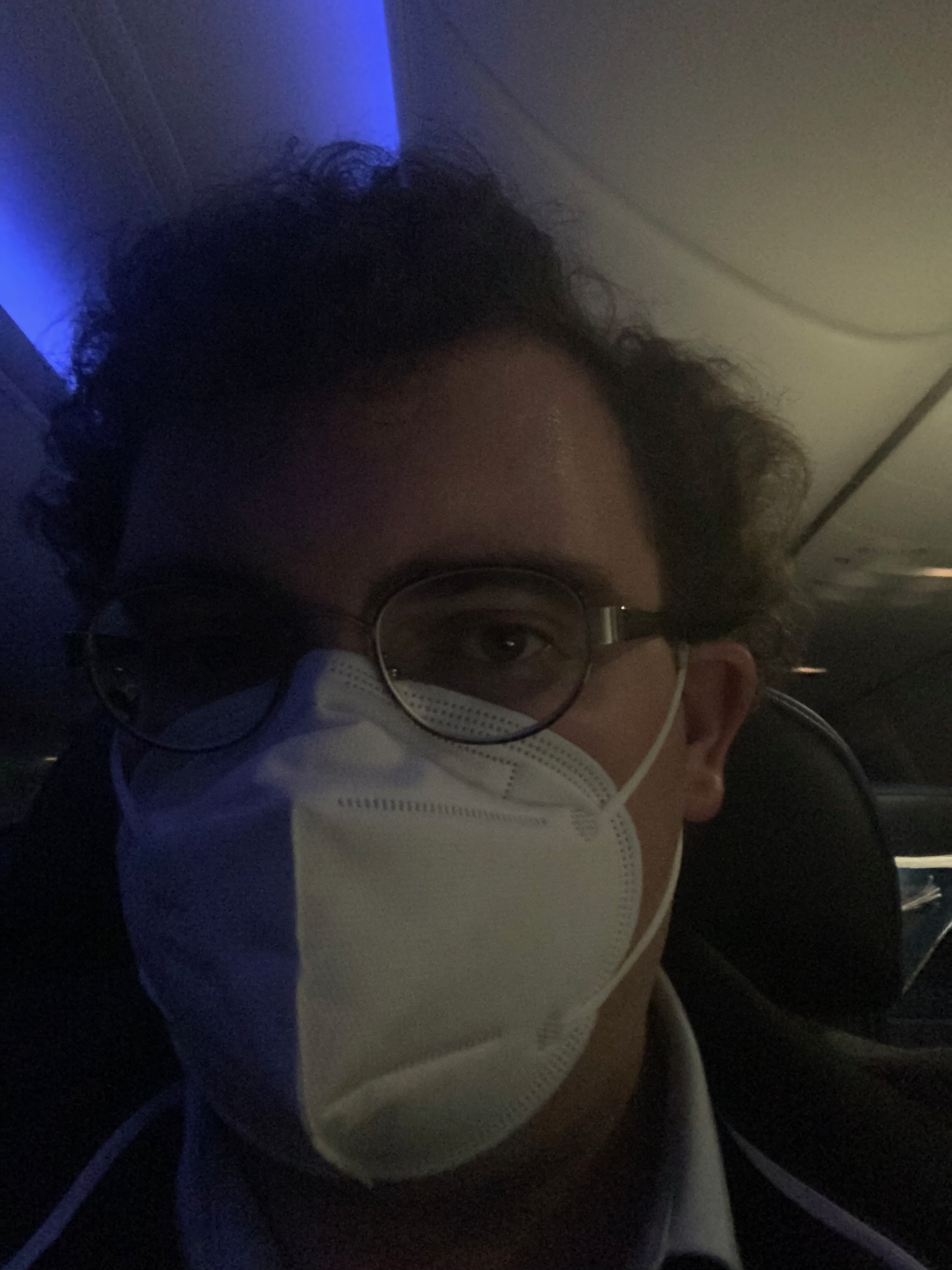
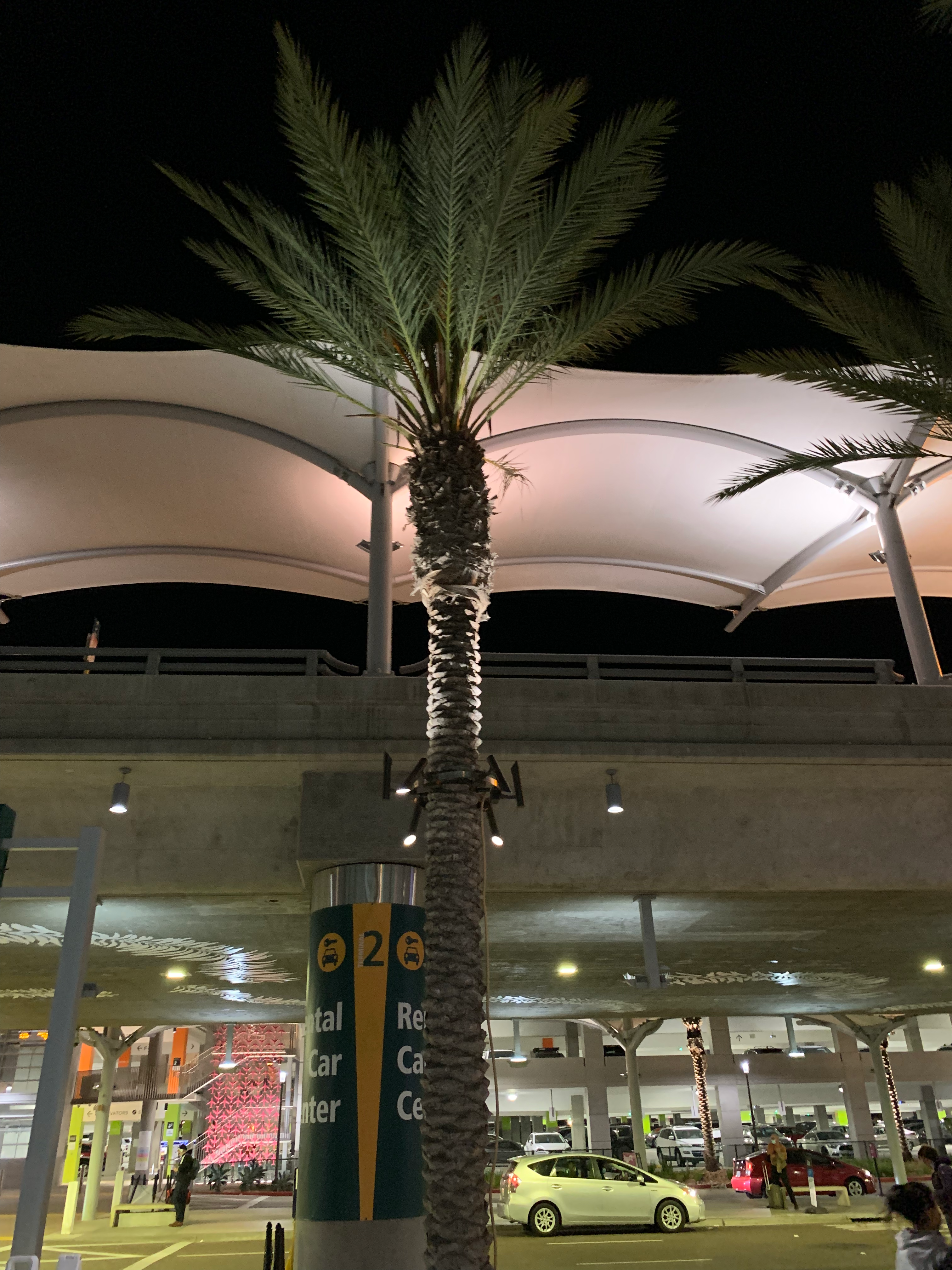
This evening I had the opportunity to travel from my usual place of business in Binghamton, NY to the sunny port city of San Diego on the far side of the country and this continent. It was my first time flying on a full transcontinental route; coming from the Midwest I’ve benefitted from living almost halfway between Atlantic and Pacific until now. The experience was largely uneventful, though I’m humbled by the fact that this continent across most of which I’ve now driven (as far to the east as Boston, as far to the west as the Great Salt Lake) could be crossed in the same amount of time it would normally take me to drive west from Kansas City to that place in western Kansas where I’ve found myself within sight of the tallest clouds rising off the Rockies just west of Denver. I spent the flight reading a compelling story, checking my preferred flight tracking app, and listening to Planetary Radio. 

But the greatest physical reminder of this flight and this entire day will be the pain in my ears and the sides of my head from wearing this KN95 face mask for so long. I dearly hope we climb out of this hole of a pandemic we’ve dug ourselves into, and that my fleeting escapes from mask wearing as I took a drink of water would be signs of a future when we won’t have to wear these masks to travel. And yet, I worry that our relatives and neighbors who cry wolf about these masks so forcefully that events meant to be dull, like school board meetings, become events rife with danger, that these our fellow Americans are the ones whose actions will only keep these mask mandates in place longer. After all, we’d be further out of this continuing crisis if we were as a country more fully vaccinated. Being triple-vaccinated against COVID-19 myself, I know I’m probably safe, but the best way to ensure that is the case both for myself and for all the people around me on this plane from the oldest passenger to the youngest infant are safe as well.

I worry that in the fear-mongering of the last decades we’ve lost a sense of communal spirit. We’ve become suspicious of our neighbors who once we could trust. Any statement deserves to be questioned, so I ask you now: what went wrong? When did we choose to fear others before learning to appreciate them? And why don’t we lower our pride for even a minute and let ourselves lower our guard?

We have a lot of problems facing us today. Step one clearly will mean that we’ll have to at least start by looking each other in the eye and at the very least saying hello. It’s a start.

I don’t think I’m in New York anymore.

Shucks!

If there was a word that could fully express a sense of regular melancholy at yet another well laid plan turning out poorly, it is my favorite expression of this sort of sighing shrug of the shoulders: shucks! It’s a word that seems well suited to resignation and repeated failure, one that speaks to the lovable loser in all of us.

I often use “shucks” to mean many of these things. It’s a way of expressing a sense of humility in the face of great odds. It is the sort of Charlie Brown inside of me, the guy who’s just living his life despite all the failures and problems that come his way. Shucks then is a word that seems friendly and warm, a relief when I’d want to cry out in frustration.

All that said, while researching this favorite of exclamations, I learned its etymology comes from a portmanteau of two of English’s more ordinary and yet colorful words. It’s a combination of two of this language’s oldest terms, the noun shit and the verb fuck. It turns out then, that my favorite melancholic exclamation originally had both a fecal and a sexual connotation. Shucks!

An Equal and Opposite Reaction

21733868_10214068171760956_1726168460_oOne of the fundamental maxims of physics is that “For every action there is an equal and opposite reaction.” For everything that is said or done something of equal vigour must be in order. By this logic then, for every fascist, far-right, or white supremacist threat to American society and we the American people there must also be an equal reaction by the far-left, by the Anti-Fascists as they have deemed themselves. Yet what good does the threat of violent action do? What is the point of bringing one’s guns to an anti-fascist protest? What is the point of eradicating the memory of all who have had some dirt upon their hands, who committed evils in their lives?

This moment, at the closing years of the second decade of the twenty-first century, is a moment of immense change, of tribulation not unfamiliar to our predecessors from a century prior. We are living through the waning hours of a period of unprecedented social change and extraordinary wealth for many in our society. We have witnessed a plethora of forces at work in their efforts to bend our society to their aims. Some have sought to bend the law in order to further their own wealth and prosperity to the detriment of others. Still more have fought against those egotists in the defence of the common good and the wellbeing of all.

Now, as we look ahead towards the last months of 2017 and the new year 2018 we are beginning to recognise as a society how uncertain our future is. We are realising that our children will probably not be better off than ourselves, that our generation as well will probably fall in economic standing in a way unseen in the past century. It is natural to react to this with fear, to curse the political, economic, and social systems that led us to this moment. But in our present culture we celebrate fear, overreaction, and anger far too much. We have accepted extreme behaviour on television as normal, and in so doing have accepted that same extremism into our own lives.

We have reached a moment in our history when both the right and left are afraid; afraid of losing what they have; afraid of each other. We have reached a moment when the politics of fear have duped millions into electing a man entirely unfit for the duties to which he is oath-bound to serve. We have reached a moment when lies are far louder than truths and accepted as real by sections of society.

We have reached a point where at long last the old Confederate sympathies are being brought into the light of day as racist echoes of a failed rebellion from 150 years ago. Yet the zeal of the most outspoken on the far-left has created its equal reaction to the zeal of the far-right. Both now have sizeable factions at their rallies who are armed, ready to fight.

Extremism in any form is unnatural and unhealthy. Yet in the current moment in American history it is the extremes of our society that are the most vocal. I cannot deny that our political system is flawed, it absolutely is. I cannot also deny that American capitalism favours the rich, that is how the playbook has been written. I would be an idiot to ignore that our society is rigged against anyone who is not male and of European descent, there is a racial hierarchy in this country that has existed since the colonial era. But I would be blind to also deny that we can change things for the better. We can fix our corrupted political system, we can rewrite the codes that govern our capitalism, we can stand up everyday for the rights of all in this country and day by day continue to chip away at those old biases. But we cannot do these things while we are taken hostage by the far-right and far-left of our society. We cannot fully achieve the great work of our society while our society is a hostage to the militant few willing to kill their fellow Americans in defence of their extreme convictions.

We must continue to march, to protest, to organise, and to vote. We must carry on the good work that our predecessors undertook in generations past. We can make this country a better place for our children and grandchildren and great-grandchildren to live in. But we must walk the middle road of moderation to do so.

We must understand the full consequences of our actions, we must learn from our history so that we do not make the same mistakes again. There are many who are opposed to the removal of the Confederate monuments because that is “erasing our history.” I disagree. By removing those monuments to a rebellious movement in our history, we are forcing the book closed on that chapter that has yet to settle. After all, we still see the way in which Americans continue to threaten one another with violence at the slightest hint of progressive reform. To make our society better for the next generations we must rid ourselves of this disease of extremism. We must show those who want violence that through peaceful debate we can achieve far greater things.

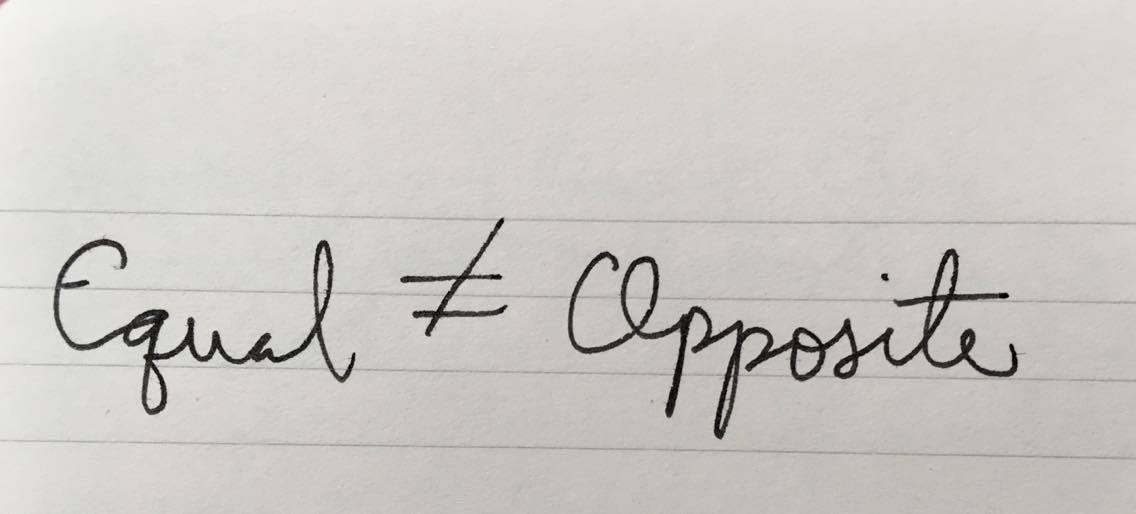
“For every action there is an equal and opposite reaction.” When the far-left responds to the far-right’s threats of violence with equal threats the far-left only continues that same cycle of violence. Consider that maxim again: “For every action there is an equal and opposite reaction.” Threats of violence may well be equal on both sides, but the threat of violence on the left is not opposite to the threat of violence to the right. It is not the positive to the right’s negative. Only peaceful protest, nonviolent refusal to play by their rules of violence can achieve that. Through peace and nonviolence we find our equal and opposite reaction. Let’s try it for once. You never know, it might just work.

Quantity over Quality

Screen Shot 2017-08-13 at 21.21.11

When we hear many politicians try to add weight to their arguments, they often will add references to their own lives, “I served in the Army for 20 years,” or “Having been a lawyer for 35 years.” In this way, they seek to promote their argument through the weight of what they possess. One of the most common that was used by Congressional Republicans in order to prove they are not misogynists like Trump was to bring their “wives and daughters” into their argument. This is a technique that I like to call rhetorical quantifying, a way of attempting to prop up a fairly weak, or entirely unoriginal argument by showing how one’s relates to the topic, whether it be through family, friends, acquaintances, or personal possessions.

 I’ll be completely honest; this tactic really annoys me. A valid argument will always be able to stand on its own without the help of some extra quantitative fluff. It doesn’t matter that Speaker of the House Paul Ryan is married to a woman, nor that he has a daughter, what matters is that his argument is valid. Yet what makes this tactic go by with so little press is that the general public has largely accepted it. People in all situations will attempt to bolster their position in a discussion, argument, or even a fight by trying to show how much better they are than someone else.

 On Saturday, at the height of the chaos unleashed by White Supremacists on Charlottesville, Virginia, a 20 year old from Ohio named James Fields drove his car into a crowd of counter-protestors killing one and injuring nineteen others. Upon hearing the news from reporters, his mother in the spur of the moment used this same technique pointing out that her son “had an African American friend.” While she was certainly in the early stages of processing all that her son had done, and the fact that he will quite possibly spend the rest of his life in prison, the way in which she attempted to counter his white supremacist actions by bringing his African American friend into the conversation shows the weakness of this argument. It does not matter that he was friends with someone who is not of European descent, what matters are his intentions and actions.

 Rhetorical quantifying rests heavily upon two particular issues, firstly the use of non-consequential evidence within an argument, that is mentioning one’s connection to a certain group of people or things in an attempt to bolster one’s argument and secondly the inherent possessiveness of quantifying. In regards to the argument itself, both issues are inevitably overshadowed by the fundamental reality that quantifying distracts from the main argument. A listener who should be paying close attention to a politician’s weak denial of misogyny is instead distracted by the sudden appearance of all of the female members of that politicians’ nuclear family.

 Rhetorical quantifying is just one of many tools a speaker can use to distract an audience away from a main point that might be rather unseemly. Though not as irritating as pivoting, an art form exhibited beautifully by Senator Al Franken on The Late Show on 1 August, rhetorical quantifying is a tried and true way to avoid answering the question and attempt to cover one’s tracks. Undoubtedly there will be those in Congress and in many state houses across the country that will use rhetorical quantifying to distance themselves from any of the white nationalist groups that partook in the rally this weekend in Charlottesville. Yet while they may gather together all of their connections to both religious and ethnic minority communities, these individuals will still be wolves in sheepskins.

 Rhetorical quantifying is a deceptive tool used to distract. Yet it is a deception that has become so commonplace we hardly notice it. We should consider our arguments carefully and consider whether what we say contributes or distracts from what we are arguing. In my book, rhetorical quantifying is a quasi-boastful tactic to be avoided at all costs.

We Stand Together

18946991_10213047198957274_893548281_o.jpgAt this point in time, after so many terror attacks around the world in recent years, my initial reaction to the attack in London last night was somewhat muted and reserved. I was not surprised that it had happened; yet I was nevertheless deeply distressed that innocent people would be so brutally assaulted. The three attackers, their identities as of yet unannounced by the Metropolitan Police, will spend eternity lapping in the seas of ignominy, far from the verdant peaceful halls of rest that they may wished to have known.
They died attacking innocents; their last actions in this life were in the spirit of chaos. With all that said, they were still human, and as a Christian I believe they, like the rest of us, were made in the image and likeness of God. So, as time passes and I think on their final acts, I will be helpless but to consider them as humans, like the rest of us, and so mourn their poor decisions and pray for their souls, that eventually they, and their victims, might find peace.

We are all human; we all start our lives with that one equalising factor. If terrorists, warlords, and fearmongers seek to divide us, we must constantly remember what unites us. For the sake of our future we must stand together. In the wake of the latest attack we have a choice: to retaliate with ever increasing violence and terror, or to stand taller and remain above their cowardly and weak tactics. When they offer war we must offer peace. When they taunt us towards destroying all they know and love, we must not validate their evil by doing so.

Our societies and governments are founded upon the basic principles of constitutionalism. They are built on the principle that no one should be above the law. Justice is the rudder of our ship of state. Every time we treat anyone as less than their rightful station, every time we jump to conclusions about a person without facts or evidence, every time we respond to terror with terror, baying for blood, we undermine that omnipresent principle of justice for all. After all, once we begin to look out from beneath our blinders and consider the people around us, we will surely see another human being with feelings and hopes, with dreams and desires not unlike our own.

I did not know the men who attacked the crowds on London Bridge or in Borough Market. As of the time of publication the police have not released their names. Nor did I know the seven people whom they killed. I do not know what they were like, what they dreamed about at night, who they loved, or what their favourite things were. What I do know however is that they were all humans like me.

In my culture the golden rule is to treat others as you would want to be treated, and while these attackers certainly did not do that, how can I stand by that rule without seeing them as humans. Sure they were flawed, after all what they did is reprehensible to the highest degree, but all the same they were human. I hope that all involved, perpetrators and victims alike can find peace in this life or in the next. At the end of the day if we want the terror to cease, we must stand together as one common humanity. We must be the change, the light that will douse the darkness. The day we cease to preach and live love is the day we give in to terror and chaos.

Donald Trump and the slow death of American Federalism

US flag

Today the world was flabbergasted and disgusted with our President once again. This time it was not due to his bullish techniques for getting in the front of a group picture, nor his obscene rudeness towards our closest European allies, nor even his disregard for the basic fundamental principles that all humans deserve equal treatment and rights. Far from that, today Donald Trump decided, for whatever reason, to do away with the safety mechanism that would at least temper the oncoming tide of climate change and preserve the planet that we’ve called home for millions of years. But that does not seem to matter to Donald Trump, the human epitome of ego.

He does not seem to care that withdrawing from the Paris Climate Deal will have disastrous effects for all humanity for generations to come. All he cares about is that “America receive a fair deal.” He is a businessman who has never had to deal with the realities of the world; he is a man who has never been fit to serve as President, and frankly is even less fit to do so today.

Climate change is a very real and present danger to humanity, to all of us living on Earth. We have developed our civilisations, our industries, our technologies in a manner that until recently has had a careless attitude. We have raped the Earth of its natural riches, leaving its soils forever changed, its seas void of so much vibrancy and life, and its air thick and soupy with the fumes of our industrial might.

Eventually, in the long run, humanity will inevitably outgrow this our nest, but until that day comes in the future we are stuck here. For the time that we have left on Earth we must do our best to maintain it, to keep it fresh and clean. Anyone who has maintained their own house without the help of servants will know what it means to keep the house in order. Judging from his biography, and his attitude towards the rest of humanity, I doubt Donald Trump has ever been in our shoes.

I have found myself on a daily basis pronouncing my embarrassment at the President’s actions to friends both overseas and here within our borders. My shame at seeing that most self-serving of men occupying the People’s House is far beyond anything I have ever experienced.

Setting aside the climate for one moment, though to be honest that is nigh impossible to do, as everything else is reliant on the climate’s continued health and survival, there is one other more directly American issue at hand here. For the past four months, Donald Trump has done pretty much what he promised to do, to bring stark change to Washington; but the changes that have come about in his time in office have been hardly positive. For one thing the long standing norms of the American body politick are finding themselves being forcibly changed, in many respects against their will. States like California, New York, Massachusetts, and Illinois, long considered key supporters of federalism, in comparison with the likes of Texas, Arizona, Kansas, and most of the South, are now finding their long held faith in Washington to be suddenly, and dramatically unfounded.

What Donald Trump has done is nothing short of contribute to the process of nailing together the coffin of federalism in the United States. Our country has always been an odd fit, some parts more willing than others to play along with the idea of federalism. Trump, a New Yorker, has played into the hands of the anti-federalist extremists on both the left and right, particularly the Tea Party Republicans in Congress and in the respective State Capitols around the country. When the State governments choose to ignore the needs of all their constituents, instead focusing on the demands of a few, we the citizens look to the Federal Government to back us up and defend our rights. Yet now both a majority of State Governments and the Federal Government are controlled by the same faction within the Republican Party that has cried foul at the regulations set up by big government to ensure the continued prosperity of a majority of Americans.

Their self-serving agenda has seen that this country elect one of the least qualified Presidents in its history, and that this country’s legislative electoral process be so mangled that they the small-government “we serve ourselves” far-right Republicans will be mathematically guaranteed to win for many elections to come. Now the rest of us who are not being served by this narrow-mindedness amongst those in power are left to look to the lowest levels of our government, to our cities, for protection and aid. Cities like New York, Chicago, D.C., Boston, San Francisco, Los Angeles, Seattle, Portland, and Kansas City are our last refuge in this our darkest hour. For the time being, while the current faction of Republicans remains in charge of the rest of our government, we must rely on our big-city mayors and our city councils to do what they can to ensure our cities remain safe for American democracy and multiculturalism.

As a European American male, I am a part of the least threatened demographic in the country, yet as an American I am a part of the most threatened demographic of all; for when one American’s inalienable rights are threatened, then the rights of all the rest of us are threatened as well. The day when we return to saying otherwise is the day when we, the United States of America, the nation of immigrants, of opportunity, of possibility, will be the day when we lose our national spirit.

The Pope and the President

Embed from Getty Images

Today a rather oddly stacked meeting took place in the splendid halls of the Apostolic Palace in the Vatican. It was a meeting between two men who could not have possibly been more ideologically or culturally opposed to each other. Yet there they were, Pope Francis and President Trump standing side-by-side. Their meeting was a diplomatic affair, in part to appease the conservative Catholic base that had aided Trump in winning the presidency in November 2016.

I was unsurprised when a few weeks ago the news broke that Trump would be visiting Pope Francis in the Vatican, after all every American president since Eisenhower had made a visit to the Holy See to meet with every pontiff since Pope Saint John XXIII. Yet I found myself hoping, even praying, that Pope Francis would bend traditional diplomatic protocol ever so slightly and arrange for his meeting with the new president not in the splendour of the Apostolic Palace where all the temporal power and wealth of the Church is to be found. Rather, I hoped the Holy Father would invite the President to meet him in one of the Vatican’s charitable centres, perhaps in the homeless shelter that Pope Francis opened in January of this year, or in one of the city-state’s soup kitchens.

If there is one trait that the current United States President does not understand, let alone practice, it is humility. During his visit to the Eternal City he should take the time to visit the Basilica of Saint Lawrence outside the Walls (San Lorenzo fuori le Mura). It was here in the third century that Saint Lawrence, a martyr of the Early Church, was buried. When asked by the Prefect of Rome to hand over all the riches of the Church to the Imperial Treasury, Lawrence responded by gathering all of the poor and destitute who had benefited from the Church’s charity and brought them together to line the street leading to the centre of the old Christian Quarter.

When the Prefect returned, Lawrence announced that he had gathered the riches of the Church together in one place for the Prefect to view. Lawrence then led the Prefect down the street, showing him the great mass of people before him, announcing, “These are the riches of the Church.” For his efforts, Saint Lawrence was grilled alive, yet his message rings just as resoundingly now as it did eighteen centuries ago.

Donald Trump is a fairly successful man. He’s done well for himself crafting a business empire based primarily on his name brand. Yet his brand of gaudy luxury cannot compare to that which is truly worthwhile in life. I have found that as much as wealth, power, and prestige can bring me happiness in the short term, it does not bring me long-term fulfilment. I have found some other qualities, love, charity, compassion, and a general sense of goodwill to be the true key to happiness.

I have seen what power can do to people, and know all to well that I want as little as possible to do with it. All I want in life is to be with the people I love, to see that they fare well, and to ensure that the generations to come have a better life than I could possibly imagine. While having some wealth can certainly contribute to this, enough to ensure that in the confines of our economic system my family will not have to worry, that money ought to always be of secondary importance to all of us. We need money to live, but we should not live for money. Unfortunately for him, and for the rest of us it seems that President Trump has yet to figure that out.

Embed from Getty Images