

Context is Key – Wednesday Blog by Seán Thomas Kane
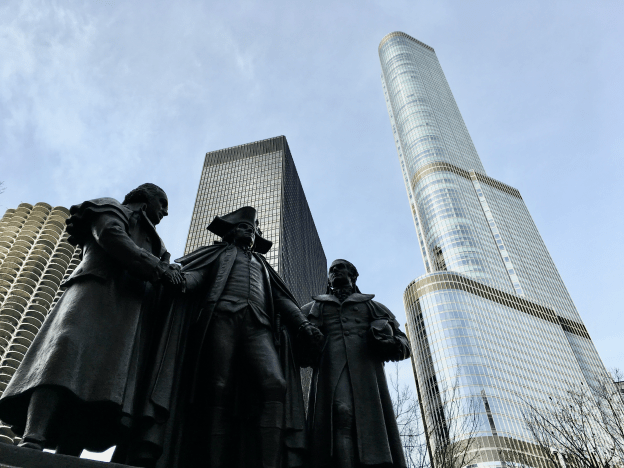
In late December 2017, during one of my family’s regular Christmas trips back to Chicago, my Dad and I were walking along Wacker Drive (upper, not lower) past the Herald Square Monument on the northwest corner of Wabash and Wacker. The monument depicts George Washington with two of the principal financial backers of the Continental Army during the Revolutionary War, Robert Morris and Haym Salomon. I took a picture of the monument with the Trump Tower looming in the background, a pairing of two presidents who in many ways could not be more different in character from one another. My Dad suggested I should learn more about the monument before posting my picture and get the full context of why it’s there in the first place.
As it turns out, the inscription on the monument’s base “The Government of the United States which gives to bigotry no sanction, to persecution no assistance, requires only that they who live under its protection should demean themselves as good citizens in giving it on all occasions their effectual support,” was what made my picture seem so poignant in the first place, and likely had the same effect on many pocket photographers who had walked by in the years since 2016 with their smart phones at the ready to capture the world as they saw it.
That inscription, I learned later that day when we returned to our hotel, was from a letter President Washington sent to the Jewish congregation of the Turo Synagogue in Newport, Rhode Island affirming their religious liberty and emancipation from any separate law code contrary to the custom in most western countries at the time. The context fit the story I was hoping to tell with my picture, yet I was appreciative of the advice to learn more about that monument before making a statement of my own with its picture.
I have many pet peeves, most of which I don’t talk about out of respect for everyone else. I’d rather be known as someone who has positive things to say rather than a complainer, and in those moments when I find myself overly melancholic or acting in a “woe is me” manner, I tend to annoy myself a fair bit. So, it takes a lot for me to want to say anything terribly negative, yet this matter of context is key to something that does bother me. I am annoyed when stories are taken out of the context in which they were created.
This usually doesn’t happen with novels or movies or TV shows, except now with the deluge of memes using images and moments from these stories to express emotions. I do see this trend played out more in music where the original story of a song might not be as familiar to the people listening to it, yet they sing the words all the same. Context provides so much more color and energy to a story that turns it from a linear narrative with a beginning, middle, and end into a vibrant world crafted by a storyteller that began as a mere idea in their mind.
Pulling a story out of its original context robs the listener of a chance to appreciate the whole depth of the yarn being spun, to see every last fiber of that tapestry being brought together in a great work of art that is inspired by the ideas of its creator. When we break ourselves off from the context of life, we lose a great deal of the beauty of the Cosmos around us. This is why we can sit back and do too little to help our planet as the climate crisis grows ever dire day by day. Last week, several researchers from the University of Copenhagen’s Niels Bohr Institute reported their findings that the Atlantic’s currents could stop moving this century, as soon as 2025, due to rising sea temperatures; earlier in the week the National Weather Service also reported that water temperatures over 100ºF (38ºC) were recorded for the first time off the Florida coast. The currents feed the very life we have evolved to depend on and to be an integral part of. By focusing just on our own story, we have lost the context of the greater world of stories that ours inhabits.
Here in the Midwestern United States the weather tends to move in cycles with some wet years followed by some dry years. In my adult life we’ve seen three wet cycles so far, with heavy flooding on the Missouri River around the years 2011, 2015, and 2019. Since 2019 we’ve been in a drier spell, with some seasonal thunderstorms but not the great floods of years past; yet these last two summers the Midwest has been inundated with flood after flood, striking different regions at different times. Over the 4th of July weekend, there were rainfalls in Chicago that dropped as much as 8.96 inches (22.76 cm) of rain on the western Chicago suburbs of Berwyn and Cicero. A few weeks later on 14 July, Kansas City experienced a storm line that produced minimal tornadoes, what we’re more used to here, but instead a line of storms over 40 miles (64 km) long from north to south which produced winds reaching at least 75 if not 80 mph (120.7–128.7 km/h) winds that brought down trees throughout Kansas City, knocking out power lines and leaving much of the metro in the dark.
I for one am used to thunderstorms, they’re quite exciting to be frank, yet this one scared me more than any other I’ve watched from the safety of a well-built house. What scared me most was that the windswept rains reminded me of video I’d seen of the Category 1 hurricanes that hit the East Coast every Fall. To me, this proved that the story I’d been hearing my whole life about the weather here in the Midwest was truly changing, that it was not a couple of bad years followed by a return to milder weather. The baking summer heat that followed that Friday afternoon storm, which last week left portions of Kansas City reading heat indices of over 120ºF (49ºC), was the flip side of the same story we heard in December when the extreme Arctic cold winds that swept down from Canada and locked much of the continent in an ice box settled on Kansas City. That weekend we were treating our garage like an air lock, closing the interior house door and making sure everyone who was going outside had all their skin covered before opening the garage door to the -30ºF (–34ºC) blistering wind to go shovel out our driveway of snow and lay down kitty litter (our preferred road salt) to try and break up some of the ice that had formed.
Without the full context, we cannot see the future we are creating for all life on Earth. Visitors to my favorite place on Earth, Chicago’s Field Museum, will likely go see their fossil halls, an exhibit now called Evolving Planet, in order to see the famed dinosaurs––and especially SUE the Tyrannosaurus Rex––who live in those galleries. I love going in there for many reasons, which if I haven’t written about before on the Wednesday Blog, I’ll be sure to write about the next time I visit. Yet, the Evolving Planet exhibit ends with a counter showing the number of species that have on average gone extinct over the course of any given day. The later in the day you leave that exhibit, the higher the number is. In all our other problems, and especially in all our distractions, we forget that we need all the other life that evolved on this planet with us. We forget that their stories are important to understanding our own.I know a great deal more about the history of the Turo Synagogue after stumbling into Sam Aronow’s Jewish History series on YouTube just before Christmas in 2021. Learning other peoples’ histories allows us to have a better appreciation for the entire tapestry of humanity. For me, it presented a greater sense of respect in President Washington’s words engraved in the base of the Herald Square Monument at the corner of Wacker and Wabash. That context only strengthens the story of our national experiment at citizen-led representative government, now nearing its 250th anniversary.
 Wednesday Blog by Seán Thomas Kane