

On Little Things – Wednesday Blog by Seán Thomas Kane
This week, recent events have inspired me to think about the wide, wide world on a smaller scale.
Last Wednesday, after publishing “On Democracy, Part II” I took my place in the driver’s seat of my car, the Mazda Rua, and went out on a day trip to Jefferson City to join the protest against the congressional redistricting underway here in Missouri. I wanted to drive long distance at highway speeds again like I used to four times a year on my Long Drives East and West between Kansas City and Binghamton. There’s a lot of little things about those drives that I miss now that I’m more rooted here in Brookside. Today, I don’t drive every day. Often times if I can I’ll choose to walk to wherever I want to go in the neighborhood. It’s healthier to be sure, and I get the same free time away from the obligations that crowd my desk to listen to music, podcasts, birdsong, or to just think. These walks aren’t terribly taxing, Apple Fitness likes to remind me that the difficulty is “easy” to “moderate,” yet each one adds up into a sum which says that I am healthier today in mid-September than I was in mid-February or mid-March, let alone a year ago now. Moreover, I loved driving even just about town for that free time. Drivetime was often my podcast time. Now, I’m also reassured that I’m not operating a large and potentially dangerous vehicle while I’m listening to an engaging conversation or story; instead, I can focus on the story itself and not split my attention between that and the road.
So, last Wednesday I did try to recreate the things I loved most about those road trips that marked the beginning of this decade. On the outbound drive I listened to a fascinating discussion about political philosophy and space policy on Planetary Radio and on my return trip I listened to the pilot of the new audio drama Star Trek: Khan. Yet as much as I was thrilled to be back on the road and experiencing things that I felt like I had lost, even at my own volition, I still found that some of the little things got to me. For one, I was annoyed at getting stuck behind a semi-truck on the outbound drive for about 10 miles east of Sedalia and even more frustrated that I couldn’t pass a pair of semis that were ahead of me on the return drive as we transitioned from the two-lane divided highway in Cole County back to the one-lane country road that is US 50 in between the state capital and Sedalia. I know well that I control how I react to things, and therefore that I ought to react better to most things today than I did in my younger years, yet getting stuck behind those larger, slower vehicles on the stretch where passing was far more difficult really annoyed me. The beauty of a country drive is lost somewhat when you’re staring at the same big box retailer’s advertisement on the back of their vehicle for mile after mile.
These little things are what give our experiences life. The great, grand gestures that get remembered are one thing, yet they cannot be sustained without the small tokens of affection or whispered advice that comes from living and making the choices that define who we are. I believe that we are fundamentally formed by our experiences for good or ill. I’ve often ended up resorting to grand actions to try and solve questions or puzzles that find their way onto my desk. Marking something off a checklist is one of the most satisfying things I can do in my life. Those grand acts often become boxes which I can fill with the little things that I undertake. Currently, I am working on editing my translation of André Thevet’s (1516–1590) book Les Singularitez de la France Antarctique to send its book proposal off to an academic press. I have enough of my translation edited to send to them now, the first 16 chapters to be precise, yet there’s more still I need to do. This publisher prints page-facing translations and requires that the original text be sent alongside the translation. So, now I am spending my time typing out the original Middle French text of these first 16 chapters to be included in my proposal. There is a Wikisource page for this book, taken from the 1878 French edition that I could copy and paste from, yet it lacks the folio numbers from the original that are vital signposts to navigate the text and has enough nineteenth-century re-renderings of the sixteenth-century French original that I decided it was better if I just went ahead and typed it out myself. The first chapter took me about an hour to do, so I figure in all I might be able to have most of this typing done by the time I publish The Wednesday Blog next week.
Each character here is a little thing that together add up to the surviving thoughts and memories of a man who lived 450 years ago who exists in the scholarly memory of his time yet rarely in the spotlight. In my work, I hope to turn that spotlight on him and demonstrate his erudition and centrality to the cosmographic profession as it existed in the 1550s and 1560s. All this boils down to the same solution I’ve used to get through big projects for years. On Monday I smiled hearing a friend say essentially the same thing with her work in the history of mathematics, that the best way to solve a problem is to break it down into its constituent parts and figure it out piece by piece. A decade ago, this week when I moved to London, I found that the only way that the move was not overwhelming was to think of each thing I needed to do separately. My frustration rose when I found that I couldn’t make sense of a particular facet of one of the things I needed to do. One particular moment of note here was when I was summoned to the international student office to provide visa papers to confirm that I could legally study in the United Kingdom well after I’d started my coursework. Something got lost in the shuffle, but it was serious enough to scare me a little. When I moved to Binghamton, I had similar bureaucratic problems from issues getting my New York residency owing to my Missouri driver’s license having cracked in two, to a year later having big issues proving my residency to my university because I forgot to cross a t somewhere on a form.
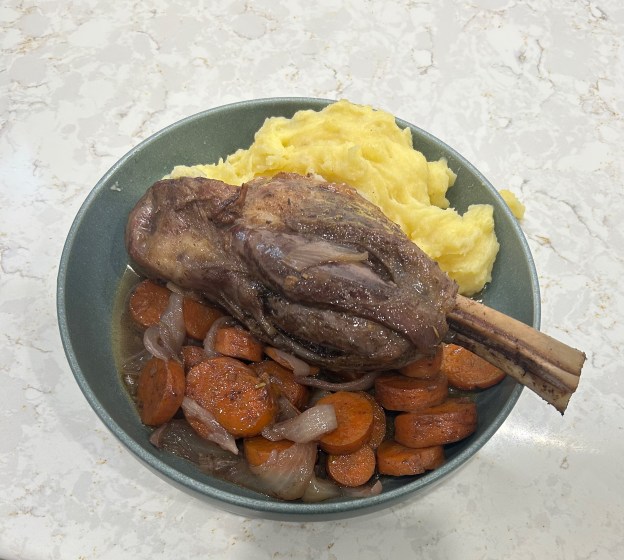
Again, I choose how I react, and in the years since I’ve learned to take little things in stride and think of them in the broader context in which they exist. I believe doing the little things can show fidelity to a greater cause because it shows that I’m there for the long run, not just in the good moments. That’s something I learned from Robin Williams in Good Will Hunting, one of the finest movies I’ve ever seen. I think perhaps the best metaphor to explain what I’m trying to say to you, dear Reader, is that we should approach the things in life like we approach cooking. Recipes break down the task of cooking into smaller pieces that are more easily attainable. In May I made an Easter roast for some of my best friends that comprised several recipes I’d never tried before that day, and I truly didn’t know if it had worked until I finally sat down and took a bite of it. The roasted lamb shanks were perfect, as were the mashed potatoes, and the flourless chocolate cake that I rounded things out with was excellent and just as good the following day. In each recipe, I not only took things one at a time but even experimented a bit here or there based on my own experience from cooking similar things. For one, I had to quickly rethink how I was going to cook the lamb shanks because they were larger than nearly all of the pans I had. For another, I realized later than I wanted that in melting the chocolate chips for the cake I should’ve encouraged the process along with a spatula here and there. Each of these little things rounded out with a fine Tempranillo wine from Rioja to make one of the best dinners I’ve yet cooked.
I have a lot to do right now, and in every respect I’m on course to complete the things I have in my docket. The work would be overwhelming if I looked at it as a great mass, yet it is far easier to approach in small bites. That’s the big reason why I’m ending the Wednesday Blog one month from this week on 15 October. I’ve said what I wanted to say, and looking ahead I can use the time that I devote to writing this blog and recording the podcast working on other things great and small that need my attention. This publication is made up of a great many little things, small ideas that flower with their peers and culminate in an essay each week that I usually feel proud of writing. Little things make the lives we live.
 Wednesday Blog by Seán Thomas Kane