Tag Archives: Writing

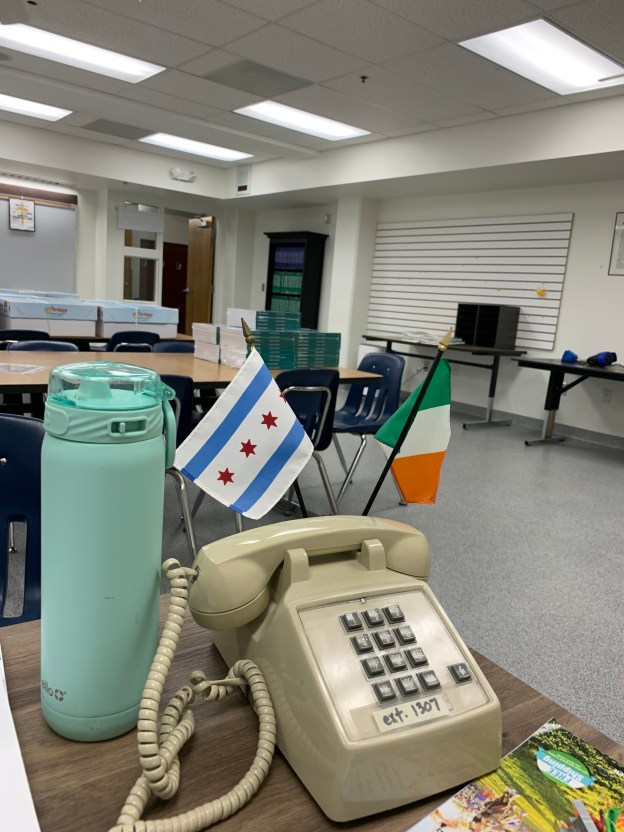
A landline telephone in a classroom.

Electronic Signals

This week, the coalescence of my thoughts over the last few months about how the way we communicate today in 2025 is so rooted in our technology.—Click here to support the Wednesday Blog: https://www.patreon.com/sthosdkane


This week, the coalescence of my thoughts over the last few months about how the way we communicate today in 2025 is so rooted in our technology.


For most of my life I tended to write a lot of ordinary quotidian things out by hand on paper either in notebooks, on notepads, or on the backs of receipts, envelopes, or whatever paper I had around. I kept up a good cursive hand and used it on a regular basis. Yet in the last decade technology has caught up to the humble notepad; a decade ago when I was living in London and trying to write out ideas for my first round of graduate essays on my phone’s Notes app while I was on the train or walking about, I often found that app in particular drained my phone’s battery at a considerable and worrisome rate. Then again, that particular smartphone tended to die if the battery dropped below 40 percent, so it had a bad battery. Still, that led to me continuing with the practice of keeping notes and scribblings in little notebooks or on notepads that I carried with me in a pocket. 

It’s funny then that it’s only now in 2025 that I notice how little I write these same notes anymore by hand; in 2021 when my Mom came to visit me in Binghamton, she brought me a couple of notebooks emblazoned with pictures of various national parks on their covers, a new trend in notebooks that began around then. I was a little taken aback by this gift because by that point I’d largely done away with handwritten notes all together. In fact, my Binghamton years launched me head-first into doing as much as possible on the computer so that I’d have less paper and books to carry back and forth between Upstate New York and Kansas City. Like printed books over digital ones, when I returned to Kansas City I began to write handwritten notes again. This is largely thanks to my employers at the Kauffman Center for the Performing Arts; in our department we still carry around paper performance notes on our shifts. When I started, I was surprised to realize that at some point in the last 5 years I’d stopped carrying a pen with me on a daily basis. Since then, in April 2023, I’ve always had a pen in my pocket.

The pandemic reinforced our digital communications in ways which pushed us firmly forward toward more frequent videocalls and texting to the detriment of the telephone in particular. Most of my friends and family tend to prefer text messages over phone calls, especially among my fellow millennials, to the point that I often second-guess myself as to whether I should try calling someone in the first place. Is a phone call intrusive, whereas a text message is like a telegram or a letter? It can be replied to in the recipient’s own time, though with a text the response time is usually expected to be faster than with a letter that’ll take days to arrive, or even an email, which I see as slightly more formal. Since the invention of Samuel Morse’s electrical telegraph in 1838, our communications have moved into a realm of electricity which was foreign to our conversations and our lives beyond lightning strikes and the daily shocks one gets in a dry climate.

This Spring then, when I was regularly on videocalls–usually over Zoom–with friends, colleagues, and family alike a thought occurred to me that all of our communications are being translated down to electrical signals being sent over wires from one person’s device to another. Those messages, no matter the content, all buzz and fizzle through our wireless data signals and across our telephone wires, through our data centers and bouncing off our satellites all to better communicate to anyone whether on the planet or high above us in orbit or beyond. It’s made us all so much closer to one another. Today, I’m regularly in contact with people in North America, Europe, and Asia and that contact is often almost as instantaneous as if we were together in the same room. It’s what makes my solitary life feel lived in community with the people I like. And yet it’s also spoiled us for the slower communication of the written letter or even the face-to-face conversation that started all these “words, words, words” as Hamlet says that we “might unpack my heart with words.” We communicate to do just that: to speak our thoughts and to live in the strange and beautiful worlds we build around ourselves. So often now, those conversations are not only occurring with the aid of the electrical signals pulsing about our minds telling us how to react and what to say and do, but also through their extracorporeal currents which connect us through our technology across vast distances to one another.

You are listening to my voice filtered by the microphone and my audio editing software being transmitted to anyone with an internet connection. While naturally we aren’t supposed to hear it, as my hearing isn’t quite as good as it should be, I can now hear the differences between sound frequencies in a finer detail yet to the point that if two voices are speaking with the same frequency, I only hear ringing at that frequency and no words or other noise. This was demonstrated to me with dramatic and terrifying effect several years ago when I was nearly t-boned by a Kansas City fire engine roaring along at full speed because I didn’t hear its siren, which wails at the same frequency as the particular section of the 1st movement of Tchaikovsky’s Violin Concerto that I was listening to in my car at the time. So, when you hear my voice what you’re hearing is an electronic recording of my voice being transmitted to you. Often, I sound higher pitched on the recording even by just a half-step, than I do to my ears when I’m doing the recording. I’m a tenor, so I’m okay with that. Still, it’s noticeable especially if I record later in the day or at night, or if I’m nervous.

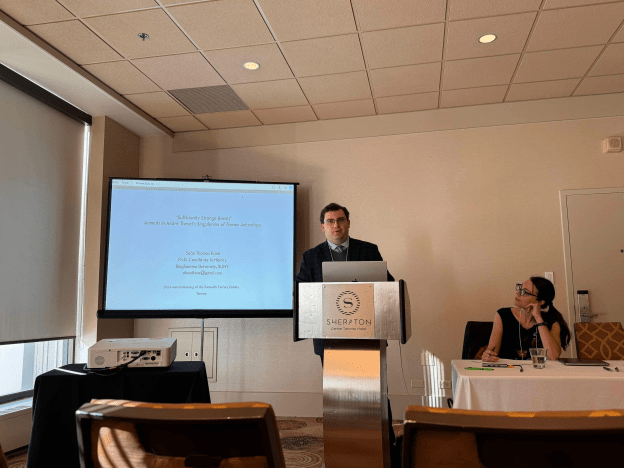
After I began my graduate studies in History back in August 2017, I started making a practice of recording any conference presentation or invited lecture I gave. I’d usually only make a sound recording, not wanting to deal with a camera. This way too, if someone missed a talk and wanted to see it, I could lay the slides over the recording in iMovie and turn it into a video to send around. This has turned into a wonderful tool for listening to changes in my voice over the years. Yet it’s also interesting now because I not only use this tool for recording the actual performance but also the rehearsals as well, and sometimes when I’m editing papers. I gave a lightning talk last week that was part of a webinar hosted by the Graduate Student Advisory Committee of the Renaissance Society of America about animal intelligence titled “Animals Adapting to Changes in Nature: Perceptions of Animal Intelligence in the Renaissance?” The paper itself was pretty quick and easy to write; it maybe took me an hour to make the first draft several months ago. Yet I began recording rehearsals and making edits after each one up to the minutes before I went live on Thursday morning. I was a bit nervous when I presented, so in the end the cool and practiced pace I’d planned with a mid-range voice ended up being a minute faster than expected and closer to my upper register. When I’ve thought about what to do if anyone asked to hear this talk after the fact, I’ve considered possibly sending out my last rehearsal recording from an hour before the performance, after all many speakers would in decades past make a separate recording of their lectures & speeches from the actual live reading. Yet to keep it authentic to the talk as it went ahead, I also feel inclined to send out the one that I gave on Thursday morning to the 16 other panelists and organizers on the call and the 35 attendees listening in from around the globe. This question gets to the heart of my talk because I made the case that André Thevet’s sloth showed signs of intelligence by refusing food it didn’t want to eat and not falling to the same bad practices as the Frenchmen who captured it or the native Tupinambá who were more familiar with it. Those practices, human faults one might say, include indecision.

Rather than flip a coin or pick another method of choosing, I’m instead going to play for you now the last rehearsal recording for one very simple reason. The main benefit of my recording of the actual talk is that it ought to have captured the organizer’s introduction and the questions that followed my presentation. Yet, my phone’s microphone couldn’t pick any of that up because my computer’s sound output was going into my headphones. So, without any more gilding the lily here are my thoughts on Renaissance sloths adapting to changes in nature, brought to you through a most electronic form of communication.

~

Animals Adapting to Changes in Nature:

Perceptions of Animal Intelligence in the Renaissance?

I want to begin by thanking the members of the RSA Graduate Student Advisory Committee for holding these lightning talks and accepting my proposal among the speakers today. When considering this question of animal intelligence, I’m drawn back to the Aristotelian notions of the animal sensitive soul in contrast to the human rational soul; Erica Fudge put it well, writing that animals can feel, perceive, and move, yet humans are the only natural beings to express intellect.[1] Animals were used as stand-ins for humans in allegory and vivisection, and an over-exertion of passion could drive a human into a state of animality, yet the human was understood to be fundamentally different because of our facilities of reason developed through experience over one’s lifetime.[2]

Newly encountered American animals played a disruptive role in this dynamic. Anatomically, many such animals defied European expectations for their size, or their chimerical character appearing as a composite of unrelated creatures known to exist in the wider Mediterranean World. Chief among these in my research is the three-toed sloth which was described by the French cosmographer André Thevet (1516–1590) in his 1557 book Les Singularitez de la France Antarctique. There are many different aspects of Thevet’s sloth which allowed it to stand out as a singularity among singularities from its appearance as a bear-like ape to its vocalizations “sighing like a little child afflicted with sorrow” to its general disregard by the indigenous Tupinambá people who explained aspects of its manner to Thevet.[3] I’ve written and spoken extensively about this, I know several of you have heard me talk about Thevet’s sloth at a number of conferences in the last several years. Today though, I want to discuss something I haven’t addressed yet in all these presentations; namely the signs in Thevet’s text which point toward some sense of the sloth’s intelligence.

The sloth’s intelligence is seen in its abstention from eating the food Thevet provided it. Thevet wrote “I kept it well for a space of 26 days, where I knew that it never ate or drank, but was always in a similar state.”[4] This reaffirmed Thevet’s assertion that “this beast has never been seen to eat by a living human,” either by the Tupinambá or the French.[5] This abstention from eating could well be understood as a sign of the sloth’s lack of a rational soul which would know to eat; yet I think it is better to perceive the sloth’s abstinence as an active choice made by an animal who didn’t favor the food it was offered. Thevet wrote that “some believe that this beast lives solely on leaves of a tree named in [the Tupi language] Amahut,” which is one of the Cercopia species known to live along the Brazilian coast.[6] Yet a 2021 sloth behavioral study published in the journal Austral Ecology has proven that this claim is less grounded in the genus’s actual experience.[7]

Perhaps the sloth can be best contrasted with the dogs which killed it at the end of that 26-day captivity, or even with the accused descent from humanity by first the Tupinambá and later the French in accusations of cannibalism. Unlike the humans who occupy these stories from France Antarctique who so often fall so far from their rationality to eat each other, the sloth simply refused to eat at all. This small creature, taken from its forest home and left in the care of an unfamiliar human who didn’t know what to feed it, chose to preserve its nature and not eat what was foreign to it. The sloth adapted to changes in the nature around it and expressed an intelligence perhaps more elevated than the humans who captured it. I’m drawn to one of the most poignant lines in Montaigne’s essay “Des cannibales” in which the erstwhile political animal himself wrote “I think there is more barbarity in eating a man alive than in eating him dead; and in tearing by tortures and the rack a body still full of feeling.”[8] In all of the variations on his sloth account, Thevet published this same story twice first in the Singularitez of 1557 and later in the Cosmographie Universelle of 1575, the dominant sense I get from Thevet’s text is one of befuddlement at an animal that defied his expectations in so many ways. In the tradition of animal allegories from Aesop to Renyard the Fox the sloth fills the role of an exotic oddity, a stranger in the canon of European natural history which didn’t quite fit any mold available. Even after Thevet’s sloth was christened by Conrad Gessner an Arctopithecus in 1560 and by Carolus Clusius as an Ignavus in 1605, this fact that it refused to eat or drink what Thevet offered it for 26 days remained a constant in its story. I see in the sloth a sign of intelligence beyond expected human norms and rules which rendered it exceptional. Any assimilation of the sloth was an artifice laid over its character, a colonial imposition. Still, its abstinence fit the framework of the sensitive soul, reflecting a delicate sensitivity toward things it found unfamiliar.

~

How does a 450 year old sloth’s intelligence have any bearing on the electronic signals which carry our communications in this new century? I wouldn’t have been able to study Thevet’s sloth in the way I have without the internet and all our technology. So much of my work is with digitized primary sources, mostly printed books, that I do almost all of my research on the computer. It’s a rare occurrence that I get to go into an archive to look at a source in the flesh. Yet I think there’s another interpretation we can take here: like the sloth we choose how much we are in touch with each other, how much of our lives are spent with our phones in our hands. My weekly screen-time report tends to fall in the 3 hour range per day. Yet I’m not only checking my social media accounts or texting with people on my phone, but I’m also reading books and writing notes and ideas down on my phone or using the camera to try and capture an artful reflection of the lived world around me. Recently on Instagram I saw another person’s screen-time report say they spend 14 hours on their phone per day, which is essentially the entirety of my waking hours. To me that is unhealthy to an extreme. Yet that’s how that individual has chosen to live their life.

I know that no matter where I end up, I will remain connected to others through our technology. Somedays I do miss the slower pace of sending letters or calling family and friends on the phone as things were when I was a child. I’d rather talk with someone face-to-face or voice-to-voice than text. As I wrote in January, I feel that we’ve allowed texting to take the place that videocalls were supposed to hold in the 21st century. We’re not constantly talking to people over monitors beyond Zoom calls that are scheduled and with that pre-arrangement more formal than the quotidian string of text messages. Today, I do have a notepad on my desk, one that was given to me among the materials of a workshop I attended at the École des Hautes-Études en Sciences Sociales in Paris last summer. It’s gotten some use, yet one year later I’m still only halfway through the gridded pages. As with so much of life in general, I feel that I’m trying to find a balance between the digital and the manual, between life online and life in this place where I find myself in a given moment. All I know for certain is that over all else, I long for connection.


[1] Erica Fudge, Brutal Reasoning: Animals, Rationality, and Humanity in Early Modern England(Cornell University Press, 2019), 13.

[2] Fudge, 17.

[3] Thevet, Singularitez (Antwerp, 1558), 99r.

[4] Thevet, Singularitez (Antwerp, 1558), 99v–98r.

[5] Thevet, Singularitez (Antwerp, 1558), 99v.

[6] Thevet, Singularitez (Antwerp, 1558), 98r.

[7] Gastón Andrés Fernandez Giné, Gastón Andrés, Laila Santim Mureb, and Camila Righetto Cassano, “Feeding ecology of the maned sloth (Bradypus torquatus): Understanding diet composition and preferences, and prospects for future studies,” Austral Ecology 47 (2022): pp. 1124–1135, at p. 1132.

[8] Michel de Montaigne, “Of Cannibals,” in The Complete Essays of Montaigne, trans. Donald M. Frame, (Stanford University Press, 1965), 155.

On Sources

This week, the fourth in several scribblings about my research: borrowing from Oscar Wilde, the importance of being earnest with one’s sources.—Click here to support the Wednesday Blog: https://www.patreon.com/sthosdkane—Sources:Ologies Podcast: https://www.alieward.com/ologies"Metropolis," Wednesday Blog 3.20: https://wednesdayblog.org/2023/01/11/metropolis/.Marie V. Alessandro, "The Workers of Metropolis" in Cinema at UMass Boston, (6 November 2020), https://blogs.umb.edu/cinemastudies/2020/11/06/workers-of-metropolis/Surekha Davies, “Here be black holes: Like sea monsters on premodern maps, deep-space images are science’s fanciful means to chart the edges of the known world,” Aeon (13 July 2020), https://aeon.co/essays/how-black-holes-are-like-sea-monsters-at-the-edge-of-our-vision.Chicago Manual of Style, 18th Ed., Notes-Bibliography System Quick Guide, https://www.chicagomanualofstyle.org/tools_citationguide/citation-guide-1.html.Jacob Burckhardt, The Civilization of the Renaissance in Italy, trans. S.G.C. Middlemore, (London, 1878): https://www.gutenberg.org/ebooks/2074.


This week, the fourth in several scribblings about my research: borrowing from Oscar Wilde, the importance of being earnest with one’s sources.


Over the weekend when I was chatting with some friends in my parish choir about the rallies and political protests ongoing in our city and around this country, I made a joke that I went about making my own protest sign, something I’ve been slower to do. I said the sign fit my temperament and was useful for a wide range of protests. This sign, conceived for the sake of a joke, reads “I am rather miffed.” One of my friends retorted that she expected any protest sign of mine would include citations. I laughed and retold one of my favorite stories from my History Master’s program when I wrote a footnote that traced the historiography of a particular concept back through at least four generations of the scholarship to the early nineteenth century; I described this particular citation as a footnote within a footnote within a footnote within a footnote, much to the bemusement of my friends.

This got me thinking more about citations, something I often tend to think about anyway with my work. I do honestly love writing footnotes, it’s one of the more technical aspects of my work that gives me a great sense of pride at accomplishing manually, that is to say without the help of any extra software built to keep track of citations. One of our professors at UMKC introduced my cohort to Zotero, for example, and I flatly refused to consider using it saying, “I memorized the basic formulae in the Chicago Manual of Style in my undergraduate, I don’t need a computer to help me with this.” That’s been my take on this kind of software since. I see the benefit of it, yet I don’t feel the need to adopt it in my own work. I’ve seen so many student essays that copied & pasted text into their footnotes where something went wrong with the formatting that I’d rather just type the text out character by character. There’s something delightfully personal about taking this slower approach because it means I’ve considered every character in the document, and by and large I can avoid typos and errors as a result.

The format of my citations will vary slightly depending on the publication. A proper peer-reviewed article or book chapter will get the full treatment, sort of like the top of the line all-inclusive package they offer at a high price at my local car wash. In contrast, my book reviews rarely include citations beyond those to the book being reviewed, and in that instance, they are mere in-text citations with the page number listed alone. That could be seen as the quick and cheap package at my car wash. Here on the Wednesday Blog, I endeavor to include hyperlinks in all of my citations and in the text of the blog where I first reference a given source. I’ve begun to see more hyperlinks included in peer-reviewed journals as I suspect the vast majority of us who read Isis or Renaissance Quarterly do so on their computers as I do, and thus can click on those links, rather than reading the journal in print when it’s mailed out with each issue. I make an effort to include any citations in the text description box on each of the Wednesday Blog podcast episodes as well, for the benefit of listeners who access this publication through any of the podcast platforms where it is found. I’ve seen the likes of Ologies do this as well, in fact I was inspired by Alie Ward’s thorough efforts at citing her sources on Ologies to do the same on the Wednesday Blog. In my case, it was a question of whether I needed to have the same rigor in this publication as I do in my scholarly writing. I concluded that it was not only needed but that it would be something that could set my work apart from my peers.

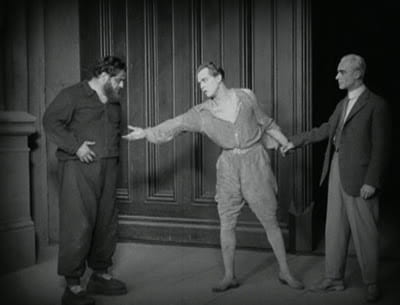
My footnotes are the hard workers of my writing, the double-checked cross-references that populate the bottom of my work yet add such vitality to it all the same. Without the footnotes the rest of the essay would lack the depth of meaning that they provide. They root my sentences in a rich soil of past scholarship which can enlighten even the densest lineage. Yet the footnotes require clarity in the text which they elaborate. For them to work I need to ensure that my own text makes sense and is readable, something which often needs a bit more thought after the first draft. I think of the relationship between the text and footnotes in a manner similar to the stratified society in Fritz Lang’s 1927 science fiction masterpiece Metropolis; the footnotes are the hands to the text’s head, the evocation of thought that elaborates on the essay’s thesis.[1] Yet without the footnotes’ deeper connection to the human experience the world above soaring high into the heavens with the foolhardiness of the biblical Babel would awaken to find its words meaningless.

“The Mediator Between the Head and the Hands Must Be the Heart.” Photo source (and a good blog on the workers of Metropolis).

Citations are a form of cross-referencing that was engrained into me from even my elementary school years. I remember seeing footnotes in some of my favorite childhood books, in particular in Watership Down and I believe in The Lord of the Rings trilogy. I wanted to use them on my stories from as early as elementary school but didn’t have a proper need for them until I was an undergraduate writing essays that needed full and clear sources for their work. It’s funny to me now because I do often read peer-reviewed articles that don’t have the same rigorous citation systems in place as the one that I committed myself to over a decade ago now. My rule is that if I make a fact-based claim then I cite it, regardless of how important it is to the argument. I know from my own experience scouring academic databases for secondary sources on André Thevet (1516–1590) and his contemporaries that even the smallest off-hand mention of the man in a source that may have very little to do with him could nonetheless lead me to another source that has a great deal more to offer the Thevet scholar. It made me laugh earlier this week reading one such book that made a fairly large claim about its subject without providing sources for all of the historical figures mentioned in a given sentence, just the ones the author clearly thought were more important.

The way I think of citations resembles how Surekha Davies, one of the leading experts in the field of Renaissance monster studies, described the category of the diagram in a 2020 essay for Aeon. Like Davies’s diagrams, citations “are devised by interpretative communities made up of readers, makers, and practitioners. Each interpretative community has its own distinct pictorial language.”[2] In this context, that language is the style guide for citations in use. Access to the information contained in my citations is eased by using an accepted and standard style, in this case the notes-bibliography system set by the Chicago Manual of Style, which just published its 18th edition last NovemberThere lies the rub of this: citations embed a strong sense of subjective importance in their nature. I try to cite anything and everything that goes into my work, while others will only cite those things which they deem to be the most valuable to their reader. I’ve always looked toward a wider readership, maybe hoping to catch the eye of my colleagues, graduate students, and the odd bookshop aisle walker alike who happens to see my work on the shelf. My more liberal use of footnotes reflects this preference for a wider readership; I try to have enough information in my citations to go around for anyone who may be curious about the connections between my work and its peers and ancestors. I understand the argument that older secondary literature often has less to contribute to contemporary conversations, my dissertation committee for instance asked me to write a new historiography document that only focused on the literature that I’ve used which was published since the millennium. Yet in the twin magnetic poles between which lies my field, Renaissance Studies and the History of Natural History, my historiography begins in the former with Jacob Burckhardt’s 1860 The Civilization of the Renaissance in Italy and in the latter with the likes of Linnaeus adapting new understandings of the natural world from the sixteenth and seventeenth-century perceptions of it which include Thevet’s own cosmography. This is to say that my historiographic timeline begins far earlier than many, and I have to take the full scale as well as the particular scope of it into account.

The earnestness with which I approach my sources is reflected in the quality of my work. I’ve long heard words of warning about particular institutions as places that promote competition between graduate students and between faculty in order to keep the flow of a high level of research and writing. I for one initially heard this and felt a sense of trepidation, why not if I couldn’t keep up with the best of my colleagues. And yet, when I’m in the flow of my writing, things are magnificent. I wrote the first draft of an article of mine that’ll be coming out in the December special issue of Terrae Incognitae in the period of about a week last summer; it uses sources that I’m very familiar with, in fact an expert on, and it makes an argument I’d been thinking about for some time when I sat down to write it. That article’s gone through several rounds of revision since, yet from the beginning one area that needed minimal rewriting were my citations. Today I have another paper I plan on writing in the next few weeks that I initially conceived of in a proposal to another journal special issue, yet I decided to go ahead and write anyway; after all, if that first journal rejects my proposal, I can always send the finished manuscript to somewhere else.

The rub of all of this is that by getting my citations down early, I’ve started my work in a strong place that’s only grown stronger and more resolute with each essay that I write.


[1] S.T. Kane, “Metropolis,” in Wednesday Blog 3.20, (11 January 2023).

[2] Surekha Davies, “Here be black holes: Like sea monsters on premodern maps, deep-space images are science’s fanciful means to chart the edges of the known world,” Aeon (13 July 2020), https://aeon.co/essays/how-black-holes-are-like-sea-monsters-at-the-edge-of-our-vision.


A Sense of Purpose

This week, the third in several scribblings about my research: how studying Thevet and his world fulfills a need to find purpose in life.—Click here to support the Wednesday Blog: https://www.patreon.com/sthosdkane


This week, the third in several scribblings about my research: how studying Thevet and his world fulfills a need to find purpose in life.


Throughout my graduate education the need for new work to compliment, correct, or add to old work has remained a constant theme. It’s critical to our profession, otherwise why devote our time and talent to studying the past if we’re merely rehashing something already said in the generations of our profession’s own history? I passed through the first five of years of my graduate education without that purpose or that drive, and I think it’s what kept me behind some of my colleagues in achievement. Yet when I found something to make my own, a historical topic upon which to pitch my tent and make myself known, I took that chance. Still, I wasn’t entirely sure what value studying Thevet actually brought to the profession. He is an important figure of middling influence in the development of Renaissance natural history, one whose contributions have often been reduced to laughable exemplars of a time before the scientific study of zoology developed. A secondary approach I take to Thevet is to view his work in light of the great contributions to natural history of the great minds of the Enlightenment, active two centuries after the cosmographer, who are often the next great mile marker in the long road that is the history of natural history.

Of these Enlightenment naturalists, the Comte de Buffon (1701–1788) acknowledged the better parts of what Thevet wrote and adopted those as mile markers in his own natural histories. I think Thevet often appears in the eighteenth century because the center of European thought had shifted by that time from Italy, the radiant heart of Renaissance humanism, to France and so the likes of Buffon and Humboldt would’ve been familiar with Thevet as he was one of the more prominent French naturalists whose books were available. Thevet’s notoriety in his own century lay predominately in the transalpine republic of letters, most famously with his Zurich-based admirer Conrad Gessner (1516–1565) who was personally responsible for elevating Thevet’s natural history beyond the original editions to a broader consciousness by including Thevet’s animals in his own Icones animalium and Icones avium omnium of 1560 and his German Thierbuch of 1562. While Thevet’s Singularitez was translated into Italian by the Venetian Giuseppe Horologgi in an edition published by the eminent Venetian printer Gabriele Giolito de’ Ferrari (1508–1578) with the title Historia dell’India America detta altramente Francia Antartica, that volume didn’t carry over the woodcuts which Thevet included in the first edition published in Paris by Maurice de la Porte in 1557 that were copied for Christophe Plantin’s 1558 edition published in Antwerp. This says to me that these pictures didn’t fit the purpose of Giolito’s edition; they especially didn’t fit the sorts of books he anticipated selling Thevet’s alongside. As such, without the pictures Thevet’s work doesn’t seem to have carried as much weight in Italy and is instead better remembered in its original French.

When I was first searching for copies of the Singularitez in August 2019, I initially downloaded a copy of the 1878 Paul Gaffarel edition of the book, which while of great utility especially in its footnotes, isn’t as important as any of the original 1557 or 1558 editions published in Paris and Antwerp to my research. These are the core sources for my work; in particular I used a copy of the 1558 Plantin edition published in Antwerp as my main source for my translation. I can make the case that the Plantin edition is more important in the context of Thevet’s natural history, as it’s the same edition that Gessner acquired and used as the basis for his inclusion of the sloth and toucan in his 1560 pair of Icones books, however in all truth I ended up working with that edition because it was the first one that I found from the sixteenth century. Unlike the two Paris editions (1557 & 1558), Plantin’s edition was not intended for a domestic French audience. The most recent effort of mine toward the publication of my translation was to translate the different royal and imperial privileges and letters to patrons of each translator in order to fully place my own translation within the varied contexts in which each of these contemporary editions existed. It’s interesting to see Thomas Hacket’s 1568 English translation be dedicated to Sir Henry Sidney, who was a major player in the Elizabethan conquest of Ireland and in the early English colonial enterprise. In contrast, Horologgi’s translation begins with a letter to his patron, Paolo Giordano I Orsini (1541–1585), the Duke of Bracciano and like Sidney a noted military man. Thevet himself dedicated his book to Jean de Bertrand, Cardinal of Sens (r. 1557–1560), and in doing dedicated it to the French national cause within which one can best understand the whole French expedition in Brazil.Thevet sought a sense of purpose in his life built upon the travel books he loved to read. He made himself a character in those books, a cosmographer who could be trusted to tell the truth of the faraway because he had seen it with his own eyes. The logic of this always made good sense to me, after all the authority of the historian lies in our expertise and familiarity with our sources. In my case, I’ve found a sense of purpose in my life built upon the travel books I loved to read, and I’ve built my career on my expertise in Thevet’s works. We need to have a sense of purpose in what we do to find life rewarding. I’ve done jobs that’ve been for the money and sure they’ve kept the lights on, but they haven’t been nearly as fulfilling as my research and teaching, which I love doing. The people I’ve met in academia are among my favorite anywhere, fellow experts with whom I can discuss historical topics with a sense of mutual respect and admiration. That’s what I want in my life more than anything else, that community that comes from our profession and a sense of purpose in what we do.


On Vanity

This week, I reflect on the role of love in balancing between self-praise and community in a discussion of vanity.—Click here to support the Wednesday Blog: https://www.patreon.com/sthosdkane


This week, I reflect on the role of love in balancing between self-praise and community in a discussion of vanity.


Today, in Rome the College of Cardinals will convene for the new conclave to elect our next Pope. By the time you read this we may have already seen white smoke rise from the chimney and met our new pontiff by his papal name on the balcony of St. Peter’s. Or more likely when you read this the cardinals will be amid one volley or another of voting rounds and deliberating their right course of action. Since the death of Pope Francis, I’ve felt rebuffed by the electoral speculation over who will be the next pope; by and large I’ve avoided reading any of these articles or watching any of these analyses. On the one hand, in my lifetime these lists of papabili have often been wrong. Francis was an unexpected choice. Yet on the other hand I see a sense of vanity in all this speculation which seeks the political power of the Papacy while ignoring its pastoral nature. I’ve long heard that the eventual choice of Pope is supposed to be directed by the Holy Spirit, whispering perhaps into the ears of the men in red like God did to Elijah in the cave. In my own experience, I’ve seen this most in the realization that the best path for me to take often is the strangest or most winding in character.

It takes a great deal of humility to take that particularly uncertain way in life, to not know where you’re going to end up. You have to learn to trust in yourself and in the people around you to make that path work. I’ve learned to expect things to break, and nothing that I try to work, and to figure out how to move forward in spite of what I’d dreamed and hoped for. I try to learn from my experience even when it is painful or heart wrenching to see dreams vanish and new realities, perhaps less glowing than what I hoped for, take their place. Still, the best way in my experience is to be patient and let things grow naturally around you and within you. The initial instinct isn’t always accurate, yet it should not be discounted either. There are days when the useless is best just to let your mind rest and decide where to go next. The late Renaissance French humanist essayist Michel de Montaigne (he actually wrote “I am no philosopher”) wrote in his essay “Of Vanity” of the men of his own time when France was wracked by forty years of civil war, “a time when it is so common to do evil, it is practically praiseworthy to do what is merely useless.”[1] I am often focused on resolving questions by finding immediate solutions, even if they are smaller steps leading to a greater whole. Yet in recent weeks I’ve found those solutions aren’t always needed or warranted, for they can sift the complexities of a problem so far down that the problem itself slips through the strainer and remains unresolved.

I recognize a degree of vanity here; I figure I have a strong mind and being reasonably well educated that I can attend to any problem and find a logical solution. Yet logic cannot account for humanity in all our chaos and charm. The character and nature of humanity is to spy ourselves in the glass and be marveled by it. We can be so caught in imagining our own glories and our own defeats that we miss the lived moments in between when we are surviving the daily fare and writing even the smallest of verses which will contribute to the song of our lives. I’ve learned to accept that my wishes for things are not always going to happen, and that as much as I warm my soul with dreams of wonders to come those dreams will only be realized by living with the people around me, learning about them, trying to understand them, supporting them, and appreciating them for who they are. Why enforce my own persuasions on you when I could appreciate you, dear Reader, for your own self and your cosmovision? This is a word I only recently learned, I saw it first in Surekha Davies’s new book Humans: A Monstrous History. It seems to originate in Spanish as a way of expressing the way in which reality is subjectively understood through our sensory perceptions. Descartes’s famous maxim for knowledge, “I think, therefore I am” means in this sense that we know what we know because we can perceive it. The cosmos in all its wonder is familiar to us through our sight, hearing, smell, and touch. I would much rather wait to hear your song and listen to it harmonize with mine than pull your voice into my own melody against its own nature.

Montaigne admired those in his generation who kept up the good nature of humanity, its customs, laws, and mores in spite of the world around them losing so much of that common purpose. In quoting Cicero, “not by the calculation of your income, but by your manner of living and your culture, is your wealth really to be reckoned,” the essayist speaks the greater value of a good life enriched by a passion for community and a charitable outlook on our pursuits.[2] While I’m a practicing Catholic, ever striving to be more faithful in my life, I firmly believe with my whole being that the state should be secular, the better to reflect the totality of the people from whom government derives its power. I would be vain to demand that the state reflect my Catholicism at the detriment of all my neighbors, even my fellow Catholics, whose faith is personal and distinct from my own. A good person recognizes this and seeks communion through mutual respect and appreciation. The most central tenant of my faith is that God is love, άγάπηφιλίαand ἕρως alike in the original Greek, and the greatest expression of this love is in our liberty to make our own lives, our free will. If we are meant to live in this image then surely we ought to lower our pride and our vanity and hail the liberty of those around us to live their own lives and make their own choices?

For much of my life I’ve had a hard time taking criticism. I’m better at it today, yet it still is a something I know I will always need to work on. I’m no longer in a state of mind where I feel that I need to justify my actions or choices to everyone. On the inverse side, several years ago I finally caught myself trying to deflect praise with a witty quip that deflated some of the experience. This is something that I’d been doing for a long time perhaps to not inflate my ego too far. I went through my phase of wanting to be important, wanting to be a leader, and to be at the front of things and today when I am in that position in so many organizations, I’ve found that it’s much more fun to be a part of a team working together to achieve our common ends. Together these twin forces pull me toward a humility that I hope keeps me grounded, in which I’ve allowed myself to experience my successes while embracing the troubles that occurred in the course of those victories.

In my academic career I’ve published to date one public-facing article about my historical zoology research into the three-toed sloth and an encyclopedia entry titled “Amerindians in Brazil” for the volume South America: From European Contact to Independence which was published earlier this year. In both instances, I’ve since found things that I got wrong. It was a bit of a shock at first to realize this. In the case of the encyclopedia entry, I made a rather large error in misgendering a god, the Tupi deity Maire-Monan who I interpreted as feminine following the lead of the sixteenth-century Portuguese authorities, only to realize while I was writing a book chapter last summer about magic in Shakespeare’s play The Tempest the error I’d made. As such, the correction to the encyclopedia entry appears in the footnotes of that forthcoming chapter. Likewise, in the editing stage of a forthcoming article of mine, my first peer-reviewed article to be published, I was presented with conclusive evidence that my prior conclusions that the three-toed sloth found in my sources cannot be definitively identified as a southern maned sloth (Bradypus crinitus) as I’d written in that article “The ‘Sufficiently Strange’ Sloth” for EPOCH Magazine’s June 2024 issue but is in fact more likely either a northern maned sloth (B. torquatus) or a brown-throated sloth (B. variegatus). That prior assertion in favor of the southern maned sloth stands corrected now not only in my forthcoming article “A Sloth in the First French Colony in the Americas” but also in the latest draft of Chapter 3 of my dissertation.

A few years ago, I would have still had significant trouble accepting these critiques out of a strong sense of embarrassment at making such a mistake. In the case of the sloth’s historical zoology, I thought I read all there was to read about the different three-toed sloth species which live in the Brazilian Atlantic Forest, yet I was proven wrong by a generous reviewer who even offered a bibliography of where I could look to find more reliable information. Were, I always fixated on the looking glass of my successes I would surely miss the flaws that pronounce my humanity and not see the ample room for growth. I know that I’m not perfect, in fact I revel in the fact. And while my faith exists, I challenge anyone who claims to know definitive things about matters of belief whether they can really know the mind of God, a concept which as I wrote previously in my blog post from 12 March titled “The Divine Essence,” that divinity extends in scale far beyond human comprehension.

These last few years I’ve long felt a sense of disconnect between the two poles of my life. On the one hand in Binghamton, I felt a sense of professional accomplishment, I was at a good university conducting research and teaching, and a part of an academic community, however disparate that community was in practice. Yet I missed my family, I missed the Midwest, my home cities of Chicago and Kansas City became longed for isles of the blessed far to the west on the flatlands beyond the Appalachians. I longed to be active in my parish and to offer my talents to my brother Hibernians in elected office. I missed the regularity of the live music in Kansas City, the greater presence of the Kansas City Symphony in this city than anything I could find in Binghamton. Yet when I left Binghamton at a moment when I know I needed to leave, I found that I gave up more than I necessarily wanted. I lost that sense of professional accomplishment and surrounded myself by friends from beyond the academy who appreciate what I do but don’t necessarily understand the nuances of it. In the last few months, I’ve found something of that professional community through the learned societies that I’m a part of and at academic conferences where once again those two poles seem linked by a common axis. That axis is essential to a good life because it provides the balance which allows the individual to truly live to their fullest potential as a part of a wider community. I’ve known true solitude, a mantra of mine in recent weeks has been the simple Irish phrase, “Is mé i m’aonar,” or “I am alone.” It’s a plaintive call of sorts, yet it’s also a moment to learn from, that as much as I’m used to this existence that I want to grow out of it. Montaigne wrote in “Of Vanity” that “it is pitiful to be in a place where everything you see involves and concerns you.”[3] This is the solitary life, a life where about you all things revolve, and what’s worst about it is that it can be lived in community. Alone together was a phrase I read time and again during the recent pandemic. Yet even then with our need to stay apart we found ways to be together. I spent much of the pandemic years here in Kansas City rather than in Binghamton and still felt far more closely attuned to my professional community and the friends who populate it. 

In these past few weeks, I’ve been happiest when I’ve had that connection with my family and friends, when I’m with other people and experiencing their lives, their passions, their perceptions of our shared world. I put faith in the currency of human connection and community because that is the most valuable coinage I’ve yet seen. All the gold and silver that humanity has ever mined cannot compare with the value of community and the humility it brings out in all of us. I have many highly accomplished, brilliant friends, and I’m delighted to count myself among them. There is some vanity in these friendships, after all we approach each other with our own experiences and stories to share, highlighting the things we’ve done, yet in a good relationship we do so to elevate our friends and encourage them to seek greater things for themselves. I feel fortunate to have met these friends, and to be able to put my talents to use serving our common cause.This week then as the cardinals vote in Rome, I hope they will look not just to their own personal interests, theological bent, or political persuasion. I pray they will listen for that suggestion that seems just strange enough that it could be right, and that they chose a Pope to lead our Church who will continue to build bridges that may close the divides erected for millennia between ourselves and so many of our fellows. I hope for a pope who will be a friend to all, a good diplomat who can unite disparate peoples together into one common cause. May his humility guide him to be the pope we need now in the second quarter of the twenty-first century, and when he is elected may we rise to the occasion to better ourselves.


[1] Michel de Montaigne, The Complete Essays of Montaigne, trans. Donald M. Frame, (Stanford University Press, 1965), 3.9., p. 722.

[2] Montaigne, Essays 3.9., p. 724.

[3] Montaigne, Essays 3.9., pp. 725–26.


Montaigne and the Ages of Life

Montaigne and the Ages of Life Wednesday Blog by Seán Thomas Kane

This week, reflections on Michel de Montaigne’s perception of his changing character throughout his life.—Click here to support the Wednesday Blog: https://www.patreon.com/sthosdkane


This week, reflections on Michel de Montaigne’s perception of his changing character throughout his life.


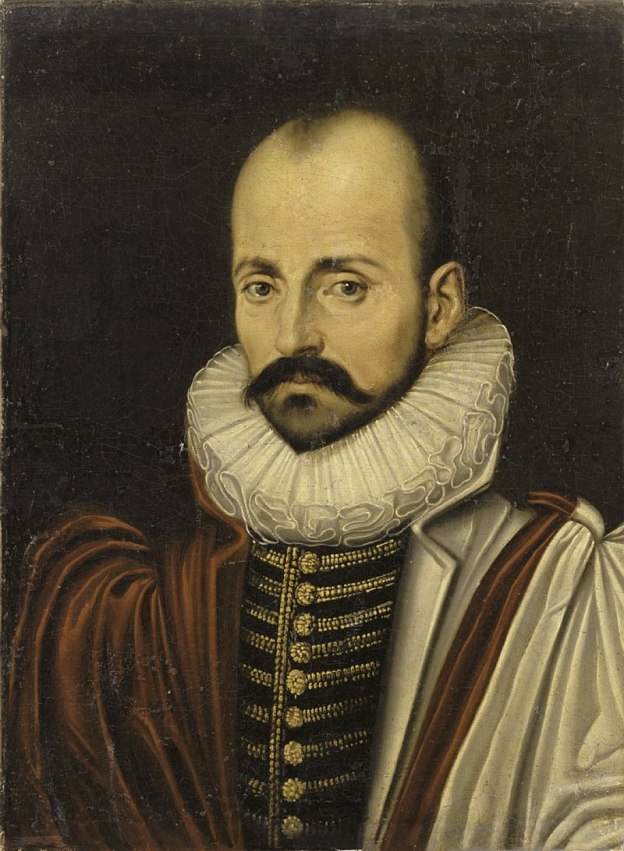
I’m currently reading Philippe Desan’s biography of Michel de Montaigne, the French philosopher and statesman and the father of the essay. Montaigne is an influence for me in how the Wednesday Blog has developed over the last four years that I’ve been writing this weekly. He is also one of the figures on the orbit of my dissertation, and one of the most important sources for critical analysis of the events which I describe in that doctoral work. Philippe Desan in turn is one of, if not the most prolific Montaigne scholar of our time. So, it’s been a delight to read his biography of this man who I’ve gotten to know however faintly through the frame of his Essays in my research.

Most of my work deals with his famous essay “On the Cannibals” found in Volume 1 of that three volume collection. “Des cannibales,” as it’s known in its original French, was published in the first collection of Montaigne’s essays in 1580, and it’s this collection with which I’ve been the most invested in my work. The cannibals of Montaigne’s focus speak to questions of humanity and human dignity which I pose in my dissertation, which is titled “Understanding the Sauvage in André Thevet’s Brazil: 1555-1590.” 

Yet it is in the third volume of Essays where Desan established a crucial connection between Montaigne the man and Montaigne the humanist of the late Renaissance preserved in the amber of his words. In the essay titled “On Vanity” Montaigne poses a fascinating self-reflection looking back at his life as he remembered it and who he was at the time he wrote that particular essay near the end of his days. Quoting here from Donald Frame’s 1965 translation, Montaigne wrote that in the years since he published his first edition of essays in 1580 “I have grown older by a long stretch of time; but certainly I have not grown an inch wiser.” Here whether out of humility or in refutation of Aristotle’s maxim that age and experience begats wisdom, Montaigne sees himself as the same light as before. Despite this, Montaigne continued to observe that “myself now and myself a while ago are indeed two; but when better, I simply cannot say.”[1] This struck me that the essayist could see such a simple yet profound difference between himself as he was when first he wrote and published his magnum opus and the man he later was publishing his third and final volume of essays nearly a decade later.

From my earliest days of extensive writing in my high school years I found myself looking ahead to a time late in my life when I would return to the places of my teenage youth and reflect on what once was and who I’d become. I suppose there’s some vanity of my own in having this profound sense of legacy even from what was then quite an early point in my life. Still, in recent weeks I’ve been reintroduced to younger versions of myself as my family carries out a Spring cleaning and we’ve found decades old boxes of photographs and postcards that I still remember taking and sending yet which haven’t seen the light of day since their capture. I was humbled and heartened to see in particular how loved was the boy I once was, and how inventive and imaginative he could be. Looking at these photos, especially from around my family’s great move from Chicago to Kansas City in 1999, I remember each and every one of them being taken. I remember the sights and sounds, the smells, the prairie winds and the things I was thinking in those first days of my life in Kansas City. These memories have always been there in my mind, yet the subsequent quarter-century has piled many more atop them so that they are now rendered foundations for the memories that comprise me today.

I suspect these days spent pouring over decades-old photos removed some sort of mental block I’d put up out of stress that’s kept my imagination in check in recent months. I longed to have the same expansive dreams and wandering thoughts that’ve populated so much of my consciousness, and now again I find it easy to tap into that deep reservoir which too is built into my memories yet also grows out from them into things which are wonderous and extend beyond the limits of reality toward the possible. Am I then wiser than I was when first I began writing essays in my adolescent and early teenage years? I’d like to think so, at least in some respects. I have a sense of calm today which was lacking in earlier years, and while the stresses of my life are great, as they are for all of us, I know how to accept them and tamper down some of their effects.

Yet in so many ways I do feel that I too am a different person from the kid who moved west all those years ago. Likewise, I see a clear distinction between the student starting high school in the years after the turn of the millennium and imagining his future in the last decades of this century. I’ve learned to live more in the moment in which I find myself, to influence that moment to fit what I aspire it to be. A complex turn of this answer is to consider all the potential lives I might have led, a thought experiment which I’ve considered developing into a short story with some sort of science fiction shenanigans. In one version of this, a broken-down elevator occurring simultaneously across parallel realities as a sort of mirror image resulted in contemporary alternative versions of myself ending up stuck in the same elevator all at once. I could see it either being a bit of a laugh-fest as one version of myself attempted to out-wit the others, or a simmering cauldron of irritation. 

What all this speaks to is the complexity of our personalities. We are all multifaceted with so many different competing thoughts and desires and inclinations and perceptions. I’ve thought more recently that perhaps my academic career would be further along if I limited myself to only focusing on my research, yet then again, I’ve always had multiple hats in the ring so why would I stop doing all these different things now? The Wednesday Blog for one remains a sort of release-valve for me to write about things which I’m curious about yet don’t directly relate to my research. I look to my colleagues, and I see people with similar interests and in some cases similar paths they’ve taken to get to where they are today. Several days ago, when I was dwelling in a particular bout of melancholy thinking about the long winter that has grayed the skies over my own doctoral candidacy when compared to my peers, I felt a sense of pride at noticing just how I’ve persisted in my efforts and my work in spite of all the challenges which the last six years have brought. Perhaps it is this combination of trial and hope which forms a person; it’s what formed me into the historian I am today.

When I started writing the Wednesday Blog in March 2021 I did so because I felt such a profound sense of nostalgic hope at one particular memory that surfaced after a sleepless night amid my comprehensive exam studying that I felt compelled to share it with the world. I know for a fact that I am a different person today than I was four years ago when I wrote that blog post about an Air France commercial I remembered seeing on ITV and Channel 4 five years before when I lived in London. The difference lies in the added layers of experience laid by all the trials which I’ve endured and the hopes which’ve kept me going. When I had such tremendous trouble unlocking my imagination and letting myself daydream in the latter months of 2024, I recognized that I am happier when I allow my mind to wander and craft stories that no one else will ever know. These are often stories of the future I hope I might live and the wonders I might come to know and explore. That imagination, that connection with my own consciousness, is the thread that runs all throughout my life and connects these different versions of myself that I’ve grown into and out of with the passing of time.

When Montaigne picked up a copy of the 1588 edition of his Essais, containing all three volumes of musings, he took a pen to it and steadily began correcting things he found beneath the standards he’d developed at that late moment in his life. I don’t often read my own writing after I’ve finished editing a document. I’ll occasionally return to an old blog post when I’m referencing it in a newer one, and even more occasionally if I’ve cited a source before in a previous paper, I’ll open that paper to aid me in citing the same source again in the research project of the moment. Yet, I rarely sit down just to read my own writing. The last time I did I ended up switching from a PDF file back to the Word document version so I could edit as I read. In fact, when I was moving into my apartment in Binghamton in August 2019, I found an essay I wrote in my sophomore year of high school when I was 15 years old. It was a near 20 page essay that attempted to summarize the history of religion in Britain and Ireland from the Stone Age to St. Patrick. Reading it then at the start of my doctorate and thinking about it as an essay that I might grade, I would’ve given it a low B- or maybe a C+.

I need to remember that my old writing fits into a particular time and place in my life and ought to remain in that setting for as long as I can muster the strength to not try to refine it further. These ages in my life mirror those in everyone else’s, and I hope that as I dream about the ages to come, I will be able to share them and live them to their fullest potential. Montaigne died in September 1592, almost 400 years before my own birth. At that point, he’d made his name in politics and in philosophy. The Wednesday Blog is essentially my collection of essays of varying length and quality. I hope that when I wander off in my own time that my life in all its ages will have been as fulfilled and prolific as the great essayist.


[1] Montaigne, Essais (EB) 3.9.433r, Frame, 736.


Dominion or Cultivation of Nature?

Dominion or Cultivation of Nature? Wednesday Blog by Seán Thomas Kane

This week, how our relationship with the natural world reflects on our relationships with each other.—Click here to support the Wednesday Blog: https://www.patreon.com/sthosdkanePhoto by Hariprasad Ashwene, 2024.


This week, how our relationship with the natural world reflects on our relationships with each other.


A line in the Book of Genesis that comes into play in my dissertation is in the very first chapter of that first book of the Bible in the first Creation story in which God made humanity “after our likeness” and gave us “dominion over the fish of the sea, the birds of the air, the tame animals, all the wild animals, and all the creatures that crawl on the earth.” In the context of my research this divine proclamation of human dominion over the rest of Nature in Verse 26 was used to justify the conquest and colonization of the Americas by Europeans beginning in the last decade of the fifteenth century. Here these newcomers from across the sea found worlds that to them seemed less touched by human hands. Brazil in particular stood out for André Thevet, the man at the heart of my dissertation, because its great forests seemed unaltered by its human inhabitants. The Tupinambá had in fact been living and using the great Atlantic Forest for generations, yet to Thevet coming from a France covered by cities, towns, villages, and a countryside that’d been farmed and ploughed for thousands of years he beheld something that to him seemed primeval in this world on the far side of the Atlantic.

I grew up hearing the adage that before settlement of the Midwestern states in the Early Republic and Antebellum decades that a squirrel could travel from the Atlantic coast to the Mississippi River leaping from tree to tree without ever setting foot on the ground, and that these great forests were ancient and unspoiled by human hands. I now know that while there once were great forests in the old Northwest Territory, the Great Lakes states where I was born, those forests seemed far deeper and darker to the European explorers and colonists of the 17th and 18th centuries because the diseases which their predecessors introduced on North America’s coasts in the 16th century. Those pandemics killed vast potions of this continent’s indigenous populations such that by the Revolution the old indigenous forestry efforts of controlled burns were fewer and farther between.

I was born in the western suburbs of Chicago, a city which is famous for its engineering triumphs that shaped the natural world on which it was built. Chicago stands on the borderland between the Eastern Woodlands and the Prairies. Generations of engineers and innovators created an environment suitable for the building of one of the greatest metropolises in all of human history. I remember as a child listening with a sense of awe and pride to my Dad’s retelling of the story of how engineers reversed the flow of the Chicago River at the turn of the last century to keep Lake Michigan, the city’s drinking water source, clean from all the pollution in the river. The western suburbs where I grew up were largely built as bedroom communities for downtown commuters. Our home was 26 miles west of the Loop, which in a preindustrial context would’ve take a pedestrian nearly 9 hours to travel. Wheaton, my hometown, became accessible from the city thanks to the railroad, in this case the Union Pacific which as of time of writing continues to operate trains for Metra through Wheaton’s two commuter stations into the Ogilvie Transportation Center, or Northwestern Station as I knew it. On the Metra you can today get from Wheaton to the Loop in 45 to 50 minutes, making it a viable commute for many. This sprawl is possible because of industry and the ways in which we’ve grown in our civilization with this mentality that we have dominion over nature and ought to use it and change it to our needs.

An even more radical transformation of nature can be found in my adopted home city of Kansas City, a metropolis of 2.2 million built around the confluence of the Kansas and Missouri Rivers about 400 miles southwest of Chicago as the crow flies. The land here is a mix of old glacial hills and prairie, yet unlike in Chicago where the city and suburbs were built from the old forests which survive as preserves in various pockets, in this drier region trees normally only grow in those few places where rivers, creeks, and streams flow. Kansas City is on the easternmost edge of the arid western half of North America, and so this region’s original state could not support the same kind of verdant canopy nor the large population which it does today. Brookside is a beautiful place; I love my neighborhood in particular for all the old trees which line our streets. The oldest of those trees were planted by developers working for J.C. Nichols between 1906 and 1950 when he built the Country Club District, of which Brookside is one part. The Kansas City Public Library’s history collections contain photographs of my neighborhood when it was just being built in the 1920s and while I recognize the contours of the hills, I find the lack of tree canopy to be somewhat alien to my recollection.

In developing neighborhoods like Brookside, our ancestors sought to create lived realities which fit what they knew in the Northeast, where too as William Cronon so expertly wrote in Changes in the Land, the landscape there was transformed by the first generations of colonists to resemble something of England, the Netherlands, and France depending on whether the colonists were in New England, the Hudson Valley, or along the St. Lawrence River. I find something reassuring and communal in seeing similar neighborhoods to my own in cities across this continent, from Atlantic to Pacific; this tells me that there are others whose lives might be something like mine, and that I’m not as alone as I often feel. It’s the same reason in fact why I like watching Jeopardy! or the national evening news broadcasts, because I know millions of others are also watching these programs, and maybe even a few people I know & love are among them.

What I hope I’m getting at here is a sense that I have that we’ve built up our world and transformed the nature of the worlds ours replaced in order to better fit some sense of normalcy which has been brought further and further toward the fringe of our world from some idealized source. I for one am drawn to the sense that this source is English, owing to the prevalence of English names in so many of these neighborhoods whether drawn in the Midwestern case from New England, the Mid-Atlantic states, or the Old South, or in each of those cases from England itself. Yet with that embrace of a nostalgia for an idyll that may never have fully existed, of the idealized American town whose cultural roots fall in the idealized English market town, do we also carry on the sense of ownership over nature? This dominion after all caused English forests to be so depleted in the early modern period that wood began to be imported from New England and Canada for the building of ships for commerce and war alike.

I’ve grown used to expecting a less than favorable reception from other people. I’m ready to flinch and to put up my defenses whenever necessary. I suppose this is a learned hesitation; I’ve met a lot of people throughout the years who were interested in me only for their own benefit. Recently I loaned out a pen to a friend and immediately reawakened a 20 year old memory of doing the same thing in middle school only for the classmate to declare that pen was theirs now and not mine, leaving me to write the rest of the day with an old stubby pencil that was barely longer than my thumb and forefinger are wide. Last week, I wrote about how traffic even in Kansas City seems to have gotten worse, and the behavior of drivers across the board more aggressive since the recent pandemic. Unlike my Dad who learned to drive in Chicago, I never use my car’s horn out of a general knowledge that in this country other drivers are likely to have guns, and I’d rather my frustration at their conduct remain unannounced to them in the name of self-preservation.

The great trial of the present moment seems to me to be one of ordinary people like you or me just trying to survive amid a deluge of unnecessary troubles brought on by the greed of a few. I believe that before profits or efficiency that empathy must always come first in all our deliberations. I hope for the best intentions in all people whom I meet, and in many cases I see the good in their eyes and posture and in the way they interact with our world. Do we allow for the flood to persist because we are so jaded to the naïve hope that love could actually be the most powerful emotion? I know that love is more potent than greed, and that in the end it’s flame will always burn brighter than one fueled by fear. Yet love requires patience, as St. Paul wrote, and patience is not something which industry can well afford to have.Should we then look for other ways of living? If we are to begin anywhere, it’s to remember that we are natural beings ourselves, yes made in God’s image, yet evolved out of the same natural materials that begat all other life on Earth. I don’t know where the Divine comes into play in any of this, you can read my recent blog post on that topic for more. In fact, I see myself as much a hopeful skeptic as a believer. What I do know is what I’ve experienced, and that is that there is no more powerful emotion than love which burns so bright as to blind the mind and senses to any other voice. I for one love the aspiration and mission of studying how the innate and fundamental in nature was understood in our historic past, and I hope to continue learning more about this. Yet I feel the weight of our world on my shoulders, and like many others who feel isolated from the higher pursuit of wisdom in all its philosophical pulcherity, today I’m just trying to keep that love which I feel burning bright while I also do what I can to survive in this world we’ve built. It is our dominion, which is a triumph to our humanity, yet its roots are still in nature and nature will outlive anything we build.


Tóg go bog é | Take it easy

Tóg go bog é | Take it easy Wednesday Blog by Seán Thomas Kane

This week, a few words on taking life slower.—Click here to support the Wednesday Blog: https://www.patreon.com/sthosdkane


This week, a few words on taking life slower.


Where I grew up first in the Chicago suburbs and later on the western edge of Kansas City, Kansas the average speed limits were around 35 mph (56 km/h). I think there’s something to be said about a life that’s taken at those sorts of speeds, that the speed we drive from place to place reflects in how we approach other aspects of our lives all the same. By comparison, in the year that I lived in London I fell out of practice with my driving, instead I knew how to navigate by walking speed, closer to 3 mph (5 km/h). Perhaps this is one of the reasons that I found Binghamton to be such an incongruent place to live because the average speed limit is 30 mph on the local streets and roads in that valley.

When I learned to drive then, the average speed that I found myself at hovered around 35 mph. Furthermore, I learned to drive on the highways before I learned city driving, as most of my early daily drives were on the highway K-7 between our home in Piper and my high school in western Lenexa, Kansas. It was a 30 minute commute each way to school every day, and one that I don’t remember getting that old too fast. In more recent memory, I found that driving a good 20-25 minutes every day down to the school I taught at in Leawood, Kansas did grow taxing to the point that now I’m less willing to drive quite as far in town as I did even a few short years ago.

I’ve noticed several types of driving and several variations on speed that my car will embody depending on how I’m feeling on a given day. There are times when I am so attuned to my surroundings and to my car, which I lovingly named the Mazda Rua 6 years ago, that it will feel as though we are one in the same, that my car will adjust its direction and speed with the slightest turn of my hands, or the flick of my eyes from one direction to another. This feeling was especially pronounced on my 14 long drives between Kansas City and Binghamton that I undertook between August 2019 and December 2022. On those drives, I would usually keep a steady pace of around 75-80 mph (120-129 km/h) on the Interstates between the Catskills on the eastern edge of my route and the Great Plains to the west. When I’m out on the open road I’ll still sometimes set my car into cruise control at this sort of speed, which tends to be the pace of highway traffic anyway and let the day’s drive go by.

Yet I’ve noticed more and more in my drives around town, I’m not going quite as fast as I used to. I tend to drive a few times per week between my home in Brookside and my place of work in the Crossroads, always on the city streets and always in a decent amount of traffic for Kansas City. Yet the pace of traffic has slowed somewhat; where before I’d keep to that 35 mph threshold, now I’m fine if I’m hovering between 30 and 35 mph (48 and 56 km/h). Just before writing this, I drove home from a haircut with my cousin Richard Morrissey at his salon in Mission, Kansas and I found that I didn’t particularly care that the traffic was going 30 mph, especially when I crossed the border and merged onto the northern reaches of Ward Parkway. Nor did I mind the slower speeds when I decided to turn off that major boulevard and onto a side street that goes up Sunset Hill toward Loose Park where traffic really ought to be moving no faster than 15 mph (24 km/h). I didn’t mind the slower pace because I didn’t feel the need for speed.

My generation grew up with the role models of our parents and grandparents whose generations worked day in and day out for decades and who built our sprawling metropolises in which we need cars to get around. I’ve accepted this world that I was born into and its hurried tempo and made myself far busier than I probably need to be. On a recent day when I had 3 meetings in a row in the span of 3 hours I was struck by the fact that when I was still in Binghamton I was busy but not this busy; that the reason why I’ve not been keeping up with podcasts or TV shows the way I used to is because I simply don’t have as much time in the day for them.

The key here is a learned moderation which goes a long way to what I find is a happier life. There are things which I hope for and want with an eagerness that inspires me to plow on forward yet I’ve learned that the best things I can hope for are those which occur in the quiet moments of calm between those rushing evocations of the modern life. I for one would much prefer to just be an academic spending my days reading and writing about historical zoology and having deep and enriching discussions with friends and colleagues. I would much rather listen to my colleagues about what they’re researching, and about the things they’re learning in their own particular topics. And yet, when I was with my colleagues at the Renaissance Society of America’s conference the week before last in Boston, I felt that I stood out in some ways from them by all the different fires I have going at once. I’ve always been one with many different projects in the works. Even now, alongside this weekly blog and my dissertation I have two articles in the review and editing stage, a third that I’m hoping to submit to a journal soon, two books on the way that I will be reviewing, and a short story I’m plodding through writing. 

On top of this I hold several different committee assignments in the Fr. Bernard Donnelly AOH alongside my primary recording secretary duties. I also work part-time as an usher team captain for the Kauffman Center for the Performing Arts and now have somewhat of a hands off approach to my Mom’s efforts in leading and organizing a local progressive protest organization called Blue Brookside. Simply put, I have to persist at this higher speed to keep track of everything.

One of the first phrases I learned when I started studying Irish in 2007 was one which I initially misheard: Tóg go bog é, which translates as “Take it easy!” This is a nice sentiment, and one which I’m trying to live, to be less worried, to inflict less stress upon myself. Perhaps even though I didn’t identify it as such this may well be what I’m trying to give up for Lent this year. You might say it’s working in some stripes yet not in others. What remains is a key question about how I can grow from finding this balance between busyness and nonchalance? Maybe this is something we all need, time away from the constant stream of information and news and worry. I’ve recently begun responding when people talk about social media that I admire those who’ve dropped away from it; were it not such a good way of staying in touch with friends and family near and far I probably would do that too.Let this be a motto for us to aspire to: tóg go bog é, take it easy.


On Genealogy

This week, I discuss how my experience working with genealogy databases helped prepare me to be a professional researcher. — Click here to support the Wednesday Blog: https://www.patreon.com/sthosdkane


This week, I discuss how my experience working with genealogy databases helped prepare me to be a professional researcher.


One of the things that struck me about the history that I liked to read as a child was that few of my own ancestors’ names appeared in those books. I remember sitting up late at night in my elementary school years reading these fifty or sixty year old children’s histories of the Vikings and the Romans and imagining the illustrations to life. I could convince myself that I could hear, even on the softest level, the oars of the longships pushing with the current of the Thames as the ropes that tied their sterns to the pillars of the old Roman London Bridge grew taught. I’d return to my regular school day the following morning, to Mass and eight hours of classes introducing me to everything from basic mathematics to orthography and English grammar to music, yet when we had our hour in the school’s library the books I knew to search for were the histories.

My elementary school, St. Patrick’s in Kansas City, Kansas, was founded in 1949 and most of the history books dated from the late ‘40s and early ‘50s, by modern standards they were historical artifacts in themselves. Moving forward I didn’t have access to the same kind of library after my middle school years, my high school had a “media center” that functioned like a library, yet I never remember finding books to read there. So, one of the first places that I went on arriving at Rockhurst University in August 2011 was the upper floor of the Greenlease Library to wander around with my new friends and see what books lived there. I made great use of that library during my four years at Rockhurst, and before the pandemic continued to occasionally check books out with my alumnus privileges.

Yet when I was probably 8 or 9, on one trip back to Chicago my grandmother Mary Lou Kane gave me a book about Irish folklore, and I began to hear stories about my family’s history from her and other relatives. I’d known our ancestors were Irish for as long as I could remember, I was 7 when my grandfather’s aunt Catherine McDonnell died; she was one of the last immigrants and probably the last native Irish speaker in our family. Just before my 10th birthday on a trip to England I met my Welsh cousins who introduced me to that side of my maternal family. We kept in contact writing letters back and forth every now and again. 

This all led to my formal introduction to genealogy when I was 13. At that point I talked my way into starting as a volunteer at the institution then known as the Irish Museum and Cultural Center, now the Irish Center of Kansas City. The director at the time thought I was 16 but let me stay after I showed I could be responsible. There were days where I was the only one in the little office we had in the lower level of Union Station, and among my responsibilities was to help the frequent visitors with genealogy questions about their own Irish ancestors. I became familiar with the different genealogical databases around then and steadily built up a good knowledge of where to look for what sorts of records and had the occasional success finding a long-lost relative for someone. I continued volunteering at the Irish Center until around my 19th birthday, when now an undergraduate at Rockhurst with a growing list of clubs on top of my three majors and two minors I stopped volunteering at the Irish Center.

I’ve had a fair bit of luck with researching my own family history. My own database is built upon the work of several relatives on both my paternal and maternal sides who did a lot of the initial research. What I’ve done is to fill in some of the gaps and to elaborate on the circumstances of these people’s lives. This has come into handy here and there, I was fortunate enough to visit the building where my Finnish 4th great grandfather worked as the town judge in the southwestern port town of Rauma in the mid-nineteenth century. Moreover, my Dad wouldn’t have his Irish citizenship through descent were it not for the research done by myself and several others that helped find his grandparents’ birth certificates.

My one genealogy position as an adult that I undertook was as a volunteer in the genealogy reading room of the National Archives’ Kansas City regional office. I regularly attended to this position for a good year and a half while I was beginning my M.A. in History at UMKC. It was fun at times, though in many other occasions it could become quite dolorous as the cases I was often presented with were unsolvable or restricted in some ways or another. I left that position as my work at UMKC began to grow, around the time I started writing my second M.A. thesis in fact.

All this research that I’ve undertaken for myself and others in genealogy helped prepare me for my work as a professional historian where so much of what I do is search through databases looking for archival sources that will offer the glimpses into the past that I need to write my work. At some point once I feel confident that I’ve done enough historical research to earn my first professorship I intend to turn to the boxes of family papers collected by long-time Wednesday Blog reader Sr. Mary Jo Keane, one of my grandfather’s cousins, whose research is the foundation of what I know about my paternal family in Mayo. When she died, I took those boxes with me with the intention of writing some sort of family history like the one she intended to write in her last years.

We often talk in the historical profession about history from below as one of the newer genres of history-writing. I’ve liked this idea since I first heard about it, and in some sense, I’ve tried writing from the perspective of the animals which are at the heart of my professional research to varying success. Genealogy is often history from below because as much as we may hope to find some famous ancestor––at one point Ancestry.com claimed to prove my relations to several famous people––it really ought to be a recognition of who our family has been in the generations that we can still find. It is a supplement to memory even as that living memory of our past fades. At Kane family funerals I would often learn something new about the immigrant generation in my family, my great-grandparents, that would explain their lives just a bit more. Those stories turn these people from just being figures on paper into memories that have some of the color and life of those illustrations in my childhood history books. I want to know more about my family’s past to understand how I fit into our world today with its progress and troubles all the same. In the first half of the last century that generation lived through world wars, the Irish War for Independence and Civil War, the Great Depression, and a global pandemic. And through it all they took the bold step of leaving home and starting a new life for our family in Chicago. That life was the one I was born into at the end of the last century, and even after my parents & I moved to Kansas City that life in Chicago still forms the bedrock of my life and perception of things today. None of this would be nearly as personal or as impactful if I knew nothing about the ancestors I never met. It’s thanks now to all this research in genealogy that they live on in my memory today.


The Versatility of Storytelling

The Versatility of Storytelling Wednesday Blog by Seán Thomas Kane

This week, how the same tools can be used to weave a variety of different stories. — Click here to support the Wednesday Blog: https://www.patreon.com/sthosdkane


This week, how the same tools can be used to weave a variety of different stories.


My favorite sorts of stories are the ones where I feel that I’ve gotten to know the characters and can relate to them on a personal level; that these characters are either real people who I’ll never meet or entirely fictional is beside the point. I often remember the stories I was reading, or watching, or listening to more than the experiences from my own life that surrounded new tellings of those stories. This potent relationship is heightened in moments when my own life is dull or foreboding, as in the height of the recent Pandemic when I passed the long days of isolation in my Binghamton apartment or at home in Kansas City watching and reading stories in the Star Trek franchise which I only really began to discover in February and March of 2020.

I wanted to be a storyteller from my youth. I read a book by the Irish journalist Frank Delaney called Ireland which followed a young man as he discovered his own passion for storytelling by listening to the seanchaí who often visited his family’s home. I began to write for myself around this time, though my efforts were focused more on poetry and plays at first. A decade ago, I built up the endurance to write a longer-form short story called “Abducted and Abandoned,” and around that time started writing what today is The Wednesday Blog. By the time I was working on my first master’s degree in 2015 and 2016 I’d begun writing a longer work, my book Travels in Time Across Europewhich I self-published in 2017. That one tells the stories I collected from my year living in London, stories of my own adventures traveling from the British capital to other cities across Europe. At the time I imagined that it could become a sort of valuable source for readers seeking to understand the world as it was in that last year before the Brexit referendum and the rise of Trumpism swept across Britain and the United States.

Dr. Olivia Stephens, the main character of “Ghosts in the Wind.”

Like the main character of Delaney’s Ireland, I too went to university to study history, to use my passion for storytelling, and as things came about, I’m now close to earning my doctorate in the field. Today, besides my efforts here with the blog I largely am just writing things related to my research. Alongside my dissertation I currently have one encyclopedia entry soon to be published, a book chapter and a scholarly article submitted for editing and am now writing another article related to my translation of André Thevet’s Singularitez. I still try to write the odd bits of fiction, like “Carruthers Smith’s Museum” which I released two weeks ago, or “Ghosts in the Wind” which I’m quite proud of. Yet I haven’t written anything to be acted in years. That’s striking to me, because my first big scribal efforts were for the stage and screen in my high school years. I do have an idea for a play that I might turn to someday in the next few years, yet even writing that here fills me with a sense of loss because it could well become another project that I’m excited about and have good ideas for yet don’t ever get to.

What I love most about writing for the stage and screen is that there’s a chance I’ll get to hear my words interpreted into lived experiences. Ideas that once only existed in my mind could be seen by many others played out before them and enlivened by the actors who utter those words & all the designers of sets, sound, lighting, props, effects, and music who flesh out that lived experience into something relatable and emotional in its truth. In short, to see my words brought to life in performance is to see a world created from what was once my thoughts, the smallest and most intimate of stages that I alone know.

To this end then, I am awed by the versatility of those storytellers who create these worlds in their performances. My erstwhile dissertation advisor Dr. Richard Mackenney, a man for whom I have the deepest respect and consider a friend, often talked about his own experiences on stage playing characters created by Shakespeare alongside many of the greats of the British theatre. In his lectures I saw a performance like any revival of King Lear or any of the Henrys or Richards that Shakespeare wrote. My own lecturing has taken on this same quality, yes at least in part in flattery, because I saw how he kept the rapt attention of most of the 150 or so students in the lecture hall with his art.

In recent weeks I had the pleasure to see the English actor Ralph Fiennes play two very different yet still akin parts in the films Conclave and The Return. In the former, Fiennes plays Cardinal Thomas Lawrence, the Dean of the College of Cardinals who is tasked with managing a papal conclave on the death of the Pope. In the latter, Fiennes returns to the screen a mere month after he appeared cassocked as an English cardinal this time dressed in rags as Odysseus returned to Ithaca after 20 years away at war against Troy. To see the same man inhabit two characters who on the surface could not be more distinct is a profound testament to the man’s mastery of his art. Both films are pieces of theatre imagined with the realism of a certain type of cinema that is more European than American, with less effects and a minimalist score that has its roots in the French New Wave. In the American context it’s reminiscent of the minimalism that we see in some of the television dramas produced recently for their streaming service by Apple.

I felt that I could instantly relate to Cardinal Lawrence in spite of his high office. The finest leaders I’ve met, whether cardinals and bishops or mayors, senators, and ambassadors are all people first and foremost. They acknowledge the trappings of their offices yet retain the everyman spirit that makes them relatable. I saw this in Cardinal Lawrence more than in many of the other characters who populate the halls of the Vatican in Conclave. That he is an English Catholic cardinal speaks to the post-Reformation moment in which we now live when the old sectarian wars of religion feel behind us and reflects on the Catholic Church in England and Wales that I know from my year living there and going to Mass in London. He speaks for a certain Anglophonic ideal that is democratic yet still upholding of tradition and custom.

Ralph Fiennes as Cardinal Thomas Lawrence and Odysseus, in performances which premiered within a month of each other.

Odysseus in contrast is a man who has seen much and endured much more than I ever hope to. His pain is written across his mostly silent face, and in this role, Fiennes says more with a tortured look than with words. That he only acknowledges his own identity verbally once in the film is telling. This is a man who fears that he won’t be the man that his family have waited for over these twenty long years that he was away. I can merely relate in that I’ve noticed time and again how my home and my city change each time that I’m away. On this most recent return of my own from Mérida on 10 November I was startled in the weeks that followed to see that the last vestiges of the long summer we had in this region at last faded away into a brief Fall before receding into the winter cold far sooner than I expected. Even more dramatic was the city I found on my return from London at the end of August in 2016. Kansas City wasn’t the same place it had been even 8 months before when I flew home for Christmas. There were plenty of stories I’d missed while I was away, one relative who’d been born and who I met for the first time at a far later date than any of her cousins in the youngest generation of my family. In that loss that comes with being far from home I can relate, yet in the pain he suffered and inflicted while he was away at war, I am thankful to lack that experience.

Yet the brilliant versatility of storytelling here expresses itself in Fiennes’s ability to say so much with so little about the war he fought and the trials he faced on his homeward voyage. Odysseus suffered for his efforts, and in his suffering, I see his humanity & feel that I can relate to him. At the end of the film, I felt that I got to know Odysseus for the man he’d become, and that in spite of the Bronze Age setting and the far looser garments, in a film whose costumes are marked by a combination of loincloth & cloak, than anything I would wear, I felt that I could see myself, my own humanity in that moment in time on the island of Ithaca in the second millennium BCE, perhaps the 12th century BCE as the polymath Eratosthenes of Cyrene (276–194 BCE) dated the fall of Troy to 1183 BCE.Where both Conclave and The Return succeed is in placing the lives of their characters in moments and settings which feel real. Odysseus’s Ithaca feels as lived in as Cardinal Lawrence’s Vatican, yet the former seems to be set in a far brighter and younger world with different morals and values than the darker and starker built world which succeeded it in the monumental edifices of the Vatican. Yet both are in my imagination places which I now have visited & seen, and both are places that I would recognize again if I ever returned to them in my memory of those films, or should I ever venture there in my own life to the Vatican or to the Ionian Islands and Peloponnese where the filmmakers created their vision of Ithaca. That stage is as lived in as any seemingly sparser platform that Shakespeare’s Muse might have evoked in Henry V; it is as alive as any other that can be imagined in our art.


Notes on Carruthers Smith’s Museum

Notes on "Carruthers Smith's Museum" Wednesday Blog by Seán Thomas Kane

This week, some notes on the story I released here last week, more about Carruthers Smith and the other stories who populate that tale. — Click here to support the Wednesday Blog: https://www.patreon.com/sthosdkane


This week, some notes on the subtext and background of my story “Carruthers Smith’s Museum” which I released in this blog last week.


            This story about Carruthers Smith was born out of a dream I had at some point between 5:00 am and 9:00 am on Saturday, November 23rd, 2024, after a late night working at the Kauffman Center for the Performing Arts. I often have quite thematic dreams like this one, and so when I woke from this particular dream, I knew I had a story to write. The dream itself only lasted as far as Part I of the story you will have just read, or perhaps heard if you prefer the podcast version. I began writing it shortly after waking and finished it close to 3:00 pm on that same Saturday. It proved therefore to be one of the quicker ones that I’ve written in quite some time, though one of the stranger ones at that. I wanted to write out several notes about the story, its characters, and its setting so you might better understand the subtext behind the story, and to preclude any other interpretations of what I’ve written.

            In my original dream none of the characters had names. I observed the action from the perspective of Agent Pat O’Malley, which is why in the first part of the story he is the narrator. In my original dream he was filing some sort of metallic slide rule for the character that became Carruthers Smith, a reversal of roles as in the dream I was initially there to interrogate Smith for some uncertain cause. The setting of the story, Carruthers Smith’s Museum, was there in the original, though now writing this nearly 18 hours after waking today I remember it looking more like an art gallery built on a platform above the sanctuary of some old Upstate New York church with a big square base to the bell tower and a more Victorian looking wooden exterior that I often saw in the small villages in Broome, Tioga, and Tompkins Counties on my drives between Binghamton and Ithaca when I lived in Binghamton between 2019 and 2022. Agent Penny Wilson’s character was in the dream yet taken off-stage by Smith’s accomplice, trapped somewhere, yet my character couldn’t prove they were so entangled and thus I had no reason to properly accuse Smith’s character. At that point of desperation, I awoke and began writing.

            My characters’ names are always quite intentional and tell more about the characters than their actions or dialogue in the story might convey. Carruthers Smith was the first character who I named in this story. I wanted the villain to be a looming WASPish figure, the last scion of the Gilded Age living a recluse in this vast museum he built for himself somewhere far from the great cities of the Northeast yet still within a day’s drive of any of them. I settled on Southeastern Delaware as the setting simply because it seemed most practical for the federal agents to drive there from Washington than if they were in New Jersey, on Long Island, or on Cape Cod. Lewes became the setting for the story because I’ve always liked that name and its connections to the county town of East Sussex in the south of England. I went back and forth for a minute between the names Smith and Jones; several weeks ago, I’d gotten the idea for a story about a man who is always wrong about everything named Erroneous Smith, which I haven’t written yet though I took aspects of his sketched character and took them into the less comical Carruthers Smith. As for his first name, I drew that from an old Sherlock Holmes story, “The Adventure of the Solitary Cyclist” published at the beginning of 1904 in The Strand Magazine in London and a month earlier in Collier’s in New York. The 1984 Granada TV adaptation of the story featuring Jeremy Brett as Mr. Holmes was my introduction to the story and remains etched into my memory from watching that series in the early mornings on PBS during my high school days. Carruthers is one of the two suspects in Conan Doyle’s story, and it’s a British-enough name that it felt fitting for the old colonial New York type of person I was looking for.

Sidney Paget’s art in The Strand edition of Sir Arthur Conan Doyle’s “The Adventure of the Solitary Cyclist” (1904). Public Domain.

            The federal agents were all named in quick succession. Bill Hardy is named to make him appear as non-descript and American as I could with a nod to the Hardy Boys. I know a lot of Bills, though none from Buffalo, and so it seemed a fitting name to use here without nodding to one in particular. Pat O’Malley drew from the idea that I can best write from the perspective of someone like me, that is a fellow Irish American. My family comes from the townlands around Newport, County Mayo a part of the country which before colonization was ruled by the O’Malleys and Burkes. Everyone around Clew Bay is related to some degree or another if you go far enough back, and I have a handful of O’Malley ancestors myself. Patrick was an easy choice, it’s the most accepted Irish name in the English-speaking world, with my own Seán in all its phonetically spelled variations reflecting each country’s version of English coming in second, though Liam, the Irish version of William, is quite popular now too probably thanks to the recently buried Liam Payne of One Direction. Penelope Wilson was a harder one to name. I’ve used the name Penelope in my long awaited second novel in my romantic comedy series which I dramatically call the Plumwoodiad and was hesitant to use it again. It’s in part a nod to Penny Hofstadter in The Big Bang Theory, one of my favorite TV shows, yet more so a nod to the original Penelope in Homer’s Odyssey. At one point when I stepped away from my desk yet was still engrossed in this story while making breakfast, I considered putting a line in there about her having to wait a long time to find a man who can string her husband’s bow. The name Penny was intended to give her a deep well of resilience and strength that she would call on to save everyone else from Carruthers Smith. Wilson was another choice of trying to make her sound as American as possible, and while I did have President Woodrow Wilson in mind a bit here, I also thought about Robert Sean Leonard’s character Dr. James Wilson in the Fox series House in mind with this name.

            I didn’t initially plan on making everyone else in this story Irish Americans. This is something which makes me laugh now thinking about it. I’ll make a small digression here, if you’ll permit me. When I was in elementary school, I remember one day my teacher brought out a stack of books for us to all read together as a class that was about a character who she said, “was from an ethnic group that aren’t often talked about in books.” I remember thinking then how the only book about Irish people or Irish Americans I could remember reading in my school was Tomie de Paola’s picture book about the life of St. Patrick, the namesake and patron saint of my elementary school, St. Patrick’s in Kansas City, Kansas. That’s nagged at me since, and I do think we Irish Americans tend to get forgotten because the Carruthers Smiths of this country have largely accepted us as white in the last sixty years since the first of our kind was elected President. It’s often forgotten today how we Irish Americans were reviled by the old English colonial population in this country for a long time. I heard some stories about this, and in the older histories of my alma mater Rockhurst University, there are stories of Rockhurst students in the 1920s and 1930s sneaking into Klu Klux Klan rallies to try and fight back against their banality. And yet, all that fit neatly into the background of Carruthers’s assistant, who I decided would be a first-generation Irish American, whose parents crossed the Atlantic during the big wave of migration among our people to this country in the 1890s. That character developed into Peter Dougherty. I had to be careful here, the first couple of names I gave him ended up being changed because I realized they were the names of actual people I know either in the Kansas City Irish community at large or nationally among my brothers in the Ancient Order of Hibernians. I imagined Peter was a sort of Bob Newhart type character who spent his early life trying to get by amid the shifting tides of the world around him, and once he found Carruthers Smith he was eventually willing and able to give up on trying to just survive and instead enjoy something more comfortable even if it meant sacrificing the woman he loved. That woman became the penultimate character I named in this story. At first her named was Bridie McGinty, Bridie being a pet form of the Irish name Brigid, yet that changed near the end of the story when I decided instead to name her after my great-great aunt Delia McDonnell who came to America from Ireland in the 1940s or 1950s. yet I had a mental image of her from the start. She was going to be a cross between Mamie O’Rourke in the 1894 classic song The Sidewalks of New York, Dorothy Day, and many of the women who I’ve known in my life who day in, and day out work in the schools and hospitals and for nonprofits trying to make life better for others. There’s a subtle yet profound truth in this: if you make life better for other people who’re worse off than you are, it’ll eventually make your own life better too. Call it trickle-up economics if you will. Lastly, there was the town doctor, who got the name Ronald out of a desire to find something that felt like it’d fit a character born in the 1940s or 1950s, and Yancey because it was the end of the story, and I was looking for something at the end of the alphabet.

From Ric Burns’s New York: A Documentary Film, sung by Robert Sean Leonard who already got a mention in this blog post.

            Let me say something briefly about the time in which this story is set. From the first moment I thought of this story taking place in 1990, thirty-four years ago. I felt this was far enough removed from the turn of the twentieth century to have much of the off-stage action feel removed yet still before the millennium which feels like a profound break in time in my own life. I did have aspects of the lived environment of the 1979 Peter Sellers film Being There in mind when I thought of the décor and technology that Carruthers Smith would have in his museum, where the building itself was largely designed forty years earlier in the first few years just after World War II, yet the technology kept getting updated to a certain point at which Carruthers no longer felt comfortable replacing things. I’ve seen this in people who prefer to stick with certain technology that they’re most familiar with even if many years or decades have passed since that technology has been commonly sold or can be repaired with replacement parts on hand with the manufacturer. Doing the math here, this places Carruthers Smith’s birth in 1914, Peter Dougherty’s in 1899, and Delia McGinty Dougherty’s in 1898. The agents meanwhile are largely children of the 1950s and 1960s, with Penny Wilson the youngest at around 25 years old. It seemed less important for me to settle their ages than it did the characters in Carruthers’s orbit. There is something of the nostalgic for me writing about characters in the seventies, eighties, and nineties who were born in the decades just around the turn of the twentieth century. These birthdates were the norm for the oldest generations when I was born in 1992, and today I do miss something of the expectation that my great-grandparents’ generation born between 1890 and 1918 would still be living in our world with us today. I in fact only met one of my eight great-grandparents, the last of them to be born, who died when I was three years old.

The Walter Parks Thatcher Archive in Citizen Kane

            Finally, I want to end by addressing the museum itself. I love museums, or musea as Carruthers would surely use the Latinate plural of that word, and so Carruthers Smith’s Museum was intended to be a twist on that happy place of mine as it was in my dream. The museum is made of one long gallery whose white walls and white marble floors match the place where I work yet whose shape is more akin to some of the galleries at the Corning Museum of Glass in Corning, New York, yet I often thought of how it appeared with its own internal lighting in a manner similar to the private archive of Walter Parks Thatcher in Citizen Kane with its long shadows and stark surfaces. That warm and welcoming space is twisted however when you remove all of the art from its confines except for something that seems eerily out of place. The great rubber artifact is a phrase that made me laugh the first time I wrote it, and yet what’s essentially a giant eraser-shaped blob of milky white goo became the unintended means of Carruthers Smith’s fall into depravity. Was he ever afraid of it? I think so at first, yet by the time we met Carruthers he’d lost any real desire to live and was happy to have something that could take his life at any moment be a constant presence in his life. He may have once loved another, he may have once been happy with his success, he may have once believed in being the patriotic good boss whose tires helped drive the Allied advances across North Africa and Europe, yet by the time we meet him he is so jaded about life itself that he sees no reason to cherish it. I imagined this rectangular piece of rubber standing atop a foot-tall podium, with the object itself reaching up to about six or seven feet in height, so it would tower over anyone who approached it, yet not by too much. Was the rubber alive? Perhaps in a sort of imagined monstrous way, yet only as much as a Venus fly trap is alive.

            The giant rubber monolith in the center of the room stands for the corruption at the heart of Carruthers, his willingness to sacrifice others for his own success. His two-faced approach to people like Peter who keeps the keys to his house, yet he still sees as little more than a servant speaks to just how morally bankrupt Carruthers is. Here is a man who was once on good terms with presidents for his wartime industrial service. In one line which I cut he admitted for the first time how on the morning of the 1948 election he voted for Dewey and then put a call to President Truman to wish him good luck because if Truman thought Carruthers Smith was a friend then maybe he’d sign another contract for more tires and tank treads for the impending war in Korea. Money for the sake of money alone is the corruption at the heart of this man, a heart that’s been hollowed out so he can hide away even more of his gains. He is the true face of an oligarch who puts on a nice mask for the sake of selling his wares in a democracy yet would rather all the nice people who buy those goods stay out of his way and leave the governing of society to the captains of industry and their cronies in government.

            Carruthers Smith then is a warning, a vision of the last echoes of the First Gilded Age at the dawn of its successor. All the successes for expanding suffrage, workers’ rights, and improving our education, healthcare, and overall quality of life are at risk if we allow the oligarchs of today try to return us to a limited regulation small government policy of the late nineteenth century. If we let the wolves into the henhouse the chances are good that they’ll turn it into a buffet for themselves to feast upon while everyone else is left out in the cold to fight over scraps or starve. Of all the federal agents who seek to bring Carruthers to justice, it’s Penny Wilson who is successful. Without her tenacity or her compassion for Peter Dougherty that reinvigorates his soul after decades of uneasy slumber in his boss’s shadow, Carruthers would have remained at large, a glowering menace on the far horizon of the seat of our democracy. The youngest of all the characters in this story is the one who saves them all.