
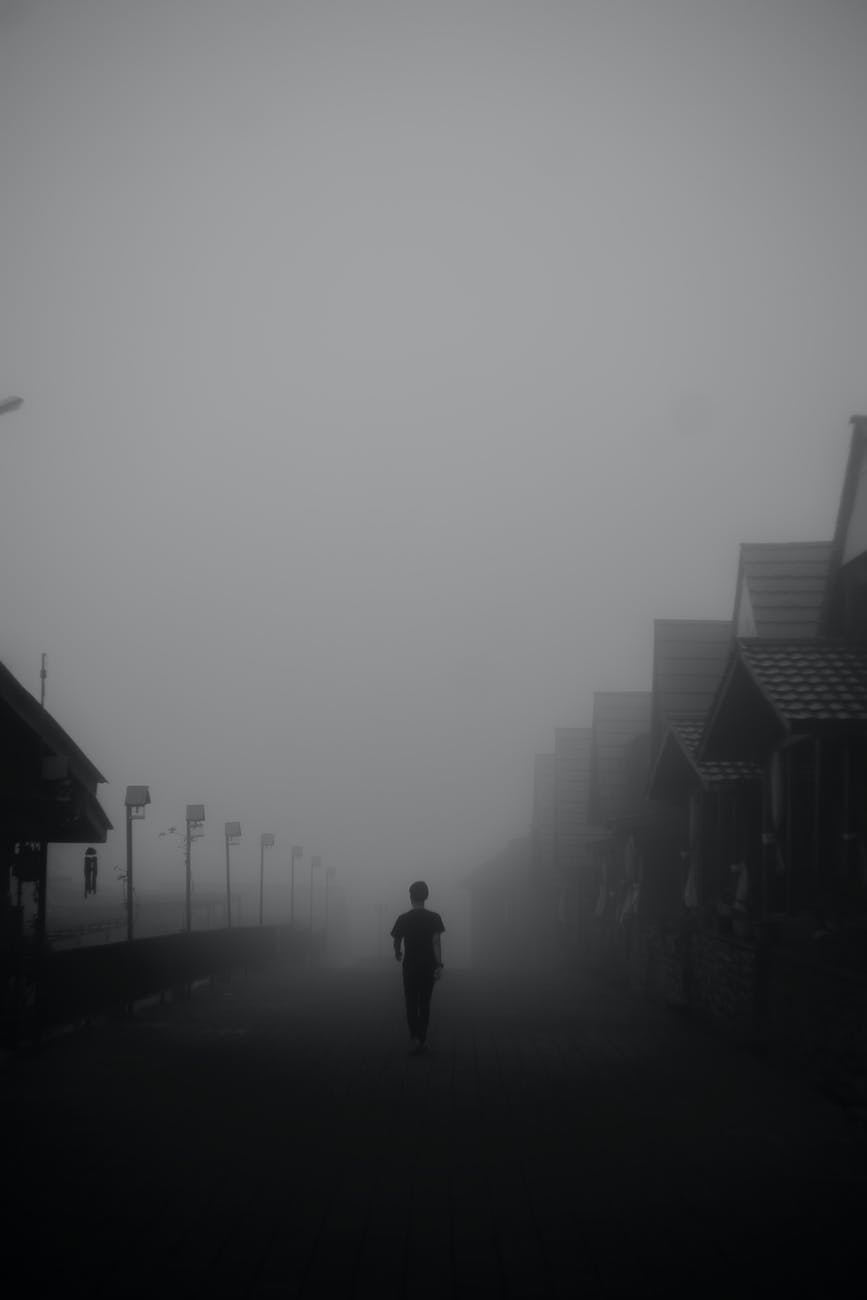

The Fog of Time – Wednesday Blog by Seán Thomas Kane
When I was an undergrad, I watched a lot of really neat films and TV shows. It was something that sticks out to me from those years as distinct, something that I’ve continued and recreated from time to time as my mood allows it. In the Fall of 2013 I saw a movie on Netflix that peeked my curiosity called The Man from Earth that I’d never really forgotten. It’s not really an action-packed story in the modern sense, no rather it’s 90 minutes of dialogue, discussion, good old fashioned storytelling about a professor who is leaving his job, home, and friends after 10 years. The reason: because he’s learned over the 14,000 years of his life that that’s a good policy to do every decade or so. Yep, John Oldman, the Man from Earth himself, is a Cro-Magnon.
For some of you hearing or reading this the plot of The Man from Earth will be all too familiar to you. It became something of a quiet hit among certain crowds. One reviewer called it “intellectual sci-fi” even. While I was home over one of my recent breaks from working on my dissertation I bought an HD copy of it on YouTube figuring I’d like to re-watch this particular classic of my early 20s again. It took me a few months but on Monday night this week while I was keeping an eye on my students’ term papers streaming in before the 11:59 pm deadline I sat down and watched The Man from Earth all over again.
What stands out to me the most about my memories of watching this film for the first time nine years ago is how it unsettled me a bit, as it did the expert characters on the screen. The very idea seems counter to all that experience has taught us. “People die!” as the goddess Persephone cries to Orpheus in another film I purchased on YouTube. Yet somehow in the logic of The Man from Earth the title character, Dr. John Oldman had been able to live for 140 centuries and still after all that time appear to be only around 35.
This time I came away from my second viewing of The Man from Earth thinking less about the literal story and more about the ideas it proposes. For one thing I found myself thinking of the perspective that such a man would have of nature and reality. My own perspective is fundamentally framed by my upbringing, it’s conditioned by the powerful forces of my Catholic faith, my Irish American traditions, my personal ethics, and by my upbringing learning about Creation as both an Act of God and scientifically the product of a Big Bang and billions and billions of years of evolution.
On the other hand, John Oldman––the fourteen thousand year old Cro-Magnon––reflects and recognizes a different sort of perspective, one born out of the entirety of human experience, one where the world began as what was knowable from the furthest reaches of the light from the nearest campfire inside a cave. For him, the Big Bang and all the creation stories we’ve been telling ourselves could well have happened after his first memories, his first inklings of reality and existence. To him those were all things that were learned over time, and their existence only became tangible once they were learned. If you think about it no one really knows things before they begin to have that first spark of an idea that those things could be possible. Today, I believe that anything is possible. That belief is grounded in my faith in an omnipotent and omniscient Divinity, yet it’s also equally held up by the course of human intellectual history, of how we keep finding out more and more things are real, and by extension at the edge of our knowledge that more and more things are possible. How wonderous is that?!
On Sunday evening, in honor of Yuri’s Night, an annual celebration held around 12 April to commemorate Yuri Gagarin’s first spaceflight, the first time a human left our home planet, I decided to watch a space-themed film. Last year I was lucky enough to join the global livestream party and hear all sorts of neat panelists talk about the past, present, and future of Space exploration. This year though that wasn’t an option, so I improvised and put on the 1982 classic The Right Stuff. For those of you who aren’t familiar with it, this is a film celebrating the Mercury 7 astronauts, the first Americans to leave the Earth and among them the first humans to orbit our planet. The Right Stuff begins with Chuck Yeager’s triumphant 1947 flight that proved the sound barrier (Mach 1) could be broken. Before he flew his Bell X-1 faster than the speed of sound no one was entirely sure it could be done. It pushed the edge of our knowledge out of a pure hope that supersonic travel could be possible.
Maybe then on a human scale we should think of our place in the history of the Cosmos less as a story beginning with the Big Bang, which as scientific as it is does bear some resemblance in how its story is told to the other great Creation stories out there, and more with that first human spark that signaled to our conscious thoughts that we exist. Maybe the beginning of the human story ought to be around a campfire in a cave somewhere, or maybe this leaves room for multiple human stories, each threads that broke off from one another until as it is in our present time there are 7.9 billion such threads living, all vibrant and emotional and passionate each in their own way.
When I think back to my beginnings, to what I can ascertain as my first definite memory that I can remember, that first moment when I could recognize my own internal narrative that keeps me going even now, I think of a day trip my parents and I took when I was around 3 or so from our home in the Chicago suburbs to the farm where my Mom’s grandfather grew up in Sheffield, Illinois. I remember sitting in the back seat, on the passenger side watching out the window as we drove by new suburbs, new neighborhoods were being built as we drove west. For me so much that I consider etiological, that I consider as origin-stories to my own, whether they be Genesis or the Big Bang or the many stories keeping my ancestors’ memories alive even when the people involved are long dead, all of those come after that moment in my own memory. So, to my own individual, my own personal recollection of history, of reality, of the Cosmos in all its wonder, all of that comes after that one moment that I can remember from 27 years ago.
What does this mean for how we understand our place in nature? I think if it changes anything, it ought to follow another line of wisdom from The Man from Earth, that the species that lived in balance with nature tended to be the ones who survived. Maybe we need to balance ourselves with our worlds. What I mean to say is maybe we should allow room for our own individual views of things while acknowledging there’s a greater truth to be found in the collective knowledge and wisdom of humanity. There is an inherent fog surrounding our understanding of time, after all we can only ever really see what’s happening right in front of us at any given moment. We can remember with growing haziness what happened in the past, and we can yearn for possible futures that are equally fuzzy in our imaginations today.
This time around I was delighted to see that a sequel was made called The Man from Earth: Holocene back in 2018. It stars the same actor, David Lee Smith, as John Oldman. I think I might watch it tomorrow, and who knows maybe you’ll hear more from me about this story next week. For now, keep imagining because that’s what allows for the improbable to become the possible.
 Wednesday Blog by Seán Thomas Kane