
Tag Archives: Zoo

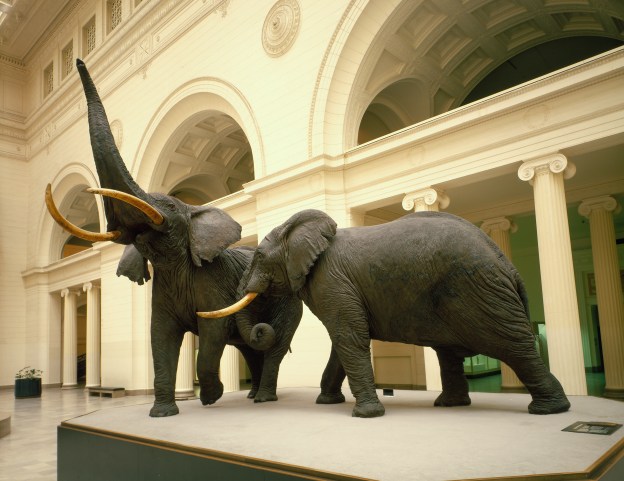
Fighting African Elephants in Stanley Field Hall. Taxidermy by Carl Akeley . 41411 is on the left with two tusks and its trunk is raised. 41410 is on the right, with one tusk. Photo credit: (c) Field Museum of Natural History - CC BY-NC 4.0.

Elephant Tails

Photo Credit: Fighting African Elephants in Stanley Field Hall. Taxidermy by Carl Akeley. 41411 is on the left with two tusks and its trunk is raised. 41410 is on the right, with one tusk. © Field Museum of Natural History – CC BY-NC 4.0.

This week, some animalistic thoughts. Photo credit: Fighting African Elephants in Stanley Field Hall. Taxidermy by Carl Akeley . 41411 is on the left with two tusks and its trunk is raised. 41410 is on the right, with one tusk. (c) Field Museum of Natural History – CC BY-NC 4.0 — Click here to support the Wednesday Blog: https://www.patreon.com/sthosdkane


This week, some animalistic thoughts.


I wonder if the reason why we take our children to zoos and natural history museums to see the animals is because there’s a deep sense where we recognize our own animality? I still go to these places today, to revel in the same sense of wonder I felt at spying the animals, living and dead, that grace the halls and paths of these scientific institutions. For me and many others these are places where we were first introduced to wild things when we too were wild in our own way.

On Tuesday morning I made one of my regular visits to the Kansas City Zoo, to enjoy a cool late summer morning, and yes to see the animals who live there. I’ve come to appreciate more elements of these zoo visits the older I’ve gotten, where before I might love to see the lions and imagine them in the hunt; today, I admire the power, strength, and grace of their forms, and their wisdom at sleeping for nearly 20 hours per day. On this visit the African elephants were out on a morning buffet run through their long enclosure, while families and zookeepers gazed on from the footpaths that line the west side of the elephant enclosure. We didn’t stay long at the elephants on this visit, instead watching them as we passed by. These animals are intelligent and powerful and reflect some of the noblest values we cherish in our fellow humans in their own way.

Perhaps that is why we seek after collecting other animals and housing them in zoos while living or in museums after they are dead. Jay Kirk’s biography of Carl Akeley (1864–1926), the father of American taxidermy, described how on 24 June 1910, while on a collecting expedition for the American Museum of Natural History in Kenya and Uganda, Akeley was taken by surprise by a great bull elephant.[1] Akeley had the distinct impression that he “was being hunted as well, and was now engaged in a mortal contest with this bull.”[2] In the furor of the moment the safety of his rifle caught, after which he threw it aside and grabbed hold of one of the elephant’s tusks “as it lanced past him with the force of a sharpened swinging log.” Akeley held on between the two tusks as the elephant “plowed him into the ground,” and gored off part of his face, breaking enough of his body to convince the Kikuyu porters who joined his expedition 14,000 feet up Mount Kenya that he was dead.[3] Thankfully, Akeley wasn’t dead, and by the end of the expedition had gathered enough mammals to begin building his African Hall of Mammals at the American Museum of Natural History in New York where many generations of visitors have learned about these species in the century since.

I see an educational purpose to zoos and museums; they allow us to view these animals up close where otherwise we would have to travel to their native habitats or watch nature documentaries of their lives. These are places where the city dweller can explore the natural world in a controlled and comfortable manner. We demarcate ourselves from the rest of nature by our inventions and our buildings and our tool-use, yet other animals have been seen to do all these things in their own way. What sets us apart perhaps is that we build worlds meant only for ourselves in which we expect other species to exist on our terms. My parents didn’t buy new rugs for their house until after our last two pets, Noel the shih-poo and Kitty the American shorthair cat both died of old age, knowing that those two and our other dogs, cats, horses, goats, ponies, and even a turtle were going to do what they needed to when and where they needed to.

The same goes for these animals living in zoos: today they have enclosures that seek to mimic their native habitats, and to keep them busy and engaged in the thrill of life even while in captivity. Where once they were kept in cages, now they are housed in enclosures. The good people of Kansas City therefore are able to see Sumatran tiger, Red pandas, and Orangutans all in the same general vicinity of each other in the Asian zone of the Kansas City Zoo with minimal risk to life or limb. I say minimal because for all the efforts to contain the natural ways of these animals, we still have the human factor to consider.

In the last week I’ve read a fair bit on chaos theory, first devised by meteorologist Edward Lorenz in the 1960s to describe seeming anomalous elements in weather patterns. Lorenz defines chaos as having a “sensible dependence” which is inherently deterministic by its sensibility.[4] Chaos “appears to involve chance,” which can be statistically estimated, yet those results are mere estimates.[5] One might say that the size of the human species alone, all 8.2 billion of us, would be enough data points to fulfill the conditions for chaos. Yet even then, there is a finite number which can be calculated, so even the uncertainty of the human factor in building environments for safe encounters between the rest of nature and ourselves for the mutual benefit of all is not uncertain enough to fulfill the need for an infinitely large sample size required for chaos to exist.[6]

Perhaps then, the best way to try to quantify the roots of chaos in the human factor would be to attempt to quantify the countless thoughts of we 8.2 billion humans? I imagine it like filling Stanley Field Hall at the Field Museum in Chicago and the balcony galleries above it to just beyond the fire code maximum capacity and then trying to count the number of thoughts each individual there might have in a given moment. In order to safely move those people out of the building to avoid overcrowding you not only would need to coax each individual to move in such an unsafely large crowd, but you’d need to keep all of those individuals calm and compliant to avoid a panic and stampede. At the end of the day, we are all humans, and humanity is inherently animalistic. A chaotic system is one dependent less on external factors, the fire marshal on a bullhorn directing the crowd out the north and south doors, and more on interior changes in initial conditions.[7] External changes then are predictable, while the human consciousness remains a wonder and a liability in situations when too many of us are in the same place at the same time. It’s a real wonder that the 2016 Cubs World Series Parade, which saw 5 million of us humans gather along the route from Wrigley Field down to Grant Park, didn’t result in any casualties or fights. I’ve argued before that this event is a sign of the inherent benevolence of the human spirit, and that we evolved with good intentions first and foremost.

Here though we’re moving from my philosophical interpretation of a branch of mathematics into matters of theology; and that doesn’t feel like an appropriate direction to take this, so I am avoiding matters of faith this week. When done right our museums and zoos allow us to learn about the rest of nature at a distance, a safe distance for both ourselves and everyone else. With all I’ve read in the last few weeks about polar bears, I’d rather just view them at the zoo, or the standing bears frozen in taxidermic eternity behind glass at the Field Museum. They might appreciate meeting me in life during their summer fast, though that’s entirely irr-elephant.


[1] “Akeley Expedition to British East Africa (1909-1911),” American Museum of Natural History Archives, https://data.library.amnh.org/archives-authorities/id/amnhc_2000084.

[2] Jay Kirk, Kingdom Under Glass: A Tale of Obsession, Adventure, and One Man’s Quest to Preserve the World’s Great Animals(New York: Picador, 2010), 220.

[3] Kirk, 221-222.

[4] Edward N. Lorenz, The Essence of Chaos(Seattle: University of Washington Press, 1993), 8.

[5] Lorenz, 9.

[6] Lorenz, 10-12.

[7] Lorenz, 24.
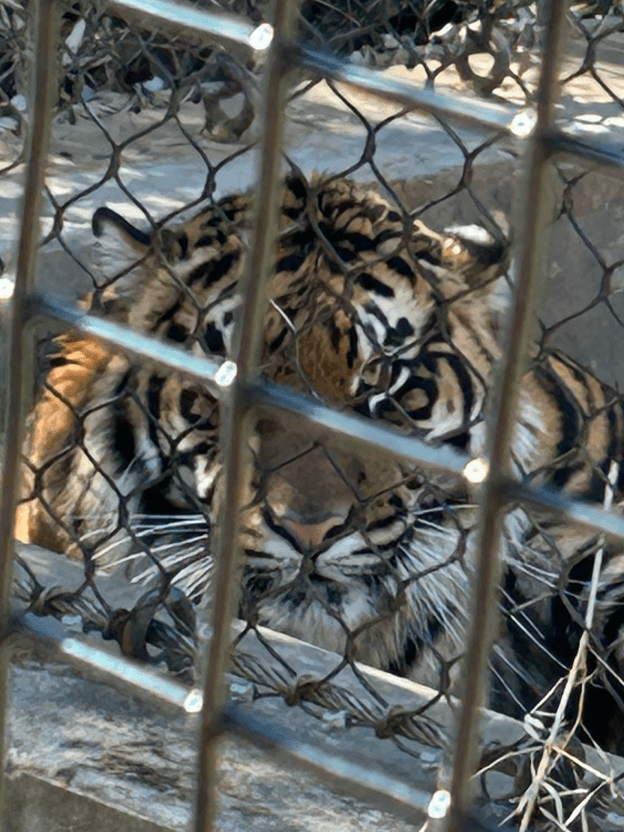


A tiger staring at the camera through two fences.

A Tiger in the Sun

This week, I have a short story for you, in the style of an Irish aisling, a dream narrative, about a tiger basking in the warm February sun. — Click here to support the Wednesday Blog: https://www.patreon.com/sthosdkane


This week, I have a short story for you, in the style of an Irish aisling, a dream narrative, about a tiger basking in the warm February sun.


On a sunny, warm, and blustery day in February I left my desk in the afternoon for a walk at the city zoo. You could never really know how many warm days you’d have in February on the prairies, a time of snow, cold, and gray skies. I showed my member’s pass at the gate to the clerk and strolled between the polar bear’s wide enclosure and the lorikeets’ walk in cage towards the penguin house where I often liked to stand quietly and watch the birds waddle and swim about. There was something wistful about these penguins today, their black and white feathers glowing with a renewed exuberance from the lengthening days outside. I’d seen these penguins in all seasons, confined to their Antarctic chamber with many good places to swim, enclosures, and crevices that even I hadn’t seen. Worlds still unfamiliar to my eyes yet already known to my imagination which saw places where these birds could play and rest away from human eyes.

I left the penguins and began to walk further into the zoo towards the Asian and Australian animals who I hadn’t seen in my last few afternoon visits. I’d read that a new pair of Sumatran tigers had been brought to the zoo from another facility on the West Coast where they’d been born into captivity. These animals it seemed had a comfortable life, if confined as they were from the wilds their ancestors had once known. My walk took me past the alligators still hidden indoors and the camels who wandered about the edges of their sandy glade looking for new grass and leaves to eat. 

After passing the pelicans I came to a grand sign displaying a portrait of a tiger, in all its majestic ferocity. The entry to this Asian walkway was marked by a fleeting glimpse of another red, black, and white animal whose furry legs and tail darted behind a wall to my left. I walked onward and rounding the wall met a red panda on a stroll within the confines of its fenced enclosure. I stopped to look at the red panda who climbed a gangway that’d been set up for its enrichment and admired its ease of movement, the jolly grace of its demeanor. Yet still, the hairs on the back of my neck stood tall, alert. I knew the tigers dwelt behind me, yet they could’ve been anywhere in their terraced enclosure. I turned and caught the yellow eyes of a cat staring back at me, its orange nose wreathed in a beard striped black, orange, and white. This new tiger was smaller than I imagined, perhaps little older than a cub. It lay there on its side like my own cat often does, finding a nice place at the highest point in its home with the sun’s rays glittering down upon its neck and back between the barren branches of the cottonwood grove which towered above both feline and me.

I stood stock still, my nature sensing some intrinsic danger in my situation despite the double layers of fencing between us. This was a tiger after all, a hunter who if in the mood would gladly seek prey from either myself or its red panda neighbors across the path. Who was I to say I was any finer a creature than this one, who was lounging the afternoon away in the warm winter sun. It had no need of work or time; no economy or politics furrowed its brow. Here was a creature free of all our worldly concerns in its terraced enclosure. I would soon have to leave this tiger and continue on my way. My walk in the zoo was merely a distraction from my labors, an escape from the small walled enclosure of my desk where Sisyphean work awaited my attention. What time did I have to lay out in the sun and cherish the day? I walked on, my body moving back towards my work, yet my imagination remained. I dreamed as I walked of adventures I might have, greater escapes from my work, and of absconding for more than an afternoon from worry.

As I rounded the corner past the lower terrace of the tiger’s enclosure my phone began to ring. I pulled it from my pocket and caught myself seeing the number, “213, who’s calling me from Los Angeles?” I answered, looking up towards where the tiger lounged high above me. “Hello?”

            “Hello, I’m calling you about your application for the archivist position at the Space Science Center.”

            “Oh yes, how may I help you?” I asked reflexively, a knot building in my throat worried at what word might come next after so many rejections.

            “We would like to offer you the position here, if you’re still interested.”

            I caught myself in my jubilation, remembering I was in public, “Oh!” I cried, “what wonderful news!”

            “So, you’ll take it?”

            “Yes,” I stopped myself from being too exuberant, “It would be an honor to work with all of you there.”

            I thought I heard a smile from the other end of the phone. “I’m glad to hear that. Can you be here later this week to start?”

            “Later this week?” I asked, stopping in my tracks near the entrance to the kangaroos’ enclosure.

            “Yes, we’d like you to take over the work from our outgoing archivist who’s retiring at the end of this week.”

            I looked at my watch, it was nearly 3 ‘o clock in the afternoon. “Well, it’s Monday now, I can be there on Friday morning if that’d be alright with you.”

            “That’d be fine,” the herald of good news replied over the phone. “We’ll see you on Friday morning here in Pasadena.”

            “Thank you again!” I said as I heard the phone on the other end hang up. “Friday, Friday morning in Pasadena. I need to start packing,” I turned from the kangaroos and was about to walk past the building ahead when I remembered that path was closed for winter renovations. I turned back again towards the gate and strolled through; my head held higher than before with a newfound exuberance. Soon I wouldn’t be scraping by just as a freelancer, my four part-time jobs would have to go. Now, I could really earn enough to begin living my life.

I passed the Australian birds in their walk-through enclosure and was amused to see they were all standing stock still on various fenceposts. One squawked at the world, in what seemed to me a jubilant chord of praise for the wonderous afternoon sun.

If I was going to be in California on Friday morning, I would need to leave at dawn tomorrow. I could drive to Denver on Tuesday and stay at my cousin’s house there, if he’ll have me, and then cross the Rockies and the high deserts on Wednesday. I’d driven most of that route before one summer vacation several years ago, but the Rockies in winter would surely be an entirely different challenge than they are to cross in summer. The last time I drove through the Eisenhower Tunnel that bored its way beneath the Continental Divide I waited to use my breaks for just a few seconds too long on the western side and nearly ignited them in their furious efforts to slow my car down as it pulled into a parking spot along a creek in the village of Silverthorne. Should I get my snow tires out then, and have those on in case the interstate was slick up in the mountains? But I wouldn’t need them once I reached Utah where the high deserts would surely be dry, and possibly still hot despite it being February.

Once in Utah, even if my tank was nearly full, I would still stop in Green River, the last town before nearly 125 miles of open desert to ensure I wouldn’t run out of fuel on that other most dangerous part of the trip. I’d avoided that part of the interstate last time, taking a smaller high mountain pass through Central Utah. This time though there was no avoiding the desert. Once I made it to the junction with Interstate 15, I could turn south and make my way to my second overnight stop in Las Vegas. I figured I might not be the only traveler passing through Sin City who wasn’t there to gamble or for the spectacle. Then at last, on Thursday, I would finish with the last leg of the drive southwest across the California border and to Pasadena where my future awaited me. Work, to be sure, was something that drove me forward, the aspiration that I might make something of myself, that I might better my stars and spend my days doing something that both kept the lights on and fulfilled my dreams.

Like the tiger, I would perhaps have time to rest in the sun, to enjoy the afternoons on a park bench near the science center. Surely in California, I would never have to shovel snow again, or scrape the ice off my car in the cold January mornings. Wasn’t California where that tiger was born? I thought about that for a moment as I walked along the path. To my left the local kangaroo mob lounged and grazed on the grasses of their meadow. A kangaroo stood and stared at me. I warily watched it, silently snapping a photo of it with my phone, and continued on my way, keeping ever a respectful distance from those remarkable creatures.

But what of my cat? How would she fare the long voyage west? Would she appreciate so much time in the car? She’d never been one for car rides even to her vet just a few blocks away. Perhaps she’d rather stay with my parents, they always enjoyed her company and she theirs. She was surely napping now too, finding a sunbeam somewhere near a south-facing window where she could enjoy this lovely day like her far larger yet far distant cousin. It would be a great change for my cat, as much as it was for me. We’d have to travel light, perhaps I could send for the rest of my belongings, especially my books, after we settled into our new abode. 

I paused at the southern gate leaving the kangaroo enclosure. Before me one of the camels stopped its grazing to stare back at me as I stood there, deep in thought. I could see my life in California well. I’d probably get a space in the basement of the science center, somewhere with no natural light where they kept their records. My domain would exist in the deep darkness there, somewhere I could make my own. Maybe I’d be far enough away from the rest of the staff or the general public to bring a radio in and listen to baseball games during the season like my grandmother used to do in her kitchen. There’d always be a part of me that would yearn for home of course, for the prairies and woodlands of the Midwest. Who would I be without this place that I came from? What would my life be like so far from everyone I know and love? Could I really separate myself off, devote my working hours to a place where few would understand what it meant to be from here, where few would understand me?

My mind returned to that tiger lying there in the sun, content with its lot in life. There was a creature that could try to hunt and prowl, perhaps it did so in its dreams. What are dreams but the longings of the subconscious? I’d always been a dreamer, an imaginer of wonders near and far from the truth. Do dreams then tell the truth, or is there such a thing as truth in the surreal realm which we imagine? I remembered a story I read as a child, from P.L. Travers’s original Mary Poppins novel, of a scene in which the roles were reversed and all the animals of London Zoo were gawking at the humans in the cages. Was fantasy so different from reality that it could not be informed by the real but instead kept unreal? 

I felt I had to return to that being whose yellow eyes had so deeply captured my thoughts that even now as I planned the monumental voyage of these coming days, a week spent crossing half a continent in winter, I couldn’t shake the image of those deep yellow eyes. I followed the path back towards the tiger sign that greeted visitors to the Asian footpath and ignored the red pandas in all their charm and found my captor laying there still. Those eyes caught mine again, and they seemed to recognize me from only a few minutes before. In those eyes I saw a truth that life was meant to be enjoyed, to be lived, yet in my eyes I was sure the creature could only see fear and wonder. Without these fences we both knew those yellow eyes would be a death sentence for me and that my power was devised in only the most artificial of means. The tiger was the real power, the true monarch of our shared domain. And yet it blinked at me, slowly, a signal that my own cat offers when it feels comfortable around me. Could this tiger feel at ease in its enclosure or is its ease perhaps from its inherited knowledge that nature gave it the upper hand over feeble, clawless, scaleless, featherless, furless me.

I didn’t feel the need to speak, this tiger could understand my expressions. I gazed into those eyes deeper, feeling my thoughts free fall into that yellow sea of potent grace. Did these eyes envision things like mine did? Could this tiger see things unknown to it in its dreams? Could it imagine a Creator? Would I still feel such a connection when I retired from my native place to that basement archive where surely, I would spend my waking hours? I wasn’t sure that the adventure of it all would be worth the query, yet I felt my nature pull me towards exploring further and deeper. I heard a noise from before me, a deep hiss emanating from a striped sea of orange, black, and white. The tiger had enough of my gaze, and with a hiss told me enough, “move along, leave me be.”

I backed out from the tiger’s view and turned away, looking to the red panda who seemed unfazed by the hissing hunter across the way. Move along indeed. In this adventure I’ll learn more about myself, and what I am capable of. When I reach the end of the line on this drive, when I arrive in California, there will surely be many new possibilities and wonders to behold. How often had I experienced a warm, sunny day in February here on the prairies? Wonderous things remained for me to find beyond my desk. I walked back to the front gate of the zoo and felt something new inside of me glow with confident glee at the thought of all that was to come.